Wednesday 20 May, 2026
[email protected]
Resilience Media
  • News
    • Events
    • Interview
    • Startups
    • Venture
    • Weekly Digest
  • Resilience Conference
    • Resilience Conference Warsaw 2026
    • Resilience Conference Copenhagen 2026
    • Resilience Conference London 2026
  • About
  • Guest Posts
    • Author a Post
  • Subscribe
No Result
View All Result
  • News
    • Events
    • Interview
    • Startups
    • Venture
    • Weekly Digest
  • Resilience Conference
    • Resilience Conference Warsaw 2026
    • Resilience Conference Copenhagen 2026
    • Resilience Conference London 2026
  • About
  • Guest Posts
    • Author a Post
  • Subscribe
No Result
View All Result
Resilience Media
No Result
View All Result

Ukraine’s autonomous weapons makers push for industrial scale

Reliable autonomy for drones is rapidly becoming a solved problem. Scaling them however, remains an expensive bottleneck.

Luke SmithbyLuke Smith
March 6, 2026
in News
Share on Linkedin

In the past five months in Ukraine, Major Maksym Gromov’s unit launched 608 autonomous Lupynis drones against Russian adversaries. Four hundred and thirty-six of them found their targets—a 71 percent hit rate, with 284 of those strikes landing on moving vehicles and personnel. The kill zone his unit could cover tripled, stretching from three to ten kilometres.

You Might Also Like

UK awards 13 defence tech startups with £4M fast-track procurement deals

Helsing, on the cusp of a $1.2B raise, forms space JV with OHB to build AI-based targeting systems

The UK adds a low-cost anti-drone system to its Typhoon fighter jets

If Ukraine could ensure even half of the drones it procures have automated terminal guidance, he said, it would transform the battlefield.

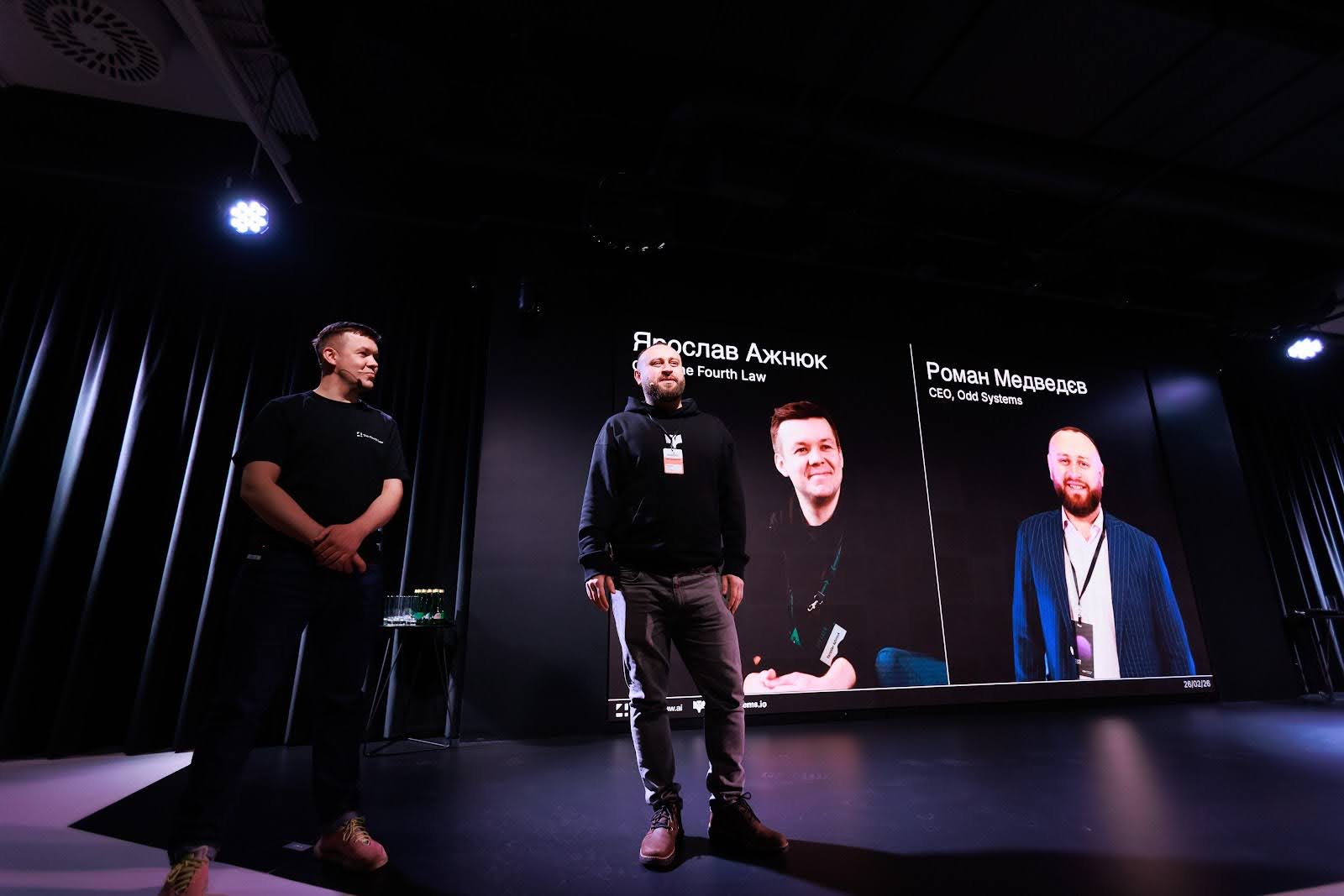
Gromov’s talk at “Autonomy and Sovereignty,” a closed-door event organised by Ukrainian defence technology companies The Fourth Law and Odd Systems, highlighted the remarkable progress these systems have made since their earlier iterations. Over 200 people from Ukraine’s military, government ministries, international industry, and the investor community attended.

Yaroslav Azhnyuk, co-founder of both startups, framed the strategic picture around three ideas.

First, autonomous remote drones and ground robots are no longer tools to support conventional units. Rather, they are becoming the primary platform for combat operations. Secondly, the capacity to mass-produce high-tech defence hardware and software is the “new oil” overtaking natural resources as the most consequential form of national power. And third, that the winner of the AI race will shape the security order for the next century.

The panel discussion that followed brought together Oleksandr Kamyshin, Advisor to the President of Ukraine on Strategic Issues; Oleksandr Bornyakov, Acting Minister of Digital Transformation; and Rick Smith, Founder and CEO of Axon Enterprise, the US taser and body-cam giant.

Ukraine, Smith argued, is innovating at a pace that most institutions and governments are structurally incapable of matching. For Axon, that makes the country a critical proving ground for technologies that will define the next generation of defence and security systems worldwide. (Axon invested an undisclosed amount in The Fourth Law last month.)

The Ukrainian government officials described a  “reality gap”. Global capital and international partners rarely grasp just how fast the technological situation on the front lines is evolving.

Azhnyuk outlined The Fourth Law’s roadmap for autonomous systems across air, land, and sea domains, arguing that these platforms are capable of altering the course of the war over the next year. He showed footage from successful combat missions and teased a series of new products, with formal releases expected soon.

Supply Chain Risk

One out of every five thermal imaging cameras produced worldwide now ends up in Ukraine. To put that in perspective, The European Union’s entire annual thermal camera output would cover just three to four months of Ukrainian demand at 4 times the cost. Dependence on Chinese manufacturers is an unacceptable risk. Explained Roman Medvedev, Odd Systems’ CEO, and Andriy Taganskyi, Camera Unit director.

The answer they propose is vertical integration. Odd Systems announced “Odd Camera Factory One,” described as Ukraine’s first factory for the serial production of camera sensors.

“What we are creating here is the roadmap for deterrence in the 21st century,” Azhnyuk said. “Sovereignty in the modern era is measured by the autonomy of your systems and the resilience of your supply chains.”

Ukraine’s defence innovators are no longer scrappy improvisers making due. They need scale, capital, and cutting edge manufacturing. Whether these will be obtainable at the needed speed remains a question.

Tags: AxonManufacturingOdd SystemsThe Fourth LawUkraine
Previous Post

Munich Security Conference got the urgency right. The hard part comes next

Next Post

Ukrainian autonomy company The Fourth Law unveils an anti-Shahed drone

Luke Smith

Luke Smith

Related News

UK awards 13 defence tech startups with £4M fast-track procurement deals

UK awards 13 defence tech startups with £4M fast-track procurement deals

byIngrid Lunden
May 19, 2026

The UK government is throwing its weight behind a list of defence tech startups and awarding a series of contracts...

Helsing, on the cusp of a $1.2B raise, forms space JV with OHB to build AI-based targeting systems

Helsing, on the cusp of a $1.2B raise, forms space JV with OHB to build AI-based targeting systems

byIngrid Lunden
May 19, 2026

Helsing, the European defence tech startup on the cusp of closing a $1.2 billion funding round at an $18 billion...

The UK adds a low-cost anti-drone system to its Typhoon fighter jets

The UK adds a low-cost anti-drone system to its Typhoon fighter jets

byIngrid Lunden
May 17, 2026

The UK has been under pressure to modernise its military amid an increasingly heated geopolitical climate and a rapidly evolving...

UK AI chip challenger Fractile secures $22.5M from NATO-backed venture fund

Fractile raises $220 million to build powerful AI chips

byJohn Biggs
May 16, 2026

UK AI hardware startup Fractile has raised $220 million in funding to build so-called "AI inference chips," specially designed chips...

Quantum Systems acquires Estonia’s SensusQ

Quantum Systems acquires Estonia’s SensusQ

byFiona Alston
May 15, 2026

German drone maker, Quantum Systems, is acquiring the Estonian intelligence management platform scaleup, SensusQ. No figures of the deal have...

person holding pencil near laptop computer

Multiverse raises $70M to help future-proof workforces in areas like AI

byIngrid Lunden
May 15, 2026

A UK company that has built a platform to help train people and organisations to future-proof them against technology evolutions...

Anduril raises $5B at $61B valuation in biggest defence tech deal of the year

Anduril raises $5B at $61B valuation in biggest defence tech deal of the year

byCarly Page
May 15, 2026

Defence startup Anduril Industries has pulled in a $5 billion Series H round at a $61 billion valuation, marking the...

SFC Energy AG contracted to supply field batteries to Ukraine

SFC Energy AG contracted to supply field batteries to Ukraine

byJohn Biggs
May 14, 2026

German fuel cell maker SFC Energy AG has received a €42.7 million order to supply “combat-proven” hybrid energy supply systems...

Load More
Next Post
Ukrainian autonomy company The Fourth Law unveils an anti-Shahed drone

Ukrainian autonomy company The Fourth Law unveils an anti-Shahed drone

high angel photography of football stadium

Augur, a 'grey-zone' national security startup, raises $15M

Most viewed

InVeris announces fats Drone, an integrated, multi-party drone flight simulator

Uforce raises $50M at a $1B+ valuation to build defence tech for Ukraine

Auterion, the drone software startup, eyes raising $200M at a $1.2B+ valuation

Palantir and Ukraine’s Brave1 have built a new AI “Dataroom”

Twentyfour Industries emerges from stealth with $11.8M for mass-produced drones

Senai exits stealth to help governments harness online video intelligence

Resilience Media is an independent publication covering the future of defence, security, and resilience. Our reporting focuses on emerging technologies, strategic threats, and the growing role of startups and investors in the defence of democracy.

  • About
  • News
  • Resilence Conference
    • Resilience Conference Copenhagen 2026
    • Resilience Conference Warsaw 2026
    • Resilience Conference 2026
  • Guest Posts
  • Subscribe
  • Privacy Policy
  • Terms & Conditions

© 2026 Resilience Media

No Result
View All Result
  • Home
  • About
  • Subscribe
  • Events
  • Guest Posts
  • Interview
  • News
  • Resilience Conference London 2026
  • Resilience Conference Copenhagen 2026
  • Resilience Conference Warsaw 2026

© 2026 Resilience Media

This website uses cookies. By continuing to use this website you are giving consent to cookies being used. Visit our Privacy and Cookie Policy.