Two months after his promotion to First Deputy Prime Minister and Minister of Digital Transformation of Ukraine, Mykhailo Fedorov took the stage in September at IT Arena, a tech conference in a Lviv football stadium.
He was there to promote his plans for AI in government. There’s a Ukrainian LLM on the way, a smart assistant for the Diia public services app, a strategy to become “the world’s first agentic state,” and even a digital twin of Fedorov himself. But the ambitions go beyond public services. He also unveiled his vision of an AI-powered military to fight what he calls a “tech war” in Ukraine.
In a darkened room filled to the rafters with attendees, a video of defence technologies filled the screen behind him. A narrator boomed in English: “Automated missions are no longer the future — they’re already a feature of the battlefield. Our goal is a fully automated frontline, not held by people but by robots.”
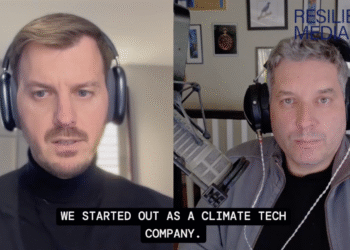
After his talk, Fedorov was whisked into an executive box overlooking the football pitch. Down below, defence tech companies showed off their wares in an expo. From up high, Fedorov outlined Ukraine’s progress to Resilience Media.
Ukraine’s vision is one of taking a layered approach, complementing more traditional means of defence with autonomous warfare tech ranging from remote-controlled ground robots to drone swarms. The ministry ultimately wants to equip “100%” of frontline drones with machine vision and AI, he said. The priority now is how to use the new generation of drones and weapons in an environment where technology is also being weaponised by Ukraine’s adversary, such as in electronic warfare used to jam signals to autonomous aircraft.
“Right now, we are focusing on making sure that when we have no connection, we can still lead the drone to the target,” Fedorov said. Meanwhile, another level of autonomy is approaching. “The next will be automated missions.”
Aged just 34 – albeit with a few grey hairs appearing beneath his black baseball cap – Fedorov became Ukraine’s youngest-ever minister when he was assigned the Digital Transformation portfolio in 2019. He quickly earned a reputation for innovative public services, especially after the 2020 launch of Diia, a mobile app now seen as a global benchmark for digital government.
His strategy was soon reshaped by war.
The digital pivot
Just two days after Russia’s invasion began in February 2022, Fedorov gained global attention after asking Elon Musk on X for Starlink ground stations. Musk replied 10 hours later: “Starlink service is now active in Ukraine.”
Since then, Fedorov has steered many of the country’s digital initiatives toward defence tech. He’s overseen the development and application of AI-guided drones, battlefield analytics systems, the IT Army of volunteer hackers, and platforms tracking Russian troop movements, embedding tech into the heart of defence.
He’s also become a close ally of President Volodymyr Zelensky.
“The president is really supportive of all the innovations because he’s young, he understands the need, and he strongly believes in all of these changes,” he said.

Like Zelensky, Fedorov is a casual dresser. On the day Resilience Media met him, he was wearing jeans and a hoodie. His black baseball cap was stitched with the logo of Brave1, the government’s defence tech development cluster that was running the event in Lviv.
The cluster has been one of Ukraine’s most successful tech projects since the start of the war. It’s gained a significant international profile in the world of defence tech for helping to bring in international companies to test and develop products and more recently to develop satellite incubating projects outside of Ukraine itself.
And in Ukraine, Brave1 has now registered over 300 AI-based innovations, with more than 70 already used by the military.
Fedorov highlights three favourites.
“The first would be swarm drones,” he says. “This is a very robust means against the attackers.”
Ukraine has pioneered the battlefield adoption of drone swarm technology, which autonomously coordinates the actions of multiple drones. Several defence tech companies outside of Ukraine building drones are taking note and developing their own swarm solutions.
“It is very time-efficient,” Fedorov said.
Last year, the country deployed the first known routine use of the swarms in combat, analysts told the Wall Street Journal.
Drones deployed in these operations used software from Swarmer, a Ukrainian startup supported by Brave1. The startup recently raised $15 million in funding — the largest publicly-announced investment in a Ukrainian defence tech company since the full-scale invasion began. Fedorov described it as “a historic investment.”
“The message for the investors is to make sure that they invest in defence, because this is going to be market number one,” he said.
His second‑favourite AI innovation is advanced drone targeting. Ukrainian companies have developed a range of these systems, from Dropla’s autonomous threat detector to Farsight Vision’s platform that converts drone footage into 3D maps.
His third pick is a specific targeting technique: pixel‑lock. The technique lets drones visually “lock” onto a specific part of a target, enabling precise tracking even when communications are disrupted. Fedorov says it “helps us a lot with interception.”
A growing list of domestic startups deploy pixel-lock. They include NORDA Dynamics, which applies the technique to guide drones under contested conditions, and Vyriy Drone, whose low-cost system runs on off-the-shelf cameras and computers.
Drone developments
According to the digital ministry, over 100 companies in Ukraine are developing drones with machine vision components. Some have raced to build equivalents of the Russian Lancet, a loitering munition capable of precision strikes. The Ukrainian versions increasingly integrate AI to detect, track, and strike adversary equipment without human intervention.
“I think that in this respect, we have become even more successful than Russia,” Fedorov said. “We produce more drones like that, and we also increase the distance of the exposure.”
Another focus area for Fedorov is fibre-optic drones. Connected to remote controls via physical cables, these UAVs are designed to be impervious to jamming in electronic warfare environments. Russia was faster to scale this style of drone, and its presence has wreaked havoc on the battlefield.
Ukraine is scrambling to catch up, and Fedorov is cagey about the progress.
“We are testing a number of different options right now,” he said. “Of course, this information cannot be public.”
Fedorov stressed that fibre-optic drones are a major focus area, alongside defending against Russia’s KAB-guided bombs, which can strike targets with high accuracy over long distances. “It is the second in the list of priorities that we have,” he said. “The first one is the fight against KABs.”
The business plan
Fedorov packages all this autonomy into a sales pitch to bring more international companies, but also funding for domestic players, to his country. Ukraine provides a frontline laboratory for defence tech companies, he said, as well as “priceless” warfare data.
“It’s important for us to test in Ukraine, and for our partners to fully understand the innovation cycle that we are following,” he said. The final lure, of course, is a promise of seeing their defence tech in action, representing potential sales and revenue both in Ukraine and a proof of concept that can be presented to potential buyers elsewhere.
This has led to a number of companies from other nations – the list includes Helsing, Stark, Auterion, and Anduril, plus many more – developing products on the frontlines in Ukraine.
Fedorov wants to attract more international businesses but is also quick to praise Ukraine’s homegrown defence tech companies.
Those domestic companies are perpetually facing a challenge. Technologically, they have often remained one step ahead of their international counterparts. Financially, however, they’re suffering from a severe funding shortage, particularly compared with their foreign counterparts, which have been raising hundreds of millions of dollars in venture capital and are on track to pick up even more, as much as $1.5 billion in Europe alone, according to our recent research.
Fedorov insisted that many international financial institutions have an “interest in supporting Ukrainian startups,” but acknowledged that more funding is needed. “We need to invest more. We also need to shape proper policies for us to be successful, because we are leading in these technologies,” he said.
One new project designed to boost funding is BraveTech EU, a partnership with the EU. Launched with a starting investment of €100 million, the initiative combines Ukraine’s battle-proven innovations with the EU’s resources. Fedorov hopes it will expand the market for startups in his country.
“This is the integration between markets,” he said. “The idea is to have defence tech startups not only in Ukraine, but also integrated with the European area.”
Before he left, Fedorov’s parting comments spoke miles about the road ahead. Russia’s threat extends beyond his country’s borders, he cautioned, and Ukraine’s allies need to learn from Ukraine’s experience.
“We already see drones flying over Europe, and we understand that if Russia realises that Europe doesn’t know how to deal with that — because there are some difficulties with detection, with shooting down these drones — that is going to be very risky for the region,” he said.
That very night, his warning was echoed from the skies. Air raid sirens rang through the darkness, heralding one of the heaviest bombardments since the start of the full-scale invasion. The attack followed several reports of Russian drones and fighter jets violating European airspace.
“That is why it is so important to strengthen Ukraine,” Fedorov said earlier that day, “because at the same time, you’re reinforcing Europe.”