Sunday 8 March, 2026
[email protected]
Resilience Media
  • About
  • News
  • Resilience Conference
    • Resilience Conference Warsaw 2026
    • Resilience Conference Copenhagen 2026
    • Resilience Conference London 2026
  • Guest Posts
    • Author a Post
  • Subscribe
No Result
View All Result
  • About
  • News
  • Resilience Conference
    • Resilience Conference Warsaw 2026
    • Resilience Conference Copenhagen 2026
    • Resilience Conference London 2026
  • Guest Posts
    • Author a Post
  • Subscribe
No Result
View All Result
Resilience Media
No Result
View All Result

Monitoring the next theater: Acua Ocean and the case for persistent naval drones

John BiggsbyJohn Biggs
February 11, 2026
in Interview, News, Startups
Share on Linkedin

Mike Tinmouth, co-founder and COO of Acua Ocean, argues that the open ocean is becoming the next operational frontier. His company, founded in 2021, focuses on autonomous surface vessels built for full ocean conditions, not just nearshore or harbor environments.

You Might Also Like

Ukrainian autonomy company The Fourth Law unveils an anti-Shahed drone

Ukraine’s autonomous weapons makers push for industrial scale

MSC got the urgency right. The hard part comes next

Acua Ocean did not begin as a purely military venture. From the outset, it positioned itself as dual use. Early designs centered on profecting undersea data cables, pipelines, and offshore infrastructure. At the time, those concerns were treated as maintenance issues rather than security priorities. Events in Ukraine and the Nord Stream incident shifted that perception.

Their drones don’t look like typical boats.

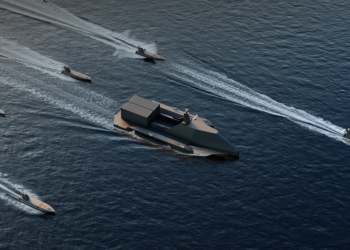
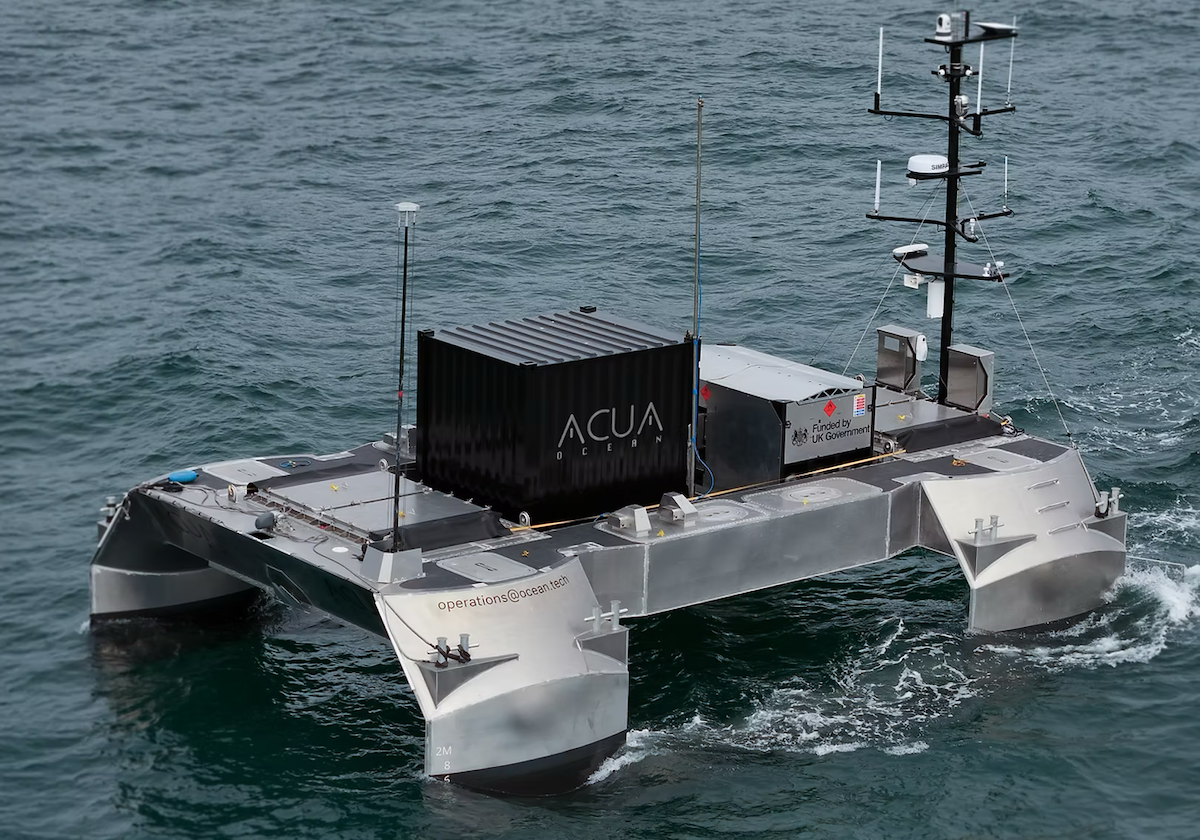
“We basically thought if it’s a robot, why does it need to look like every other boat out there?” said Tinmouth. “So we moved away from a traditional monohull and we went for what’s called a SWATH vessel, a small water plane area twin hull. It’s intrinsically an incredibly stable design, looks a little bit like a cat. So our 14 meter drone ship performs to the same sort of stability calculations as a 45 meter plus vessel. So we said rather than building a boat like all the others, let’s focus on what it’s really, really good at and make it stable as possible.”


Instead of operating in calm conditions, the vessel is designed for rougher seas. That matters in both commercial and defense contexts. Offshore operations in Western Europe are often constrained by weather windows. In conflict scenarios, operations are not paused for rough conditions. Tinmouth’s view is that systems need to function when seas reach four meters, not just when conditions are ideal.

“So if you’re operating in the North Sea and you’re only limited to 120 days of operation a year, that’s really challenging from a cost perspective,” he said. “Whereas the robotic system doesn’t have to comply with labor laws. Human safety is not a factor.”

“That’s also critical from a defense perspective because when conflict comes, it’s not going to be limited by the weather. If China is tying up a potential future conflict with Taiwan, they’re going to wait for the most adverse weather conditions.”

Aqua Ocean launched its prototype vessel, Pioneer, in 2024. The craft has accumulated more than 7,500 hours on the water, including extended open ocean trials. It became the first unmanned surface vessel to receive UK Maritime and Coastguard Agency approval under the Workboat Code 3 framework, enabling offshore commercial operations.

The company is now building its second-generation platform, with plans to scale production beginning in 2027. Tinmouth describes a shift away from traditional shipbuilding toward production methods closer to automotive or aerospace manufacturing. Without crew accommodations, vessels can be designed around systems architecture and mission requirements rather than human comfort. Their mission is to protect the sea in the same way flying drones protect the land.

“We know here in the UK, 95 % of financial transactions still are processed by undersea data cables. That is our main source of connectivity. So if you want to cause real disruption to the operations of Western Europe and most of our allied nations, you take out infrastructure at sea. And we see, whether it’s the UK, whether it’s Western Europe, whether it’s Taiwan, a lot of the potential areas of future conflict are going to be at sea,” said Tinmouth.


Tags: acua oceanboatsDronesmarine
Previous Post

Occam raises €3M to advance autonomous drone systems

Next Post

Wrecking-ball politics and the end of mutually-assured stability

John Biggs

John Biggs

John Biggs is an entrepreneur, consultant, writer, and maker. He spent fifteen years as an editor for Gizmodo, CrunchGear, and TechCrunch and has a deep background in hardware startups, 3D printing, and blockchain. His work has also appeared in Men’s Health, Wired, and the New York Times. He has written nine books including the best book on blogging, Bloggers Boot Camp, and a book about the most expensive timepiece ever made, Marie Antoinette’s Watch. He lives in Brooklyn, New York. He runs the Keep Going podcast, a podcast about failure. His goal is to share how even the most confident and successful people had to face adversity.

Related News

Ukrainian autonomy company The Fourth Law unveils an anti-Shahed drone

Ukrainian autonomy company The Fourth Law unveils an anti-Shahed drone

byJohn Biggs
March 6, 2026

Ukraine-based autonomy company The Fourth Law has unveiled Zerov, an autonomous interceptor drone built to engage long-range strike UAVs in...

Ukraine’s autonomous weapons makers push for industrial scale

Ukraine’s autonomous weapons makers push for industrial scale

byLuke Smith
March 6, 2026

In the past five months in Ukraine, Major Maksym Gromov's unit launched 608 autonomous Lupynis drones against Russian adversaries. Four...

asphalt road between trees

MSC got the urgency right. The hard part comes next

byRobin Dechant
March 6, 2026

A few weeks on from the Munich Security Conference, something many of the Resilience Media community no doubt attended, I...

NATO Innovation Fund appoints a president, Ari Kristinn Jónsson

NATO Innovation Fund appoints a president, Ari Kristinn Jónsson

byIngrid Lunden
March 5, 2026

The NATO Innovation Fund, the VC formed out of the strategic alliance of NATO countries that counts most (but not...

SkySafe Wants to Be the Air Traffic Control for Drones

SkySafe partners with major energy sector player to build out drone defence

byJohn Biggs
March 5, 2026

Southern States LLC and SkySafe announced a partnership to integrate real time drone detection and airspace intelligence into Southern States’...

Uforce raises $50M at a $1B+ valuation to build defence tech for Ukraine

Uforce raises $50M at a $1B+ valuation to build defence tech for Ukraine

byIngrid Lunden
March 5, 2026

The United Kingdom and Ukraine look like they may have minted their first defence tech ‘unicorn’. Uforce (stylised ‘UFORCE’) —...

Anthropic, OpenAI, and the new rules of Defence AI

Anthropic, OpenAI, and the new rules of Defence AI

byCarly Pageand1 others
March 3, 2026

Anthropic is facing the prospect of being frozen out of US government work after refusing to relax safeguards on how...

Periphery CEO Toby Wilmington

Periphery and Midgard partner to secure robots against capture and reverse engineering

byPaul Sawers
March 2, 2026

Modern conflict has pushed autonomous machines into some of the most hostile operating environments. Drones are intercepted mid-flight, ground robots...

Load More
Next Post
Wrecking-ball politics and the end of mutually-assured stability

Wrecking-ball politics and the end of mutually-assured stability

Stanhope AI raises $8M for new approach of AI for physical applications

Stanhope AI raises $8M for new approach of AI for physical applications

Most viewed

InVeris announces fats Drone, an integrated, multi-party drone flight simulator

Twentyfour Industries emerges from stealth with $11.8M for mass-produced drones

Senai exits stealth to help governments harness online video intelligence

Uforce raises $50M at a $1B+ valuation to build defence tech for Ukraine

Harmattan AI raises $200M at a $1.4B valuation from Dassault

Palantir and Ukraine’s Brave1 have built a new AI “Dataroom”

Resilience Media is an independent publication covering the future of defence, security, and resilience. Our reporting focuses on emerging technologies, strategic threats, and the growing role of startups and investors in the defence of democracy.

  • About
  • News
  • Resilence Conference
    • Resilience Conference Copenhagen 2026
    • Resilience Conference Warsaw 2026
    • Resilience Conference 2026
  • Guest Posts
  • Subscribe
  • Privacy Policy
  • Terms & Conditions

© 2026 Resilience Media

No Result
View All Result
  • About
  • News
  • Resilence Conference
    • Resilience Conference Copenhagen 2026
    • Resilience Conference Warsaw 2026
    • Resilience Conference 2026
  • Guest Posts
  • Subscribe
  • Privacy Policy
  • Terms & Conditions

© 2026 Resilience Media

This website uses cookies. By continuing to use this website you are giving consent to cookies being used. Visit our Privacy and Cookie Policy.