The drone war in Ukraine runs on volume. Both sides field an ever-more-sophisticated variety of drones. But more sophistication often means more bottlenecks.
Ukrainian and Russian suppliers are known to have engaged in bidding wars for components from the same Chinese factory. And even when the price is right, factories cannot keep up with the demand, especially for advanced components like the turbojets that power many newer long range suicide drones. Turbojets fly faster and higher, but that increased power comes with increased cost and production times.
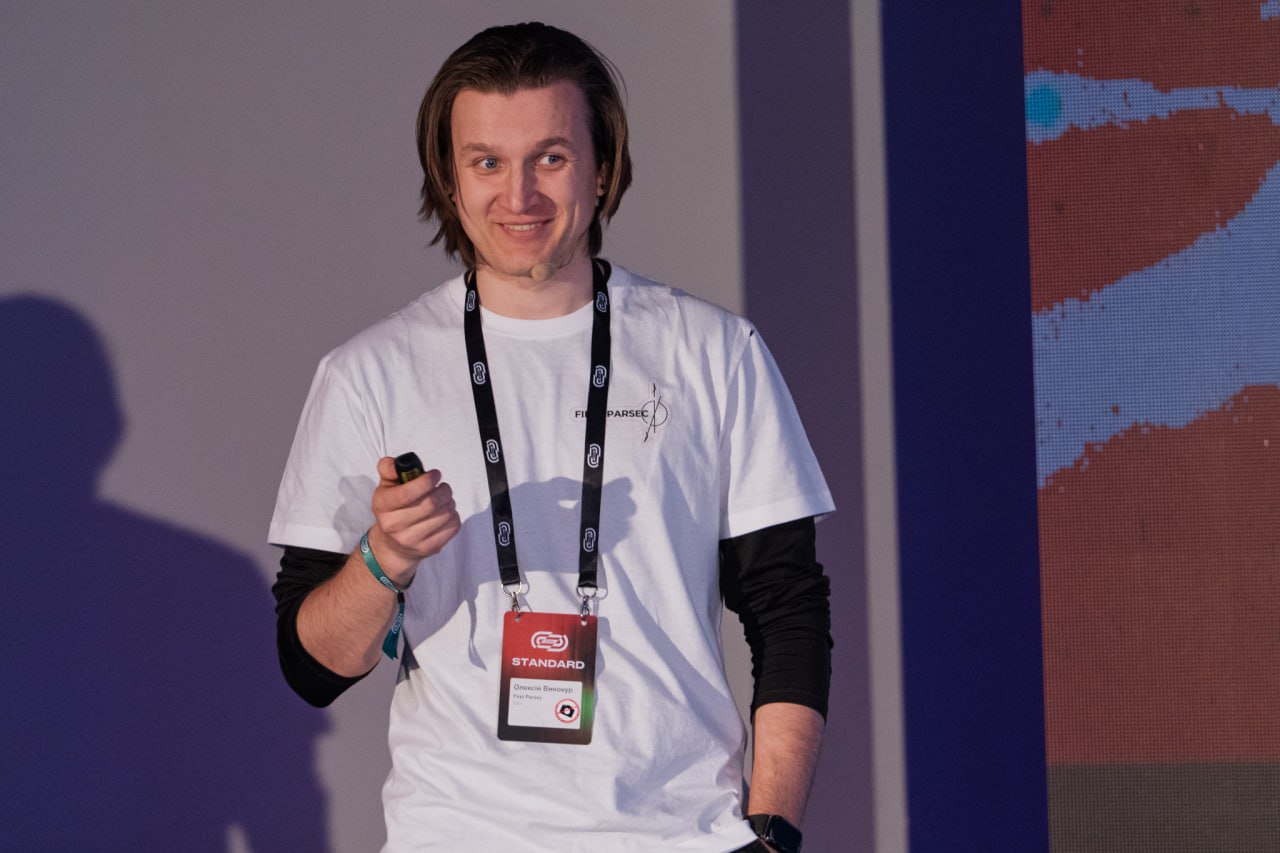
Oleksii Vynokur, founder of the Ukrainian aerospace company First Parsec, believes that perfect should not be the enemy of the good. His pitch is simple: pulsejets, lightweight jet engines that operate with pulses of intermittent combustion.
At a target cost of $500 per unit and a current production capacity of 400 engines per month with a small team, Vynokur argues that his pulsejets offer something no turbojet supply chain can: inexpensive scale.
“The problem is to make as scalable and as simple an engine as possible,” Vynokur said in an interview with Resilience Media. “A cheap, reliable, easy to maintain engine [that can] overcome, in sheer numbers, the Russian drone machine.”
But First Parsec didn’t start with pulsejets. It didn’t even start with defense.
Vynokur spent years as a software engineer in Kharkiv before deciding he wanted to build his own business. Ten days before Russia’s full-scale invasion in February 2022, he moved west to Lviv.
He’d being seeing the signs: US embassy warnings, political risk updates filtering through his professional network, and then even surprising signals of preparation, such as his local airsoft team suddenly being invited to a crash tactical medicine course with the 92nd brigade. He decided not to wait. Many of his colleagues thought he was overreacting. He wasn’t.
In Lviv, he shuttered his software startup Fixe Technologies, and, using the proceeds from that previous venture, hired two aerospace engineers and began designing an engine for rockets destined for space. (Parsec is an astronomical unit of distance measurement.)
“I [thought], I have some money,” he said, “This was the best time to start [because] I didn’t know what the day after would bring. I could be killed or hit by a rocket. It’s a pretty good reason to start something right now.”
The small team completed full technical drawings for a 9.6-ton-thrust rocket engine and pitched it to the Ukrainian government. But at the time, there was little state appetite for rocket programmes. The answer was no.
Then Mike Grace called. Grace, an American veteran and aerospace entrepreneur who has worked with multiple Ukrainian companies, found First Parsec via LinkedIn and contacted Vynokur with a proposition: he’d provide some modest seed funding of $5,000. (“Charity money to make it happen here in Ukraine,” is how Vynokur described it, with the funds getting used to buy initial materials and equipment.)
He also provided the startup with a very basic pulsejet concept in exchange for royalties on any future US sales. The initial version, running on propane, failed. The second, running on gasoline, worked.
Things moved very fast from there — so much so that the small company hasn’t even incorporated its pulsejet efforts into its public-facing website, which remains all about space tech.
From that second prototype, First Parsec iterated. The result is its current product line, the SHOOM series. The company now has its first commercial contract with a Ukrainian drone manufacturer and a growing list of potential customers. (These include what Vynokur describes as “soft agreements” for entering the US market.)
Pulsejets may seem unsexy — a throwback to the V-1 in the Starlink age. By every conventional metric – fuel efficiency, noise, emissions – they perform worse than turbojets. Vynokur is candid about this.
“We have really, really bad fuel efficiency,” he said.
And they were invented in the 19th century — by a Russian, of all people — and used in the Second World War — leading some skeptics to question where the innovation lies.
But in an industrial war where production speed is a critical constraint, pulsejets have advantages.
They are mechanically simple, requiring no exotic alloys or precision turbines. Every material in the supply chain is available domestically. And critically, the manufacturing process can scale with comparatively little capital investment.
Vynokur says that First Parsec can produce 100 engines at a cost of $500 per unit, and 1,000 engines at even less per unit than that. By contrast, UAV-grade turbojets, such as those used in the Russian Geran-3, cost tens of thousands of dollars, each.
“This is really cool with this technology,” Vynokur said. “You can really scale it up very quickly with not much equipment, not much material. All materials [are] here in Ukraine. We can just ramp it up.”
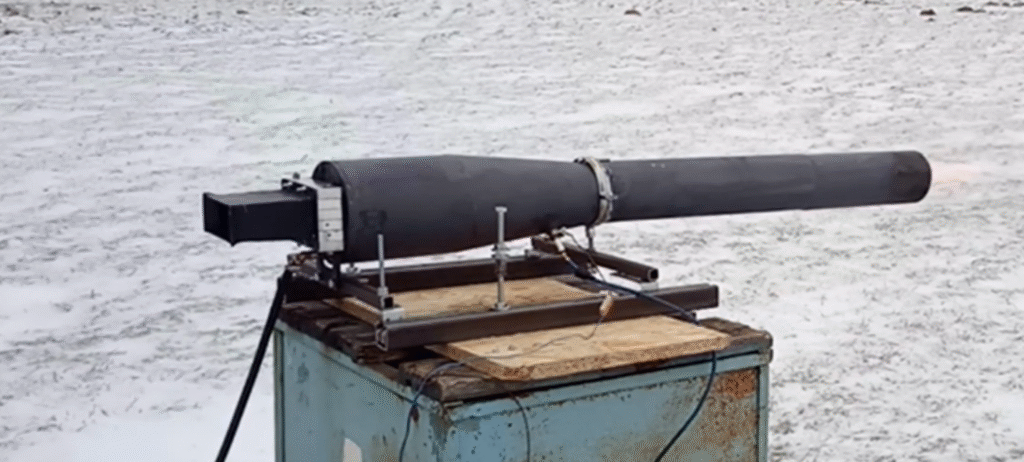
On a stand test, First Parsec’s SHOOM-20 engine ran continuously for sixteen minutes — which the company claims is more than three times the duration of any Ukrainian competitor working on pulsejets.
In flight, the runtime should be significantly longer, as the air intake helps cool the system. Vynokur’s target is two hours of continuous operation, which would translate to a range of roughly 700 kilometers, enough for a meaningful strike drone.
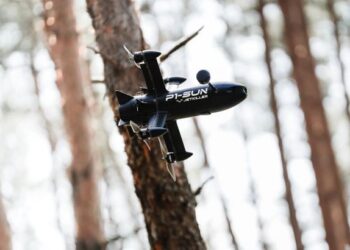
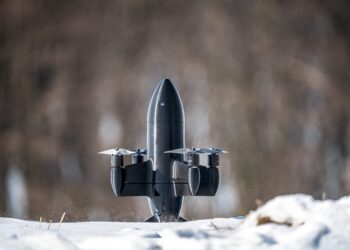
First Parsec’s pulsejets, and its KROOK-1 strike drone that it will power, are not intended to completely replace more expensive platforms. The goal is mass and saturation. One advantage of their low cost is that they can be used to absorb Russian air defense fire, improving the chances for more expensive platforms to reach their target.
Garage games get military-grade
Not everyone is convinced. Vynokur acknowledges that many technical specialists in Ukraine’s drone industry view pulsejets as a hobbyist technology, not a military-grade system.
“Lots of technical guys think this is like a garage-type technology,” he said. “But the idea is that we can make lots of them, really cheaply, and we can advance it so that it will have the same price but better and better capabilities.”
First Parsec’s main peer in the pulsejet space is Scopa Industries, which Vynokur describes not only as a competitor, but as a collaborator. The two companies share a broadly similar engine architecture, communicate regularly, and exchange technical updates.
“We are working really closely,” he said. “They share news that they have, and we share what we have.”
This reflects a broader shift in Ukraine’s drone industry, which has moved away from verticalisation and more towards modularity.
Two years ago, most companies tried to build entire systems in-house. Now, increasingly, the ecosystem is specialising to work on specific components.
One company builds the airframe, another the engine, another the flight controller. Vynokur expects that even some of his current competitors will eventually become customers, because they need longer runtimes and cheaper propulsion than what they can produce internally.
“The idea is not only to win this game, but to defend ourselves,” he said. “If we can provide our engine to other companies, and that allows them to start flight tests earlier and hit a Russian tank, that’s cool for us.”
Even if competitors attempt reverse engineering, First Parsec plans to stay one step ahead by putting out even better versions of its engines.
This is one way to ensure longevity, but it also keeps the technology more sovereign. This is in contrast to a growing list of Ukrainian companies that Vynokur claims are selling their IP to European entities in exchange for legal protection and access to investment.
Vynokur declined to name the companies, and in general the sale of IP for defence and other technology companies has been a hot-button issue that is still not fully resolved. In the past, no IP sales would have been permitted; now, some argue that they should be approved to help the enterprises in question scale.
Vynokur understands the logic that underpins this approach, but he expressed hope that Ukraine would retain more of its homegrown intellectual property rather than, as he put it, “selling out everything.” First Parsec, he noted, owns its own IP.
‘Elder men hold Ukraine’
Ask Vynokur about his hardest challenge and he doesn’t talk about engineering or funding. He talks about people.
“Everybody wants to be a software engineer,” he said.
But that may not have the intended impact you might think. Surprisingly – given the state of war that Ukraine has been in for the last four years; and the huge impact that AI and new tech like drones has had on how that war is being fought – those with software engineering ambitions are not skilled in some of the areas that have come to the fore in the current geopolitical and technological moment, such as manufacturing (eg CNC), and aerospace.
“Especially young guys,” he said. “They don’t think about space. They think about how to make money writing front-end pages.”
The war has only compounded the shortage because now skilled engineers are being sent to the front lines, and some are not making it back. The talent pool shrinks every day, and it is not being replenished.
At First Parsec, some of the most experienced workers are over sixty. One of Vynokur’s engineers put it bluntly: “Elder men hold Ukraine.”
This is a dimension of Ukraine’s production challenges that receives less attention than procurement budgets or facilities. You can build a factory in months, but training the people who run it takes years. And Ukraine is losing those people faster than it can replace them.
First Parsec has primarily been funded through a combination of Vynokur’s own funds and through grants from Brave-1, which he credits not only with funding but with introductions, conference access, and strategic guidance. The company has completed seed rounds for both its engine and drone programs (it declines to disclose the amount who is investing), and unlike many startups at this stage, it already has a sellable product rather than just a prototype.
In the near term, First Parsec is preparing for a flight test of the KROOK-1. At the time of this interview, severe winter weather had delayed testing. The initial flights will use a conventional turbojet to validate the airframe before swapping in the pulsejet.
The SHOOM-7, a smaller variant, is also nearing completion. Larger engines producing 40 and 100 kilograms of thrust are in development for heavier platforms, with interest from both private companies and, Vynokur hinted, the Ministry of Defense.
It’s also shown off tests of the SHOOM-20:
A new engine type, which he declined to describe, is planned within six months, and the company is exploring a potential turbojet program for dual-use applications that could meet EU emissions standards.
And somewhere on a First Parsec hard drive, there are still the blueprints for a 9.6-ton-thrust rocket engine.
Vynokur hasn’t forgotten them. First Parsec began as a space company, and if the war ever ends, he wants it to become one again. Before the invasion, Ukraine’s government had been planning a spaceport between the Odessa and Mykolaiv regions.
“Maybe we will start not in Ukraine,” he said. “Maybe we will start somewhere in Europe where there are spaceports for small rockets. But right now, it’s mostly a dream.”
The dream can wait. The war can’t.