Resilience: I want to start simple. What is your philosophy, what are you looking for, why defence, why these companies?
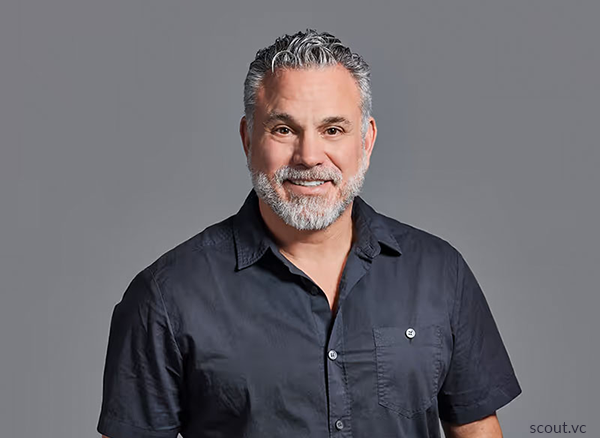
Brad Harrison: When I started Scout, I was a generalist. I had been an Airborne Ranger, then I went through grad school at MIT Sloan, then I wound up working at AOL with Ted Leonsis, learning how to build tech companies the traditional way. Right when I started the firm, one of my classmates was killed in action. About four years later, at a memorial service for him, I had an epiphany. Why are we investing in anything other than technology that protects the sons and daughters, and makes the world safer. How do we stop from having more Jasons.
R: So that is the turning point. What did it change in how you invest?
Harrison: Two things. First, we wanted to back entrepreneurs who are harder to access, but share a sense of mission. We define that group as founders from the military and intelligence community, plus leading research national labs, Los Alamos, Sandia, Oak Ridge, and top programs like Carnegie Mellon, MIT, Georgia Tech Robotics, the places doing emerging tech.
Second, we focus on what the US calls critical technology areas. At Scout we focus on critical technology that has dual-use applications.
Dual-use means commercial and government applications. We like that intersection because government will put up serious non-dilutive capital. From an investment standpoint, if we can invest a dollar and bring in two or three dollars of government money to advance the tech, that is a good structure.
The areas we focus on are AI, autonomy, robotics, cyber, quantum, space, and power. Usually there is some foundational breakthrough. A new way to modulate RF. A new way to navigate in GPS-denied environments. A new way to track missiles and drones in a battle space. The basics are still shoot, move, communicate. We invest in the enabling tech that makes that possible.
R: You are drawing a boundary too.
Harrison: Yes. We do not do weapons. We do not do munitions. We do enabling technologies, maritime, ground, aerial autonomy, navigation for GPS denied and electronic warfare, and even things like data centers in space. We have Lone Star Data Holdings, and Voyager Technologies, which went public this year. Voyager is the largest owner of Starlab, which is being built to replace the International Space Station.
R: How has it been going. From where I sit, defense in the US has not had a lot of venture behind it. I might be wrong, but in the VC world I lived in, this did not feel like a category. Is something changing?
Harrison: A lot is changing. Look at Palantir, it is doing about a billion dollars a quarter, the Army is using it, the Navy announced work with it. That is a company that came out of the tech ecosystem and scaled.
Then you have SpaceX at an enormous valuation. You have Anduril at a huge valuation. Those companies have real venture backing. Andreessen has an American dynamism team. General Catalyst has a national resilience team. Lux is here, DCVC is here. You are seeing tier one firms enter the space.
The other change is the amount of money going into emerging technology. Last week I attended classified and unclassified briefings from the Department of the Navy Rapid Capabilities Office. The Navy put innovation under one roof. They are working on objectives from now to 2027, and also what the force looks like in 2040, when front lines are no longer only men and women, but sensors, robots, autonomous systems.
Our aim is simple: Be so good at technology for national security that there is never another shot fired because deterrence is real.
R: That is a big statement.
Harrison: It is also what leadership is saying out loud now. Secretary Phelan said in an unclassified briefing that the mission is to build a technologically superior force that deters an enemy from ever firing a shot. That matches how we think.
At Scout we are a lead seed stage investor. We write first checks, one to six million dollars. We join the board. We bring a network. We have Tim Kopra, former ISS commander, as an advisor. We have Ken Braithwaite, the 77th Secretary of the Navy and former ambassador to Norway, as an advisor. We pull in people who have lived the problems.
R: Ok, then let’s talk incentives. What needs to happen in venture to encourage more growth in defense. Palantir takes a lot of oxygen. How do small teams get a shot.
Harrison: There is an opening right now that did not exist before. In the past, the primes drove the ship, Northrop, Boeing, BAE, Lockheed, RTX, L3Harris, Bell. They provide most of the equipment and support to DoD. They can interrupt innovation, and they are not built to innovate fast.
Now, because of changes in how funds can be authorized and appropriated, it is in their interest to partner with emerging tech companies. Most of our successful companies partner with primes, Lockheed, RTX, General Dynamics, in ways that were not common six or seven years ago.
That matters because emerging tech still faces manufacturing and supply chain problems. Take autonomy. Motors, batteries, sensors, cameras, a huge share of global supply comes from China, often from a small set of cities. National security is the supply chain too.
Venture can help build the company and develop the tech. Venture should not be the only source for building factories and mass production. You need debt, you need incentives, and you need non-dilutive programs. Texas launched the Texas Space Commission. In the first year they awarded $150 million, and $15 million went to our portfolio company Starlab in Houston. That kind of capital helps make the business real.
R: You brought up 2040 earlier. Based on what you are seeing, what does warfare look like in 2040.
Harrison: Autonomy supported by humans. Complex networks of sensors from ground level up to low earth orbit. When you think about hypersonics and deterrence, you need monitoring from space. At ground level you need dense sensing, standoff weapons, early detection, intercept, a kind of Golden Dome concept, changing deterrence.
Look at the Pacific. China has spent years putting sonar buoy arrays through regions of the Pacific. It makes movement harder, it changes how deterrence works. The next decade will be sensors, early detection, intercept, and the ability to replace what gets destroyed, fast.
R: That sounds like a world where war becomes harder to start. Is that wishful thinking, or is that real.
Harrison: It is part of deterrence. But deterrence also depends on industrial capacity. If a sensor network gets hit, can you rebuild it quickly. Ukraine taught us that even in a drone-heavy battlefield, they still burn through old-school artillery in massive amounts. The world’s stock of 155mm shells got stressed. Old war and new war exist at the same time.
Ukraine also showed something the US has not fully embraced yet. A mission where a system goes downrange weapons hot with no comms link, no GPS, no feedback, pre-planned routes, autonomy given a target and released. That changes the game. Humans out of the immediate loop in a way we have not seen at scale before.
R: Which raises the Terminator question. How close are we.
Harrison: Not Skynet next year. But within a decade, humanoid robots will look more capable, not in personality, but in physical form and function. Look at Figure, Apptronik, others. You will see autonomy at the squad level in every unit. A robotic dog for scouting, an aerial drone for overwatch, a humanoid to enter a hazardous situation where you do not want a person.
John: What is missing right now. What would you write a check for today.
R: I will give you three things I am writing checks for because they feel missing.
First is a company called WorldScape. They built a layer that models real physics inside simulation. That matters because if you train autonomy in simulation, physics changes everything. Materials, weather, barometric pressure, all of it affects damage and ballistics. If simulation is the training ground, physics fidelity becomes decisive.
Second is what I am most excited about, zero-point energy, pulling energy from the quantum field. The company is Casimir Space, founded by Harold “Sonny” White, who spent two decades at NASA in propulsion. He has developed Casimir cavities on semiconductors producing low power. No battery, not nuclear, but power generation from quantum field effects. If this scales, it changes the power constraint that is bottlenecking everything, including AI.
R: Five years ago, I would have called that crank stuff.
Harrison: A lot of people do. But the Casimir effect is old theory, developed through the 1900s. The math has been built over decades. The question is engineering. Ten years ago, many physicists said it was possible in principle. Today, fewer believe it is practical, but Sonny’s results are shifting how people talk.
R: Let me pull us back to AI and work. Do you expect a burst of scientific progress because people can work on harder problems without the grunt work.
Harrison: I hope so. I am hopeful for humanity. But I worry too. We might get a renaissance among people who use these tools to go deeper, and a decline among people who stop reasoning because the answer is always one prompt away.
If abundance grows, you can imagine good outcomes. More time with kids. Stronger communities. More meaning. But you can also imagine bad outcomes. People retreating into screens. Isolation. A generation comfortable in digital space and less comfortable in real life. Scott Galloway cited a study where a large share of men had never asked someone out in person, only through digital channels. That is not just a dating fact, it is a social skills fact.
Rn: Right. You can have gifted kids who are also sort of trapped.
Harrison: Yes. Huge strengths in some areas, and real weakness in breaking away from dopamine loops.