Make way for another drone startup in the European defence tech ecosystem. Twentyfour Industries is today emerging from stealth armed with $11.8M in early-stage funding at an undisclosed valuation to design and produce cost-effective, easy to operate drones at scale for European militaries and their allies.
“From day one, we set out to deliver three pillars: drone technology, sovereign production capacity, and an organization capable of being a credible supplier to governments,” said Clemens Kürten, the CEO and co-founder, in an email to Resilience Media. “Most players focus on one of these. Very few combine all three in a way that scales. Our early traction shows that this combination — technology plus industrialisation plus institutional readiness — is a strong value proposition even in a crowded market.”
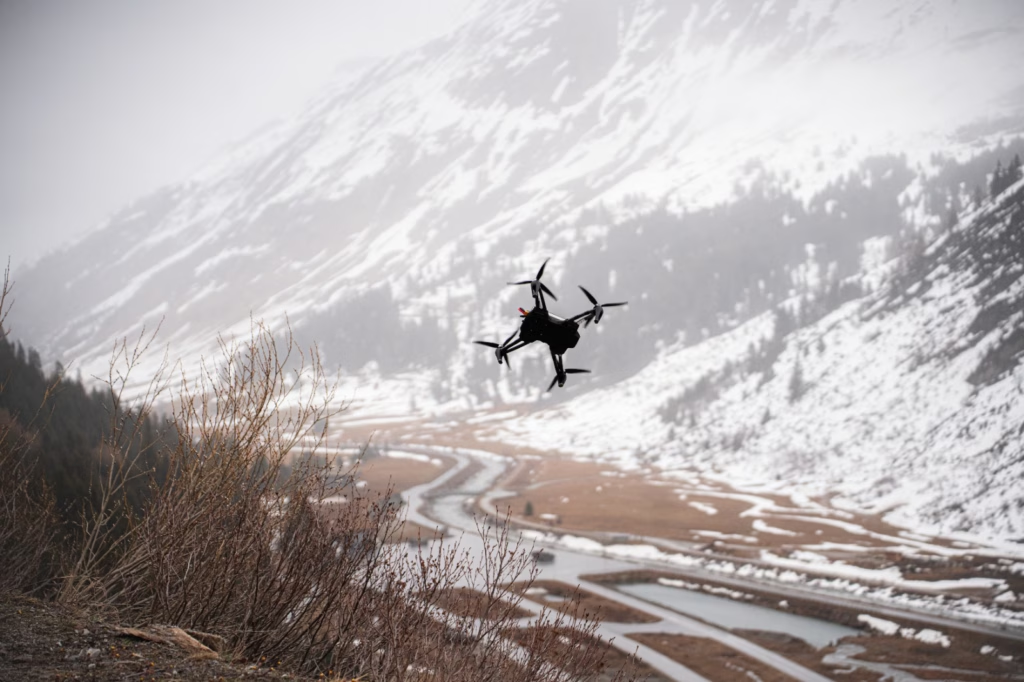
The company is coming out of stealth today but it says it has been in business for more than a year and claims to have produced hundreds of units of its first product, a 10-inch quadcopter drone branded the Q-X, which is a non-kinetic, multi-mission platform optimised for short missions (max flight time just 20 minutes); takes a maximum payload of 2.5kg based on a modular system depending on what is being carried; travels up to 140km/hour; and works within a radius of 12km. (Twentyfour Industries does not develop or supply kinetic payloads, Kürten emphasised.)
The startup is not revealing pricing or customer names but says it has “98% availability” for product and has already “signed and delivered” revenue-generating contracts across multiple countries from both civilian and military operators that are using its Q-X units on a daily basis.
Twentyfour Industries is based out of Munich, one of the major centres for defence tech in Europe right now, The company’s four co-founders — per LinkedIn they are Clemens Kürten (CEO), Erik Linden (CCO), Martin Eichenhofer (COO) and Constantin Jung (VP of engineering) — have had some background going to university and working in Switzerland. The founders’ technical training includes a track record in aerospace and materials design. It’s not fully clear how the four came together to build Twentyfour Industries, but European sovereignty is at the heart of their motivation.
“All founders are deeply committed to European sovereignty and technological resilience and bring decades of combined industry experience,” Kürten said in an email to Resilience Media. ‘We were convinced that Europe needs companies that combine technology, operations, and commercial execution from day one — and we founded this company to build exactly that capability and strengthen European drone sovereignty.
He added that one reason why the company stayed in stealth for so long was to “to focus on execution.”
“Our goal was to design, build, and deploy hundreds of drones and establish real operational credibility before going public,” he added.
Stealth or not, its activity has definitely caught the attention of connected people. Named backers in this $11.8 million in funding tranche include Lakestar and OTB Ventures, two of the more prominent names in early-stage defence and resilience startup funding in the region (both with long lists of startups that include the likes of Helsing and ICEYE, among many others).
A third backer, Berlin’s 468 Capital, has made hundreds of early-stage investments in Europe and in US startups connected to Europe (its most recent fund in 2022 was for $400 million: that’s a lot of early-stage investments). However, it appears to be only starting to dip its toes into defence tech with this investment and an October 2025 investment in US maritime drone company Albacore.
Scale reigns supreme
The emergence of Twentyfour Industries is coming at a key moment in the landscape for defence technology in Europe. To sum up quickly:
The ongoing war in Ukraine has provided a very clear signal to strategists and soldiers that drones, often equipped with autonomous software and priced competitively (and able to be hacked together even by soldiers themselves), have become an essential cornerstone in how conflicts are fought today.
That is giving rise to a new purchasing pull: ministries of defence are (like many government units) looking to do more with less money, and they are also trying to make sure their defence remains cutting-edge. Cue buying more drones and working with more defence tech companies.
That opening has led to the creation of a lot of drone companies — some believe too many drone companies, in the same way that the world might have too many AI agent startups.
However, all of the above comes with a couple of huge caveats. The first is that not every drone is as capable as the other. The second is that adversaries are also advancing their defences. The third is that there is still a sizeable production gap in terms of what is available and what is in demand.
It’s the caveats that are giving even new drone startups like Twentyfour Industries an opening to win business and grow.
Indeed, the founders say as much themselves.
“From day one, our focus has been prioritising execution over complexity and proving capability through delivery,” said Linden, the chief commercial officer, in a statement. “By working directly with operators in the field, we ensure every product iteration is driven by real-world needs – enabling us to move faster and deliver more value to our customers.”
The startup has not shown many cards in its funding/uncloaking announcement today: no valuation, no detail on roadmap or customers, no pricing, and nothing about its origins. We have asked the company about all of this, and we’ll update as we learn more.
Updated with more responses from the company.