Sunday 19 April, 2026
[email protected]
Resilience Media
  • About
  • News
  • Resilience Conference
    • Resilience Conference Warsaw 2026
    • Resilience Conference Copenhagen 2026
    • Resilience Conference London 2026
  • Guest Posts
    • Author a Post
  • Subscribe
No Result
View All Result
  • About
  • News
  • Resilience Conference
    • Resilience Conference Warsaw 2026
    • Resilience Conference Copenhagen 2026
    • Resilience Conference London 2026
  • Guest Posts
    • Author a Post
  • Subscribe
No Result
View All Result
Resilience Media
No Result
View All Result

NATO Innovation Fund appoints a president, Ari Kristinn Jónsson

Jónsson, who had been on the board, is stepping into the newly-created role to help drum up more business for portcos

Ingrid LundenbyIngrid Lunden
March 5, 2026
in News
Share on Linkedin

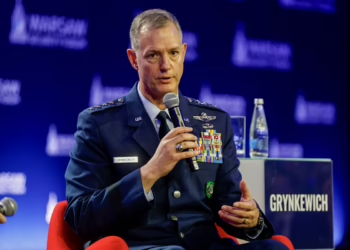
The NATO Innovation Fund, the VC formed out of the strategic alliance of NATO countries that counts most (but not all) of those countries as LPs, is making a change to its leadership structure today. It has appointed Dr. Ari Kristinn Jónsson (pictured above) as president, to help NIF portfolio companies get more business, and NIF to get a better understand of what alliance countries need. 

You Might Also Like

Ukrainian Armor and The Fourth Law collaborate on a new EW-resistant drone

ETSI pushes back on EU plan to freeze out ‘high-risk’ players from standards work

Klaus Hommels of Lakestar talks about defence consolidation and the future of procurement

This is an entirely new role for the firm as it continues to make strategic investments in defence, security and resilience out of its first $1 billion fund. 

The role is new, but person filling the role is not: Jónsson has been on the board of NIF for the last three years. Jónsson hails from Iceland and has been based there working as the CEO of image recognition startup Videntifier; he is now relocating to Amsterdam to take on the role of president full-time. 

NIF has done a lot of investing in deep tech, and Jónsson, in addition to his experience in startups, brings direct deep tech experience, too: he spent more than a decade in the US getting a PhD from Stanford focused on artificial intelligence and then worked for NASA as a research scientist. 

He is taking on the role at a prime moment for the fund and defence tech in general. 2022 marked a sea change in Europe, with Ukraine’s tensions with Russia tipping into a full-blown war, which has direct impacts not just in non-NATO Ukraine for for the wider NATO footprint across Europe.

Ukraine is outnumbered in virtually every regard by its Russian invaders. But necessity is the mother of invention, and that has led to two outcomes: Ukraine has had to be especially scrappy in building its defences domestically; and it’s created an interesting supply chain with a number of defence newcomers from outside the country. Companies building on the battlefield have ended up leading the way in a wide range of technologies like drones, autonomy and electronic warfare that are cheaper and faster to produce than incumbent analogues and often more effective in modern warfare. 

All of that has created a profusion of defence tech companies, plus an appetite for buying their products, plus an appetite for investing in them. Defence tech and DSR more widely have gone from being on the fringes of what’s cool or interesting to being at the very heart of the action. 

And that brings us to Jónsson’s appointment. His role is not to be another active investor partner in the fund but to work with partners and portfolio companies, as well as potential customers, to get more end users adopting new technology, as well to help partners and portfolio companies understand what end users need. (This is alongside the work NIF’s adoption team run by John Ridge is already doing.)

In short, the aim of the president will be to take startup product and turn that into business deals and wider ecosystem building. This can be a challenge in the extended business cycles in ministries of defence and wider government, but it’s critical to ensuring that defence tech is not the next technology bubble.

“We’re starting to see how we do adoption and capacity building,” Jónsson said in an interview with Resilience Media. “We need to, in the next years, do this really at scale. You know, we need to move from [showing] everybody that there can be really positive impact on the DSR investment environment, to [helping] our companies deploy and get contracts.”

As a fund working in defence, there are some notable details to point out.

For starters, two substantial North American members of NATO — the United States and Canada — are not LPs in NIF. And neither is one of the biggest economies in Europe, France. 

Jónsson made clear to say that this doesn’t impact its portfolio companies doing business in those countries, but it means that NIF is currently not making investments in some of the most active countries when it comes to defence tech startups (the US alone outnumbers all of Europe put together in terms of collective valuations). And that also includes not investing in arguably the only country in Europe hosting a large, sovereign foundational AI company — potentially another important cornerstone of the resilience thesis, if you buy into the AI pitch. 

Another detail: for the time being, NIF is not investing in startups that are purely defence startups; they need to have dual-use strategies (services also for civilian or commercial customers) alongside the defence propositions. At a time when we are seeing a large profusion of defence tech companies emerging, NIF is not engaging in that stream of deal activity or company building. 

NIF has seen a lot of personnel shifts at NIF over the past year, including a new chair (Jónsson is the first big appointment in fact of that chair, Dame Fiona Murray), and new partners. There is still a lot left to invest out of its first $1 billion fund, and Jónsson would not be drawn out on where it is with fundraising for a future fund. All this means there are a lot of ways that the fund could develop in the future, giving Jónsson a lot of space to make a mark in how that progresses.
Tags: defence techNATO Innovation FundNIF
Previous Post

SkySafe partners with major energy sector player to build out drone defence

Next Post

Weekly Digest: Auterion raising $200M at $1.2B valuation, Uforce’s unicorn debut, and Anthropic’s Pentagon standoff

Ingrid Lunden

Ingrid Lunden

Ingrid is an editor and writer. Born in Moscow, brought up in the U.S. and now based out of London, from February 2012 to May 2025, she worked at leading technology publication TechCrunch, initially as a writer and eventually as one of TechCrunch’s managing editors, leading the company’s international editorial operation and working as part of TechCrunch’s senior leadership team. She speaks Russian, French and Spanish and takes a keen interest in the intersection of technology with geopolitics.

Related News

Ukrainian Armor and The Fourth Law collaborate on a new EW-resistant drone

Ukrainian Armor and The Fourth Law collaborate on a new EW-resistant drone

byLuke Smith
April 17, 2026

Two up-and-coming Ukrainian defence startups have collaborated to develop a UAS model that they claim is 2-4 times more effective...

waving flag

ETSI pushes back on EU plan to freeze out ‘high-risk’ players from standards work

byCarly Page
April 16, 2026

Europe's telecoms standards body has fired an early warning shot at Brussels’ next cybersecurity overhaul, arguing that plans to shut...

Klaus Hommels of Lakestar talks about defence consolidation and the future of procurement

Klaus Hommels of Lakestar talks about defence consolidation and the future of procurement

byJohn Biggs
April 15, 2026

Investor and entrepreneur Klaus Hommels, founder of Lakestar, sees a new era of European defence spending and investment. His comment?...

To infinity and back: the opportunity for reusable hardware in space

To infinity and back: the opportunity for reusable hardware in space

byResilience Media
April 15, 2026

Germany's Atmos Space Cargo is opening an office in Poland focused on defence capabilities, announced CEO Sebastian Klaus during a...

Danish startup Sapient Perception raises €2M to widen UAV vision for real-time battlefield decisions

Danish startup Sapient Perception raises €2M to widen UAV vision for real-time battlefield decisions

byCarly Page
April 15, 2026

A Danish startup promising to give drones a much wider field of view without sacrificing detail has raised €2 million...

Daimler Truck and ARX Robotics Team Up to Bring AI and Autonomy to Military Vehicles

ARX Robotics secures British Army contract

byLuke Smithand1 others
April 15, 2026

ARX Robotics has secured its first British Army contract, delivering UK-manufactured Gereon uncrewed ground vehicles for Recce-Strike experimentation through Task...

Airship startup Kelluu raises €15M from NATO, its first investment in Finland

Airship startup Kelluu raises €15M from NATO, its first investment in Finland

byIngrid Lunden
April 14, 2026

Defence is a multi-modal concept, and today a startup focused on building a stronger pipeline of intelligence data from a...

Rheinmetall and Destinus to ‘bridge the gap’ with new joint venture

Rheinmetall and Destinus to ‘bridge the gap’ with new joint venture

byFiona Alston
April 13, 2026

The CEO of German defence prime Rheinmetall may have stepped out into the spotlight as an outspoken critic of Ukraine's...

Load More
Next Post
Weekly Digest: Auterion raising $200M at $1.2B valuation, Uforce’s unicorn debut, and Anthropic’s Pentagon standoff

Weekly Digest: Auterion raising $200M at $1.2B valuation, Uforce’s unicorn debut, and Anthropic’s Pentagon standoff

asphalt road between trees

Munich Security Conference got the urgency right. The hard part comes next

Most viewed

InVeris announces fats Drone, an integrated, multi-party drone flight simulator

Uforce raises $50M at a $1B+ valuation to build defence tech for Ukraine

Auterion, the drone software startup, eyes raising $200M at a $1.2B+ valuation

Senai exits stealth to help governments harness online video intelligence

Palantir and Ukraine’s Brave1 have built a new AI “Dataroom”

Twentyfour Industries emerges from stealth with $11.8M for mass-produced drones

Resilience Media is an independent publication covering the future of defence, security, and resilience. Our reporting focuses on emerging technologies, strategic threats, and the growing role of startups and investors in the defence of democracy.

  • About
  • News
  • Resilence Conference
    • Resilience Conference Copenhagen 2026
    • Resilience Conference Warsaw 2026
    • Resilience Conference 2026
  • Guest Posts
  • Subscribe
  • Privacy Policy
  • Terms & Conditions

© 2026 Resilience Media

No Result
View All Result
  • About
  • News
  • Resilence Conference
    • Resilience Conference Copenhagen 2026
    • Resilience Conference Warsaw 2026
    • Resilience Conference 2026
  • Guest Posts
  • Subscribe
  • Privacy Policy
  • Terms & Conditions

© 2026 Resilience Media

This website uses cookies. By continuing to use this website you are giving consent to cookies being used. Visit our Privacy and Cookie Policy.