
Monday 1 June, 2026
[email protected]
Resilience Media
  • News
    • Events
    • Interview
    • Startups
    • Venture
    • Weekly Digest
  • Resilience Conference
    • Resilience Conference Warsaw 2026
    • Resilience Conference Copenhagen 2026
    • Resilience Conference London 2026
  • About
  • Guest Posts
    • Author a Post
  • Subscribe
No Result
View All Result
  • News
    • Events
    • Interview
    • Startups
    • Venture
    • Weekly Digest
  • Resilience Conference
    • Resilience Conference Warsaw 2026
    • Resilience Conference Copenhagen 2026
    • Resilience Conference London 2026
  • About
  • Guest Posts
    • Author a Post
  • Subscribe
No Result
View All Result
Resilience Media
No Result
View All Result

Energy, robotics, and defence are driving deep tech growth in the Baltics

A new report from Iron Wolf Capital finds that defence, security and resilience (DSR) is the defining sector of the moment

Fiona AlstonbyFiona Alston
June 1, 2026
in News
Share on Linkedin

The Baltics are doing alright when it comes to defence tech growth, according to a newly published report.

You Might Also Like

Helsing launches Area 9 research unit and unveils European robotics platform

Hermeus logs first supersonic flight for the uncrewed Quarterhorse Mk 2.1 jet

Understanding China’s cyberthreat to Taiwan’s infrastructure

Iron Wolf Capital, Startup Estonia, Startup Lithuania, and WALLESS have published the third annual Baltic Deep Tech Report 2025.

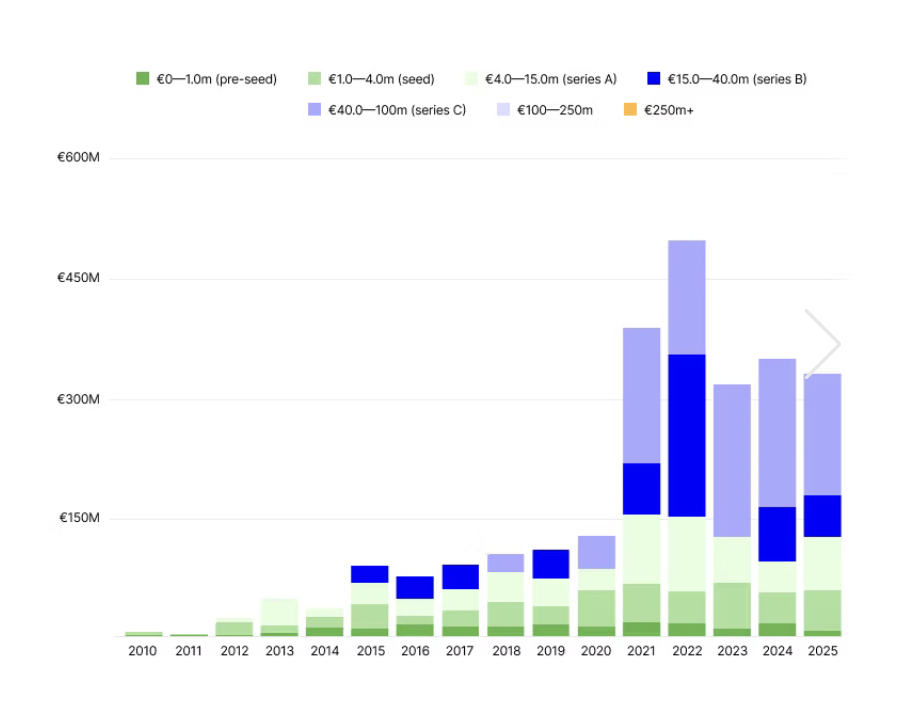
Overall, some €328 million across 106 funding rounds was invested in deep tech in the Baltics in the year, up 160% on 2020’s investments of €126 million. As a sector, deep tech is huge in the Baltics, accounting for more than 49% of all tech investments in the period.

Early stage investments continue to dominate: 20.5% of all investments were Series A, up 79% on 2024, and more than half of investments at Series B and blow, and nothing later than Series C in series or size, as the graph below shows.
But perhaps one of the biggest takeaways is that startups, investors, and the technology sector overall are all responding forcefully to world events — not least world events unfolding in their backyard.

Specifically, DSR — the overall category covering defence, security, and resilience — stands out in the report as one of the defining technology sectors of 2025 in the Baltics.

The data-driven deep dive into the region’s deep tech startup economy finds that “defence technology has emerged as its fastest-accelerating dimension.”

This directly reflects not just the war in Ukraine but also the resulting unease over what Russia will do next along the Eastern Flank: the bottom line is that Europe is hustling now to get up to speed in its defences, and the Baltics are arguably (and literally) on the front line of that activity.

After mapping 150+ DSR startups and a total of €104 million in announced funding across 47 rounds, the highest growing verticals are energy, robotics, and autonomous systems.

The data is based on publicly-announced deals, meaning it does not include what is being built — and funded — in stealth, which is not uncommon in the DSR sector.
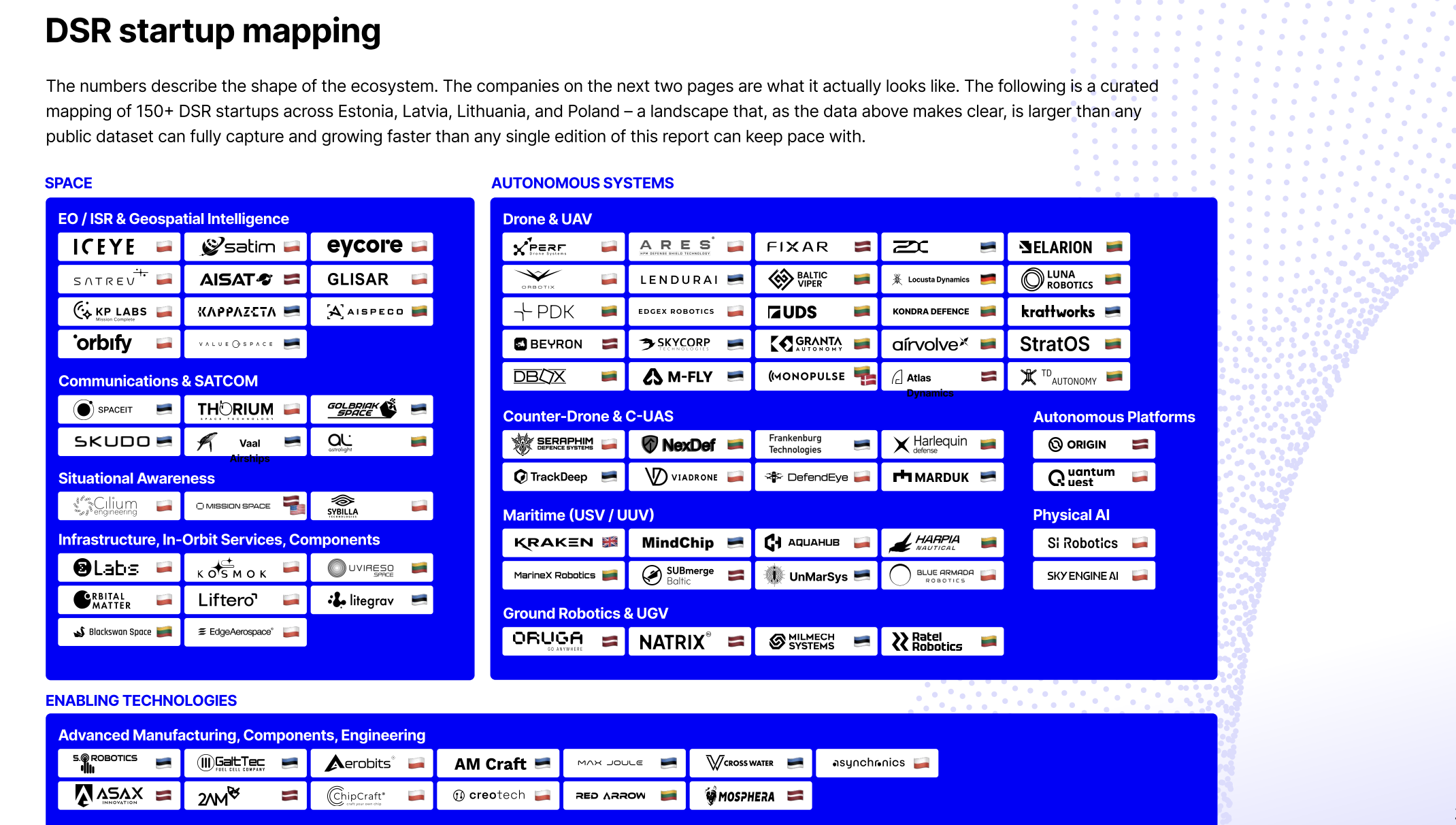
DSR companies mapped for the Baltic Deep Tech Report

Iron Wolf detailed 47 publicly-announced funding rounds in the DSR sector, which accounted for 15.4% of all startup funding in the Baltics in 2025.

Within that year, the largest rounds went to firewall firm Blackwall (€45 million), hydrogen fuel cells scale-up PowerUp Technologies (€10 million), navigation startup Lendurai €5.5m million, comms platform Wayren ($7.9 million), superbattery scaleup Skeleton Technologies ($7 million) and short range missile systems startup Frankenburg Technologies ($4 million).

Since 2025, some of these startups have gone on to raise more: for example, Frankenburg confirmed a further €30 million in funding in February. And we are hearing murmurs of a several other fundraisings in the works right now, so it seems we are far from peak fundraising in DSR in Europe.
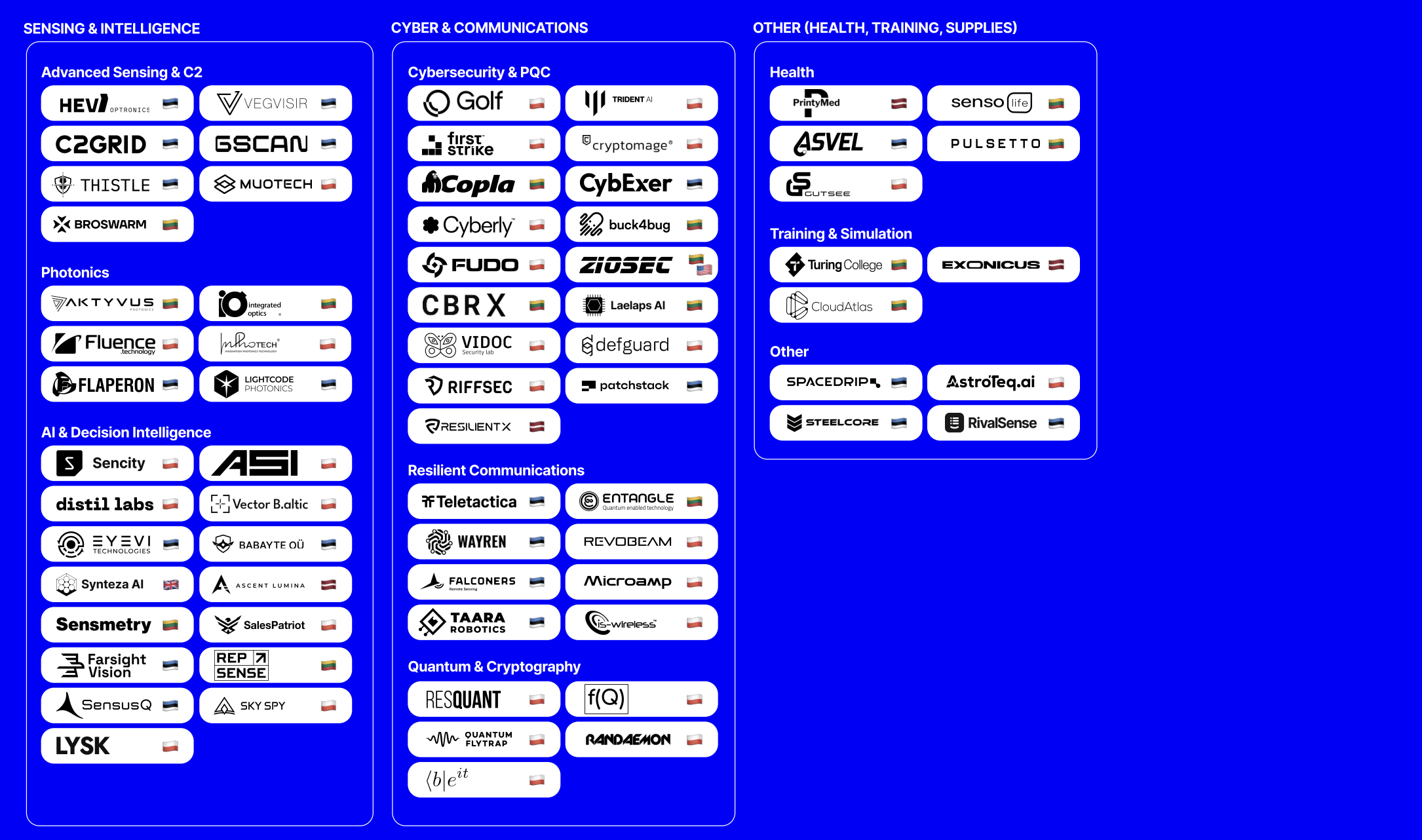
DSR companies mapped for Baltic Deep Tech Report cont’d.

Some of the activity is disproportionate to the scale of the nations themselves, another signal of how much geopolitics are driving startup activity (and investor interest).

For example, Estonia ranks 7th in Europe for VC funding in the defence sector, ahead of countries with ten times its population of 1.4 million, the report notes. The authors do not break out a hard number for money raised but notes that Estonia was the highest-ranking Baltic country for overall tech investment at €353 million.

Others have some room for growth on that front: Lithuania and Latvia are respectively 16th and 21st on the list for DSR investments. And Poland, despite having the sixth-largest economy in the EU and the eighth-largest in Europe overall, may well be disproportionately behind on startup activity and funding. 

Although Poland committed 4.7% of its $1.1 trillion in GDP to defence in 2025 — the highest proportion of any NATO country — it noted that just €19.4 million in disclosed funding was raised across 18 early-stage rounds into startups in the sector. Investor share is approximately 61% domestic investment.

You can find the full report here.

Previous Post

Hermeus logs first supersonic flight for the uncrewed Quarterhorse Mk 2.1 jet

Next Post

Helsing launches Area 9 research unit and unveils European robotics platform

Fiona Alston

Fiona Alston

Fiona Alston is a defence tech, innovation and business journalist based in Estonia. With over a decade of experience covering tech, business and sustainability for Irish and European publications, she has a knack for bringing interesting and technical stories to an everyday audience.

Related News

Helsing launches Area 9 research unit and unveils European robotics platform

Helsing launches Area 9 research unit and unveils European robotics platform

byCarly Page
June 1, 2026

Helsing has launched a new advanced research division and unveiled its first European-built robotics research platform as the defence AI...

Hermeus logs first supersonic flight for the uncrewed Quarterhorse Mk 2.1 jet

Hermeus logs first supersonic flight for the uncrewed Quarterhorse Mk 2.1 jet

byJohn Biggs
May 29, 2026

Atlanta-based Hermeus announced that its Quarterhorse Mk 2.1 experimental aircraft has completed its first supersonic flight, reaching Mach 1.21 during...

city building during daytime

Understanding China’s cyberthreat to Taiwan’s infrastructure

byPaddy Stephens
May 29, 2026

Discussions about Taiwan’s security often focus on the military domain, but in any crisis, the resilience of Taiwan’s critical infrastructure...

a computer chip with the letter a on top of it

Orbital Industries, an “AlphaFold” for materials science, raises $50M

byIngrid Lunden
May 28, 2026

A startup called Orbital Industries believes it can make meaningful, less resource intensive, breakthroughs in materials science using AI to...

text

The defence tech boom is creating a cybersecurity industry for machines

byCarly Page
May 28, 2026

The defence tech boom is quietly spawning an entirely new category of cybersecurity startup, one less concerned with phishing emails...

UK’s intelligence chief eyes Russia and China as the major cyberthreats of our time

UK’s intelligence chief eyes Russia and China as the major cyberthreats of our time

byIngrid Lunden
May 27, 2026

While Russia continues its assault on Ukraine, it’s also developed an aggressive posture on the frontlines of a different war:...

Quaze deal gives Red Cat wireless power for drones and robots

Quaze deal gives Red Cat wireless power for drones and robots

byJohn Biggs
May 27, 2026

Red Cat Holdings has acquired Québec-based Quaze Technologies, adding wireless charging capability to its growing portfolio of autonomous systems. The...

New cameras from Odd Systems are making drones faster, smarter, and more accurate

New cameras from Odd Systems are making drones faster, smarter, and more accurate

byJohn Biggs
May 27, 2026

https://youtu.be/-uqLiaA65Pk   Ukrainian defence startup Odd Systems is building a line of mission-specific camera systems designed for drones operating in...

Load More
Next Post
Helsing launches Area 9 research unit and unveils European robotics platform

Helsing launches Area 9 research unit and unveils European robotics platform

Most viewed

InVeris announces fats Drone, an integrated, multi-party drone flight simulator

Uforce raises $50M at a $1B+ valuation to build defence tech for Ukraine

Auterion, the drone software startup, eyes raising $200M at a $1.2B+ valuation

Palantir and Ukraine’s Brave1 have built a new AI “Dataroom”

Twentyfour Industries emerges from stealth with $11.8M for mass-produced drones

Senai exits stealth to help governments harness online video intelligence

Resilience Media is an independent publication covering the future of defence, security, and resilience. Our reporting focuses on emerging technologies, strategic threats, and the growing role of startups and investors in the defence of democracy.

  • About
  • News
  • Resilence Conference
    • Resilience Conference Copenhagen 2026
    • Resilience Conference Warsaw 2026
    • Resilience Conference 2026
  • Guest Posts
  • Subscribe
  • Privacy Policy
  • Terms & Conditions
  • Mission Statement & Code of Practice
  • Press

© 2026 Resilience Media

No Result
View All Result
  • Home
  • About
  • Subscribe
  • Events
  • Guest Posts
  • Interview
  • News
  • Resilience Conference London 2026
  • Resilience Conference Copenhagen 2026
  • Resilience Conference Warsaw 2026

© 2026 Resilience Media

This website uses cookies. By continuing to use this website you are giving consent to cookies being used. Visit our Privacy and Cookie Policy.