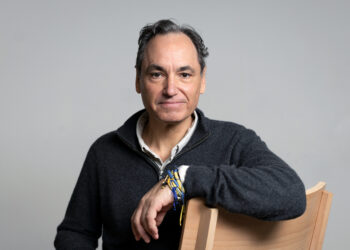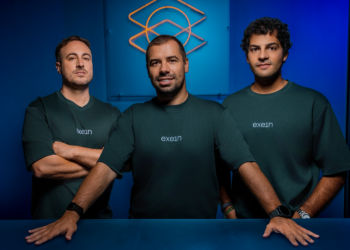
Nearly four years on from the launch of the NATO Innovation Fund, and two years after it announced a coffer of €1 billion to invest in startups to support the alliance, NIF is shaking up its top leadership. Klaus Hommels, the VC who helped found NIF, is stepping down as chairman, and Dame Fiona Murray, who had been vice-chair, is stepping up into the head role.
The reorganisation is the latest change at NIF, which has now shuffled out all but one of its original investing partners amid questions about its strategy.
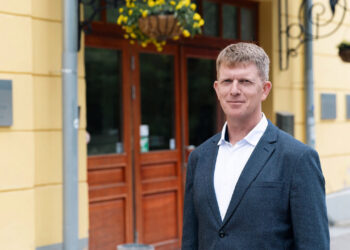
Hommels will move to chair a new Geopolitical and Strategic Advisory Council, and Karl-Christian Agerup, a NIF board member, is moving into the vice-chair seat Murray leaves vacant. Others in the advisory council will include Secretary General Radmila Šekerinska; Supreme Allied Commander Transformation Admiral Pierre Vandier; Aleksander Kwaśniewski, former President of Poland; General (ret.) Chris Badia; and EU Special Representative (EUSR) for human rights of the Council of the European Union Kajsa Ollongren, former Minister of Defence of the Netherlands.
In conversation at the Resilience Conference on Monday, where the announcement was made, Hommels said that he and Murray have “exactly the same passion” for the European defence market. “It’s about jump-starting the ecosystem,” he added.
The €1 billion fund is the first of its kind — a multi-sovereign VC fund aimed at boosting the defence tech investment scene of Allied nations. With the backing of 24 countries, its portfolio so far includes startups and investors (where NIF is an LP) in AI computing, advanced composite materials, and maritime UAVs. Companies include Tekever, Kraken, Stark and Space Forge, as well as VCs like OTB Ventures.
NIF came not a moment too soon. Prior to its launch, “we had zero dedicated tech funds, and absolutely no urgency in society — only Turkey was producing drones,” Hommels said. European NATO in particular does not currently have the capacity to defend multiple eastern capitals against a Russian drone attack.
“Today, you only have to open the newspaper to see that time is running out” to meet defence procurement goals by 2029, Murray said from the stage. “We know that aggression is coming closer,” she added, indicating recent Russian drone incursions into European airspace. “It’s right at our front door, we believe.”
She continued: “We need traditional equipment but we also need scaled new technology,” she said, adding, “Have we been preparing to be on a wartime footing? I think we can safely say the answer is ‘no,’” she said.
Until Monday, Hommels was at NIF’s helm, but even before he started NIF, he had a job in VC as the founder and leader of famed European VC firm Lakestar.
While having experienced investors involved with NIF from the start could help it hit the ground running, it has often been a double-edged sword. Some persistently ask whether the arrangement presented a conflict of interest, not least because NIF is set up as a private fund.
This was highlighted, for example, when NIF invested in ISAR Aerospace and ARX Robotics, both of which are also backed by Lakestar. NIF regularly counters those questions citing a strict charter, where those with potential standing interests in deals are recused from decision-making.
Nevertheless, Murray’s appointment, announced at the Resilience Conference in London today, moves the organisation a further step in the direction of independence from such questions.
Yet it still ties NIF leadership to an enterprising eye for startup building. With a background in applied sciences, Murray works on the commercialisation of science in her role as the William Porter Professor of Entrepreneurship at MIT.
That connection will give NIF something else: an indirect tie to the US ecosystem. The US, and Canada, have notably never pitched in money to NIF, and there are no indications of that changing. Currently the direction of travel in the US seems less rather than more interested in NATO projects.
Most recently, as NIF’s vice-chair, Murray was tasked with addressing the speed of NIF’s investment cycles – which had been seen as slow, another question mark over how the fund has been operating. (For the record, NIF counters that characterization with the reminder that the fund is meant to cover 10 years of investing, and it’s only just turned two.)
New advisory council
Meanwhile, the bigger picture is the need for NIF to keep moving forward with its mandate. The fund anticipates that defence budgets across NATO nations will triple by 2029. Refreshing depleted inventories of key hardware, speeding up massive backlogs in order books, and modernising a fragmented industrial base will be three of the drivers of that spend. All this puts questions of ecosystem, industrialisation and deployability squarely on NIF’s in-tray as much as the development of new tech.
“We need to be able to couple innovation on the one hand with production on the industrial scale on the other,” Murray said on Monday.
“We’ve allowed that scaled industrial base to be built and scaled in China,” she said. But there is a playbook to draw from in the form of how rapidly the COVID-19 vaccine was developed and circulated during the pandemic, she added.
To meet this need, the task is to bring together traditional defence players with emerging innovators as well as participants from adjacent industries, she said.
To address this, Hommels said he and Murray asked NATO “to help us set up a very efficient group of people to help us tackle exactly these challenges.”
The launch, on Monday, of the new, separate Geopolitical and Strategic Advisory Council that Hommels will chair aims to “ensure that the urgent challenges of rapid adoption and industrial scaling” within defence, security and resilience ecosystems are met, per NIF.
Hommels called it the “natural prolongation” of the project.
It remains to be seen whether the reorganisation will smooth (and speed up) decisionmaking within the fund and the deployment of its investments. As of September, NIF lists 16 portfolio companies. It’s unclear how much cash that represents, but with a cap of €15 million on each first-round investment, it suggests less than a quarter of the fund’s €1 billion has been committed.
Another issue — which is, realistically, latent to any new investment vehicle involving 24 sovereign states — is the likelihood of LPs jockeying to see individual domestic priorities and industrial bases served by the fund. That can sway heavily towards dual-use tech that is more palatable to electorates, even as more direct military applications are neglected.
Although the lack of US and Canada as LPs remains something of an elephant in the room for NIF, in terms of European security this may have a silver lining, allowing decision-making to remain with the countries in closest proximity to Russia and the concerns that presents. It’s European countries that are by far the most exposed, fragmented and have the biggest defence manufacturing backlogs if they want to face potential Russian aggression head-on.