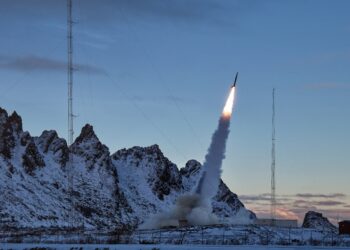
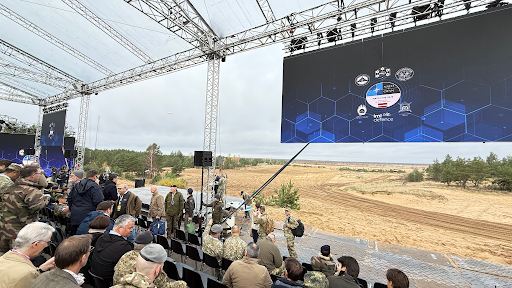
Every 10 seconds, a loud boom goes off. No warning, just a succession of explosions. The first few times I flinch, which is particularly embarrassing as I walk past important-looking people in military fatigues.
I put in the squishy earplugs they handed out moments before. The event is about to start, and I can’t help but think that the booms are the military’s approach to getting people into their seats – like a last-call at an opera house.
We’re in for what they call a “threat-informed operational scenario” – essentially military theatre, where they play out a plausible scenario.
The event starts out with our narrator, Nora, who tells us, “ladies and gentlemen, Article 5 has been invoked 4 hours ago.” We’re briefed on a fictitious scenario, in just the way a head of state would be if there were such a situation. And I’ll be honest – it was quite unsettling.
 I’m at the NATO Digital Backbone Experimentation (DiBaX) in Latvia at the Ādaži military site, sitting in makeshift bleachers with a view across what can only be described as looking like a front line.
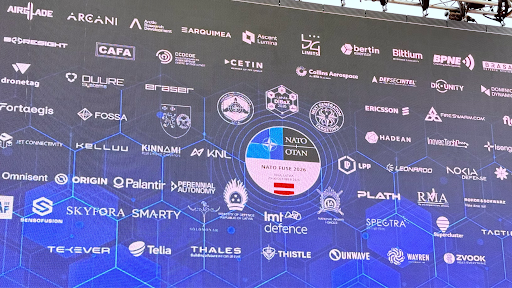
NATO’s Allied Command Transformation (NATO ACT) – 22 allied nations, together with over 60 industry participants – are demonstrating the latest in defense tech, and how it all works together. For the past two weeks, they’ve literally been in the trenches figuring out ways to make disparate technology interoperable.
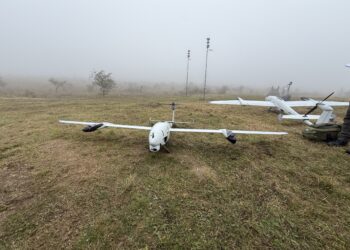
A particular focus is placed on drones, cUAS, layered-UAS, command and control, and connectivity infrastructure.
“We have connected systems that were never designed to communicate with each other using artificial intelligence to overcome interoperability barriers,” said Admiral Pierre Vandier of NATO’s Supreme Allied Commander Transformation (SACT). “It’s the first time that we have, for example, a Maven system that is speaking to a natural system, and that has been fixed in ours with Agentic AI.”
A demonstration of interoperability
The show takes off. We’re walked through various problems. How do you know whose side those drones that are hovering over us are on? How do we quickly gain feedback for engaging an adversary, when all you have is seconds? How do we jam those drones without jamming all of our own spectrum? There’s a process for everything – we see how they detect data, how that data moves, how it becomes part of a shared operational picture, and how that data is ultimately acted on.
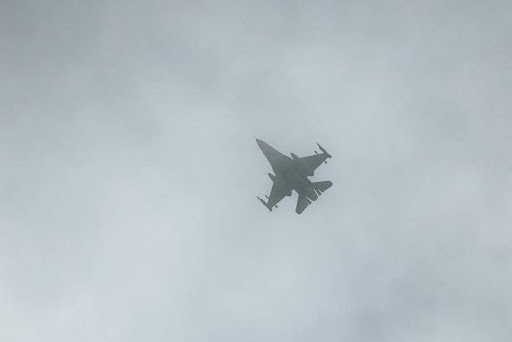 DiBaX demonstrated various innovations in drone management using the 5G network.
Under the NATO LCI-X (layered counter-UAS) initiative, a counter-UAS drone detected and engaged an adversarial drone on the DiBaX network using a 50 caliber system. Meanwhile, the NGT (Next Generation Targeting) initiative demonstrated how they were able to target the adversarial drone launch position itself over the DiBaX network.
The demonstration – with its explosions, shots, and downed shaheds – is undoubtedly impressive. But the critical takeaway is that NATO is becoming accustomed to interoperability.
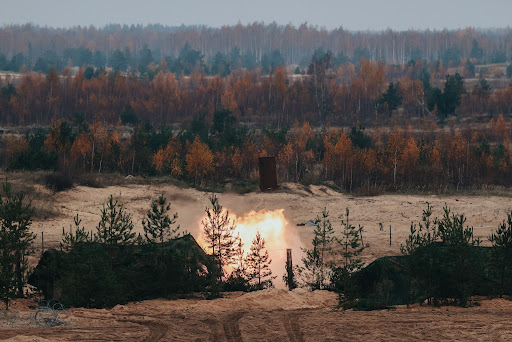 “NATO can’t afford to be locked into one vendor, one vehicle, or one network,” our narrator tells us. And real-world international competitors are working together on one [fictional] battlefield. Nokia, Thales, and LMT work together to provide what the organisers (and a lot of marketeers in defence tech) refer to as the “tactical edge.” Meanwhile, Siemens and Ericsson demonstrate 5G-based object detection at close and long ranges. That’s the objective – to combine services for better decision-making.
Lingering questions
Yet one of the largest challenges remains sharing information in real-time, in part because a variety of legacy systems and platforms are still in use.
Over the two weeks of the experiment, a sprint was underway to enable data pooling using AI agents to connect those platforms and provide a communication channel for faster decision-making. In the DiBaX demonstration, that decision was about engaging a hostile target. This is a big question to outsource to AI agents.
While the experiment made use of a variety of connectivity tools – dual-use 5G, satcom, field radio – the vast majority was built on the basis of a 5G core in the 5G military testbed at the Ādaži military base. However, as recent events in Ukraine have shown us, Starlink connectivity is also critical for battlefield success – or disaster, as the case may be when that connectivity is being throttled.
 Admiral Vandier (pictured, above) believes there are enough options on the table to develop to offset any nation being beholden both to a single communications technology and the whims of a few men.
“There are other solutions; 5G is one of them. Fiber. We have a lot of things to offer,” he said. “We want to experiment and give commanders a full selection, not just to be dependent on one form of connectivity.”
LMT, Latvia’s main mobile carrier, provided the bulk of connectivity infrastructure for the DiBaX experiment. Ingmārs Pūķis, LMT’s vice president, said that he sees satellite as just one of many solutions, for specific uses rather than all uses.
“To defend your own territory, terrestrial connectivity infrastructure is completely sufficient,” he told Resilience Media. He pointed out that satellite connectivity is needed to execute long-range missions, which are more commonly associated with offensive, deepstrike tactics. “Satellite connectivity is an additional tool in your resilience arsenal, for example, if there’s a storm, or your connectivity base has been wiped out.”
An overarching theme of the entire demonstration was how we deal with sub-Article 5 threats, which are also referred to as “grey-zone” tactics.
“We’ve seen intensification of hybrid actions,” he said. The implication is clear: we are not at war, but we are not at peace either.
With the NATO DiBaX event larger than ever this year, it seems allied partners are increasingly waking up to the reality that building up our resilience is critical, and all eyes are on the Eastern Front.