Tuesday 21 April, 2026
[email protected]
Resilience Media
  • About
  • News
  • Resilience Conference
    • Resilience Conference Warsaw 2026
    • Resilience Conference Copenhagen 2026
    • Resilience Conference London 2026
  • Guest Posts
    • Author a Post
  • Subscribe
No Result
View All Result
  • About
  • News
  • Resilience Conference
    • Resilience Conference Warsaw 2026
    • Resilience Conference Copenhagen 2026
    • Resilience Conference London 2026
  • Guest Posts
    • Author a Post
  • Subscribe
No Result
View All Result
Resilience Media
No Result
View All Result

NATO’s NIF Names Erin Hallock Its Newest Partner

NIF's sole female partner comes from bp Ventures and is bringing industrial and climate tech investing into the mix

Ingrid LundenbyIngrid Lunden
November 11, 2025
in News, Venture
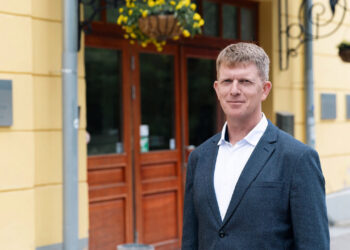
NIF’s newest partner, Erin Hallock

NIF’s newest partner, Erin Hallock

Share on Linkedin

2025 has been a year of change for the NATO Innovation Fund, the €1 billion+ investor that counts 24 NATO countries (minus the US!) as primary LPs. After cycling out all but one of its original investing partners and appointing Dame Fiona Murray as its new chair, today NIF is adding one more name to the mix. Erin Hallock is joining NIF as its newest partner, the sole woman in the current mix alongside existing partners Patrick Schneider-Sikorsky, Ulrich Quay, and Sander Verbrugge.

You Might Also Like

Anduril taps UK’s Kraken to fast-track small USVs into US Navy hybrid fleet push

Countering Iran’s UAS swarms ‘requires compressing the kill chain’

NCSC sounds resilience warning as cyberattacks threaten real-world disruption

Hallock is joining after several years with bp Ventures, the corporate investment arm of the energy giant. She’ll be bringing some of that immediate experience to the role at NIF. A big focus, she said in an interview with Resilience Media, will be on startups enabling industrial development and deep tech plays that are related to that.

bp, she said, backed startups in a few different areas strategic to the company’s interests. Most of the startups in the current portfolio work on concepts to enable what she describes as “energy transition”, including technologies to offset the ecological impact of the more traditional energy production and usage that forms the vast majority of bp’s business.

Other startups in the portfolio fall into the more general category of tech, but in ways that that are adjacent to bp’s direct interests. Those include fleet management startups and the autonomous driving startup Oxa (formerly known as Oxbotica).

There is a significant overlap between what Hallock looked at at bp and the focus of NIF, not least because a lot of what was called “climate tech” yesterday might today be described as energy transition (Hallock’s term), with the overall category often referred to more generally as “resilience tech.”

That’s not a rebrand for the sake of it, in Hallock’s view; it’s a reflection of how the world is changing geopolitically and economically.

“You’ve seen a lot of climate tech funds rebrand as resilience funds, or broadening their investment scope to look at resilience,” she said in the interview. “But the reality is that the threats that we face, the boundaries of warfare, are very different from what we learned and read about in textbooks in school [years back]. It’s very much about our infrastructure. It’s about our digital assets.”

That means a stronger emphasis on startups building technology to improve industrial processes, which are not only important for critical industries but for making the hardware that the new generation of defence tech companies (also backed by NIF) are aiming to produce.

That is very much part of the reasoning behind her appointment, it seems.

“We are thrilled to welcome Erin to the partnership,” said Murray in a statement. “Her track record in deep tech investing, combined with her operational acumen, will help the innovators we are backing move beyond proof-of-concept to industrial-scale deployment. This is necessary to close the innovation-to-adoption gap and deliver technologies that strengthen the Alliance’s technological edge.”

It will be worth watching whether more of these firms start to appear in NIF’s portfolio.

Her appointment is interesting also for its timing. The UN’s Climate Change Conference is underway in Brazil this week, notably without the attendance of major powers like the US, China, Russia and Japan. That could undermine any resolutions that come out of it. And that is not the only tremor threatening the strength of climate commitments: Europe has started walking back some of the initial targets it proposed in its Climate Law for net zero emissions, while China has, ironically, emerged as a potential purveyor of cheap green tech.

Putting all this together, there is an opportunity for forward-thinking “resilience tech” funds like NIF to back innovative, related opportunities within the NATO alliance, just at a time when it feels like those efforts might need the most help.

A bolder look at resilience, Hallock noted, has to include more deep tech. This is already a big priority for NIF, so what this could mean is looking for deep tech opportunities in industrial and critical industry capacities.

Indeed, for investors and founders, deep tech has come to mean not simply innovation without a specific commercial end point in site, but primarily technology where commercial applications have been identified, even if the tech has yet to be completely figured out (quantum computing is a prime example of that).

“Deep tech addresses some of our biggest challenges,” she said.

Another key part of Hallock’s experience that she is bringing to NIF is that she has invested “in probably every stage of private capital except infrastructure,” she said.

That has included, she said, “buyouts, distressed asset finance, and every stage of tech investing from seed to late-stage.” (Prior to bp, she also held roles at BGF and Barclays Bank.)

Today NIF has largely focused on earlier stages and backing other investment funds, but as Schneider-Sikorsky hinted in an interview with Resilience Media in August, we could see an expansion of which stages it backs in the future, not least because NIF may well soon raise beyond the €1 billion it announced at launch in 2023.

That could give a new partner with a new and resource-intensive focus a lot of runway.

Tags: Erin HallockNATO Innovation FundNIF
Previous Post

Resilience Conference 2025: The Hidden Front Line of Defence

Next Post

Stratis secures seed funding to scale real-time defence intelligence platform

Ingrid Lunden

Ingrid Lunden

Ingrid is an editor and writer. Born in Moscow, brought up in the U.S. and now based out of London, from February 2012 to May 2025, she worked at leading technology publication TechCrunch, initially as a writer and eventually as one of TechCrunch’s managing editors, leading the company’s international editorial operation and working as part of TechCrunch’s senior leadership team. She speaks Russian, French and Spanish and takes a keen interest in the intersection of technology with geopolitics.

Related News

Anduril taps UK’s Kraken to fast-track small USVs into US Navy hybrid fleet push

Anduril taps UK’s Kraken to fast-track small USVs into US Navy hybrid fleet push

byCarly Page
April 21, 2026

Anduril Industries has teamed up with Kraken Technology Group to deepen its involvement in the US Navy’s plans for a...

birds on sky

Countering Iran’s UAS swarms ‘requires compressing the kill chain’

byTom Pashby
April 21, 2026

Since the start of the US and Israeli-led war against Iran on 28 February 2026, Iran has been retaliating against...

black and gray laptop computer turned on

NCSC sounds resilience warning as cyberattacks threaten real-world disruption

byCarly Page
April 20, 2026

The UK’s cyber defence arm has warned that organisations must be ready to operate through attacks that go beyond data...

Ukrainian Armor and The Fourth Law collaborate on a new EW-resistant drone

Ukrainian Armor and The Fourth Law collaborate on a new EW-resistant drone

byLuke Smith
April 17, 2026

Two up-and-coming Ukrainian defence startups have collaborated to develop a UAS model that they claim is 2-4 times more effective...

waving flag

ETSI pushes back on EU plan to freeze out ‘high-risk’ players from standards work

byCarly Page
April 16, 2026

Europe's telecoms standards body has fired an early warning shot at Brussels’ next cybersecurity overhaul, arguing that plans to shut...

Klaus Hommels of Lakestar talks about defence consolidation and the future of procurement

Klaus Hommels of Lakestar talks about defence consolidation and the future of procurement

byJohn Biggs
April 15, 2026

Investor and entrepreneur Klaus Hommels, founder of Lakestar, sees a new era of European defence spending and investment. His comment?...

To infinity and back: the opportunity for reusable hardware in space

To infinity and back: the opportunity for reusable hardware in space

byResilience Media
April 15, 2026

Germany's Atmos Space Cargo is opening an office in Poland focused on defence capabilities, announced CEO Sebastian Klaus during a...

Danish startup Sapient Perception raises €2M to widen UAV vision for real-time battlefield decisions

Danish startup Sapient Perception raises €2M to widen UAV vision for real-time battlefield decisions

byCarly Page
April 15, 2026

A Danish startup promising to give drones a much wider field of view without sacrificing detail has raised €2 million...

Load More
Next Post
Stratis secures seed funding to scale real-time defence intelligence platform

Stratis secures seed funding to scale real-time defence intelligence platform

With Incursions In the Air, Political Turmoil on the Ground, Lithuania Names a New Defence Minister

Most viewed

InVeris announces fats Drone, an integrated, multi-party drone flight simulator

Uforce raises $50M at a $1B+ valuation to build defence tech for Ukraine

Auterion, the drone software startup, eyes raising $200M at a $1.2B+ valuation

Senai exits stealth to help governments harness online video intelligence

Palantir and Ukraine’s Brave1 have built a new AI “Dataroom”

Twentyfour Industries emerges from stealth with $11.8M for mass-produced drones

Resilience Media is an independent publication covering the future of defence, security, and resilience. Our reporting focuses on emerging technologies, strategic threats, and the growing role of startups and investors in the defence of democracy.

  • About
  • News
  • Resilence Conference
    • Resilience Conference Copenhagen 2026
    • Resilience Conference Warsaw 2026
    • Resilience Conference 2026
  • Guest Posts
  • Subscribe
  • Privacy Policy
  • Terms & Conditions

© 2026 Resilience Media

No Result
View All Result
  • About
  • News
  • Resilence Conference
    • Resilience Conference Copenhagen 2026
    • Resilience Conference Warsaw 2026
    • Resilience Conference 2026
  • Guest Posts
  • Subscribe
  • Privacy Policy
  • Terms & Conditions

© 2026 Resilience Media

This website uses cookies. By continuing to use this website you are giving consent to cookies being used. Visit our Privacy and Cookie Policy.