
Lithuania is living in interesting times on the defence front.
With Lithuanian airspace facing a growing number of incursions from Russia-aligned Belarus and the war in Ukraine showing little sign of slowing down, Lithuania’s government announced in October that it wanted to double defence spending to 5.3% of GDP, reaching approximately €4.79 billion.
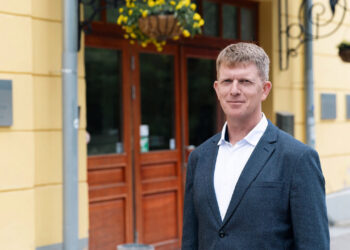
Yet who will lead that strategy is only now being figured out. Inga Ruginienė, the freshly appointed Prime Minister of the country, has only been in power since the end of September, when she rode to the top on a wave of no-confidence in the previous government. And it was just on Monday of this week that she named a new Minister of Defence, Robertas Kaunas.
Kaunas will be expected to execute on the bigger defence budget while also weathering a charged domestic political climate.
Ministerial musical chairs
Kaunas is arriving on the heels of a lot of drama in Lithuania’s MoD itself. The country’s previous Minister for Defence, Dovilė Šakalienė, a hawk, reportedly expressed doubt that the PM would follow through with the proposed 5.3% hike, and thought it was too small a figure regardless. The relationship between the two quickly unravelled, and she stepped down less than a week after the new defence budget proposal was announced.
That’s not to say Kaunas is going to be welcomed with open arms. He became a member of parliament only in 2024, and some have been publicly questioning whether he has enough experience for the job.
“It is true that the public sphere doubts R. Kaunas’ competence to lead the Ministry of Defence,” Auguste Lyberyte wrote in Delfi.lt. “The parliamentarian has no experience in the field of defence, and has been working on the Seimas National Security and Defense Committee (NSDK) for a little more than a month.”
He’s not the only one. The previous Culture Minister, Ignotas Adomavičius, was also criticized for his lack of experience. His credentials included being the co-owner of a pasta company, “Bravo Pasta,” as well as being a friend of the populist party’s chairman.
The overall concern over experience has led to mass protests, although some in Lithuania dispute the scrutiny new Ministers’ are receiving. After Kaunas’ meeting with the President to discuss his appointment, presidential adviser Deividas Matulionis spoke to the media.
“Ministers are nominated according to internal party agreements,” he said. “It is important that the person be patriotic, a team player, and aware of external threats. Many governments have had ministers without extensive experience, it can be learned.” Matulionis also noted that Kaunas had left a good impression in his talks with the President.
Defence requirements persist, projects move forward
Despite the drama, major military infrastructure projects are moving forward. Rheinmetall broke ground on a $346 million ammunition factory in Baisogala, a small town in the centre of Lithuania.
And Lithuania is building a major new military base for the German Military Brigade near the Belarus border, essentially equivalent to a new town in size.
The German Military Brigade, which is the first permanent troop deployment Germany has approved since World War II, is aimed at strengthening NATO’s borders and reaction time. It will need to house 5,000 individuals – military personnel and their families.
It has been estimated that the project will cost around €800 million, and it will require constructing the base from the ground up – including 120 buildings, helipads, training fields, marshalling areas and more than 10 km of internal roads. Lithuania has already secured a €540 million loan from the European Investment Bank to offset the costs.
And Belarus remains a looming issue. The leadership shake-up comes at a time when Lithuania’s airspace is being challenged on a regular basis by hydrometeorological balloons launched from Belarus. Currently, these are carrying contraband cigarettes.
Many believe that is not the end of the story, though.
“Today they are carrying cigarettes, but with a maximum payload weight of 50 kg, in the future who knows what they can carry,” said investor and advisor Rokas Tamošiūnas. He added that by tying balloons together, it’s possible to increase payload capacity up to 150 kg.
The Vilnius airport has experienced extensive closures and rerouted flights in recent weeks, with six disruptions in October alone. The problem is so extensive that the Economy and Innovation Ministry has issued a call for proposals for businesses to think up solutions to the airspace disruptions, with €1M on the table for the business that figures out a solution. Three shortlisted ideas will be allocated €300,000 each to quickly prototype and test their innovations in a real environment.
The incursions on airspace prompted the full closure of the border with Belarus by the Prime Minister, resulting in thousands of Lithuanian delivery trucks stranded in Belarus, thereby kicking off the next diplomatic conundrum to solve. The stranded trucks are being moved to a specially designated parking lot, and Belarusian president Alexander Lukašenjko has announced a daily €120 fine for each truck.
Lithuania remains focused on defence
Lithuania occupies a meaningful geographical position. To its east is the border with Belarus, to the west is the border with Russia’s Kaliningrad. What connects Lithuania to Poland to the south (and subsequently the rest of continental Europe) is the Suwalki corridor, a border of just over 100 km in length. The narrow corridor with Russian-controlled territories on either side makes it a strategically important area, and also highly sensitive.
Lithuania is well aware of the challenges it faces, as well as the importance of defence, as proven by the unified stance on a drastically increased defence budget. The new minister will face a long, and possibly growing, list of challenges as he steps into office.