Friday 1 May, 2026
[email protected]
Resilience Media
  • About
  • News
  • Resilience Conference
    • Resilience Conference Warsaw 2026
    • Resilience Conference Copenhagen 2026
    • Resilience Conference London 2026
  • Guest Posts
    • Author a Post
  • Subscribe
No Result
View All Result
  • About
  • News
  • Resilience Conference
    • Resilience Conference Warsaw 2026
    • Resilience Conference Copenhagen 2026
    • Resilience Conference London 2026
  • Guest Posts
    • Author a Post
  • Subscribe
No Result
View All Result
Resilience Media
No Result
View All Result

Resilience Conference 2025: The Hidden Front Line of Defence

John BiggsbyJohn Biggs
November 10, 2025
in Resilience Conference
Share on Linkedin

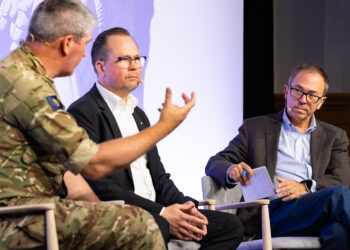
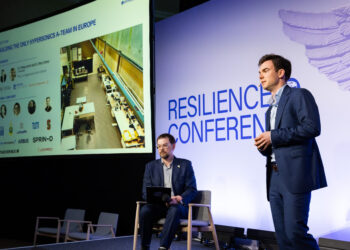
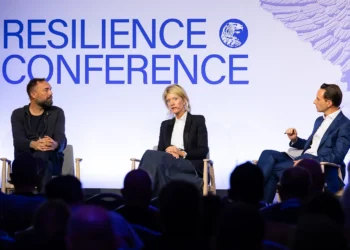
“Supply chains win wars. It’s not hyperbole. It’s just history,” said Resilience’s Matt Burns during the introduction to his Resilience Conference 2025 panel on supply chains. “It’s an uncomfortable truth that Europe must face right now.”

You Might Also Like

Jacek Siewiera: a future NATO conflict will be fought against civilian targets

Sten Tamkivi: Poland’s defence start-ups should be seen as future GDP drivers

Where are Poland’s defence unicorns?

“Is Europe and NATO’s supply base resilient enough to withstand a large-scale conflict?” he asked Robin Dechant, partner at General Catalyst and Julian Senoner, CEO at Ethon.ai. These panelist are uniquely situated to answer this loaded question.

“The level of urgency probably was never higher than right now,” said Dechant. “I think if you think about the whole industrial base in Europe, it has been really strong in some of the industries where Europe has [historically] been strong like automotive, but I think in some of the emerging industries, we’re definitely falling behind.”

“Sometimes things are so urgent, you can’t wait,” he said. “But I do think what’s important now that we strategically think about like what should we actually bring back to Europe and manufacture here and I think the only way to actually bring the manufacturing is by automation.”

From the factory floor, the constraint is people, not code. Senoner believes that the answer is AI, even in manufacturing.

“The first industrial revolution with the steam engine, second one with electricity and the third one with computerization of factories,” he said. “And I think we are now on the brink where we will see mass adoption of AI in factories to streamline operations and to help manufacturers be more effective and efficient. And, interestingly, that’s mostly a people problem and not a technology problem.”

On what works, the panelists drew a line between “point improvements and system improvements.” Point fixes include a computer vision system that automates visual checks or predictive maintenance, but the real gains come when you aggregate data from different sources and then you run AI on top of that across the manufacturing stream.

“One of our largest customers is Lindt, the chocolate producer. And whenever they produce chocolate, at some point the quality might deteriorate. So chocolate might break, it might stick. And that costs a lot of money over many, many production lines. So what we do is essentially we look into all this data and we use these causal graphs to investigate how these parameters relate to each other and we can give recommendations automatically,” Senorer said, taking an example from another industry his company is in involved in. “This way customers typically save millions across their factories, but also, and for the topic of resilience,make it worthwhile producing in Europe or the US, where it’s much more expensive to produce and where you need to be efficient and effective when producing.”

The investment view follows the same line. Reshoring only works if costs fall, so back automation and full stack companies that can own their supply and become key vendors. Capital must fit the job.

Founders are advancing despite headwinds. Senenor declined an early acquisition for a previous company, formed a new company in manufacturing, and secured Siemens as the first customer. The model scaled in measured steps. The practical lesson from his work is to build where the pain is acute and the buyer is close.

Talent is returning as well. Engineers with time at SpaceX and Tesla are coming back to Europe to build firms and teams, the panel said. This movement raises the floor on process discipline and leadership. Investors are responding to clear problem statements, credible plans, and early proof on real lines.

The conclusion is clear: Europe will not compete on price, but it must compete on skill, scale, and speed. Time is tight, said the panelists, and action taken now will compound in the form of better and strong supply chains in Europe.

Tags: EthonAIGeneral CatalystJulian SenonerRobin Dechant
Previous Post

Iran-Linked Hackers Claim Israeli Defence Breach and Leak Alleged Redback Vehicle Blueprints

Next Post

NATO’s NIF Names Erin Hallock Its Newest Partner

John Biggs

John Biggs

John Biggs is an entrepreneur, consultant, writer, and maker. He spent fifteen years as an editor for Gizmodo, CrunchGear, and TechCrunch and has a deep background in hardware startups, 3D printing, and blockchain. His work has also appeared in Men’s Health, Wired, and the New York Times. He has written nine books including the best book on blogging, Bloggers Boot Camp, and a book about the most expensive timepiece ever made, Marie Antoinette’s Watch. He lives in Brooklyn, New York. He runs the Keep Going podcast, a podcast about failure. His goal is to share how even the most confident and successful people had to face adversity.

Related News

Jacek Siewiera: a future NATO conflict will be fought against civilian targets

Jacek Siewiera: a future NATO conflict will be fought against civilian targets

byResilience Media
April 24, 2026

The wars in Iran and Ukraine have underscored how civilian infrastructure will become a feature of future conflicts. And Poland’s...

Sten Tamkivi: Poland’s defence start-ups should be seen as future GDP drivers

Sten Tamkivi: Poland’s defence start-ups should be seen as future GDP drivers

byResilience Media
April 24, 2026

Sten Tamkivi, a partner at Plural and an early Skype executive, joined Resilience Media publisher Leslie Hitchcock on stage during...

Where are Poland’s defence unicorns?

Where are Poland’s defence unicorns?

byResilience Media
April 24, 2026

"Where are the Polish unicorns in defence?" asked Marcin Hejka, managing partner at OTB Ventures, one of Poland's largest deep-tech...

Klaus Hommels of Lakestar talks about defence consolidation and the future of procurement

Klaus Hommels of Lakestar talks about defence consolidation and the future of procurement

byJohn Biggs
April 15, 2026

Investor and entrepreneur Klaus Hommels, founder of Lakestar, sees a new era of European defence spending and investment. His comment?...

Serhii Kupriienko to speak at Resilience Conference Warsaw

Karl Rosander (Nordic Air Defence) and Maciej Klimczak (Tantalit) to speak at Resilience Conference Warsaw

byLeslie Hitchcock
April 9, 2026

Resilience Conference Warsaw takes place on April 15 for a gathering of the defence tech ecosystem in Poland. The event...

Weekly Digest: Battlefield to Nasdaq – Inside Swarmer’s public listing; CEO Serhii Kupriienko to speak at Resilience Conference Warsaw

Weekly Digest: Battlefield to Nasdaq – Inside Swarmer’s public listing; CEO Serhii Kupriienko to speak at Resilience Conference Warsaw

byLeslie Hitchcock
March 26, 2026

This is a copy of our Weekly Digest newsletter. Subscribe for free here to receive this newsletter in your inbox. ...

Serhii Kupriienko to speak at Resilience Conference Warsaw

Serhii Kupriienko to speak at Resilience Conference Warsaw

byLeslie Hitchcock
March 26, 2026

Resilience Conference Warsaw is fast approaching on April 15. The one-day event will convene the defence tech ecosystem in Poland...

Announcing the Resilience Conference Warsaw Agenda

byLeslie Hitchcockand1 others
March 19, 2026

We are excited to announce the agenda for Resilience Conference Warsaw, 15 April 2026. This is the first conference of...

Load More
Next Post
NATO’s NIF Names Erin Hallock Its Newest Partner

NATO's NIF Names Erin Hallock Its Newest Partner

Stratis secures seed funding to scale real-time defence intelligence platform

Stratis secures seed funding to scale real-time defence intelligence platform

Most viewed

InVeris announces fats Drone, an integrated, multi-party drone flight simulator

Uforce raises $50M at a $1B+ valuation to build defence tech for Ukraine

Auterion, the drone software startup, eyes raising $200M at a $1.2B+ valuation

Senai exits stealth to help governments harness online video intelligence

Palantir and Ukraine’s Brave1 have built a new AI “Dataroom”

Twentyfour Industries emerges from stealth with $11.8M for mass-produced drones

Resilience Media is an independent publication covering the future of defence, security, and resilience. Our reporting focuses on emerging technologies, strategic threats, and the growing role of startups and investors in the defence of democracy.

  • About
  • News
  • Resilence Conference
    • Resilience Conference Copenhagen 2026
    • Resilience Conference Warsaw 2026
    • Resilience Conference 2026
  • Guest Posts
  • Subscribe
  • Privacy Policy
  • Terms & Conditions

© 2026 Resilience Media

No Result
View All Result
  • Home
  • Subscribe
  • About
  • Events
  • Guest Posts
  • Interview
  • News
  • Resilience Conference London 2026
  • Resilience Conference Copenhagen 2026
  • Resilience Conference Warsaw 2026
  • Startups
  • Venture
  • Weekly Digest

© 2026 Resilience Media

This website uses cookies. By continuing to use this website you are giving consent to cookies being used. Visit our Privacy and Cookie Policy.