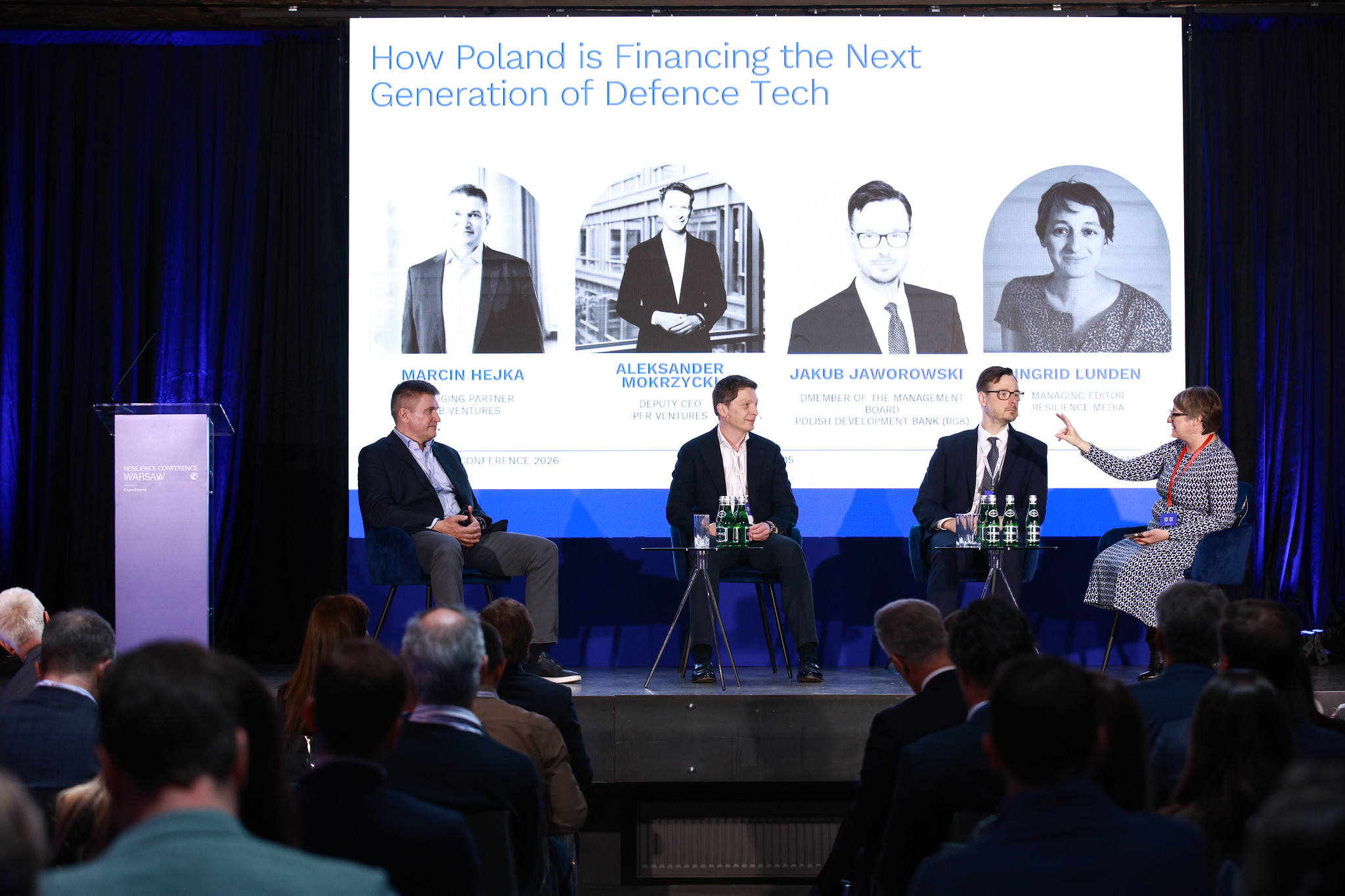
“Where are the Polish unicorns in defence?” asked Marcin Hejka, managing partner at OTB Ventures, one of Poland’s largest deep-tech venture capital funds, during a conversation with managers of Polish development institutions at the Resilience Conference in Warsaw.
Hejka expressed frustration that, despite having defence budgets roughly comparable to those of Turkey and Ukraine, Poland has been unable to replicate their domestic defence capabilities, let alone export them abroad.
At 4.7%, Poland is currently NATO’s largest defence spender relative to GDP. However, the country’s domestic defence industry is dwarfed by those of its European partners, and few private Polish innovators have achieved international relevance.
According to Hejka, creating “a vibrant start-up ecosystem consisting of multiple unicorns” would not only strengthen Poland’s security but also serve as both a growth driver and a political asset.
But it’s also not that simple. Hejka added that these days, it is difficult to survive as a defence start-up in Poland due to “incredibly lengthy procurement cycles” and insufficient institutional support from the state.
“If you’re a Polish defence start-up and the military is your first customer, you’re likely going to fail,” he concluded grimly.
Despite this, overall hopes remain high for the future. Hejka described Poland’s current position as “a massive opportunity we have to unleash,” adding that if the country reforms by shortening procurement cycles for start-ups to under 12 months and introducing pilot projects with real budgets, its ecosystem could soon deliver results.
Poland’s Ministry of Defence has been working to simplify procurement for private innovators. Last September, Minister Władysław Kosiniak-Kamysz signed off on a resolution establishing military testbeds for producers, including a clause to fast-track procurement if a product meets “urgent operational needs.” However, the program applies only to UAS and C-UAS.
Beyond this, there are signs of more support coming. Poland’s Ministry of Defence and PFR Ventures, a national ‘fund of funds’, announced at the Resilience Conference the creation of a “Defence Innovation Committee” aimed at strengthening links between defence producers and the armed forces.
However, it remains unclear how this cooperation will function or when the committee will begin operations.
While Hejka noted that financing remains a challenge, Jakub Jaworowski from the Polish Development Bank, also speaking on stage, highlighted several state initiatives designed to stimulate defence tech.
These include securing EU approval to allocate €5 billion from the Recovery and Resilience Facility to dual-use investments. According to Rozalia Urbanek from PFR Ventures, Poland, along with Estonia, were the two first European countries to establish a ‘fund of funds’ facility that authorises defence investment.