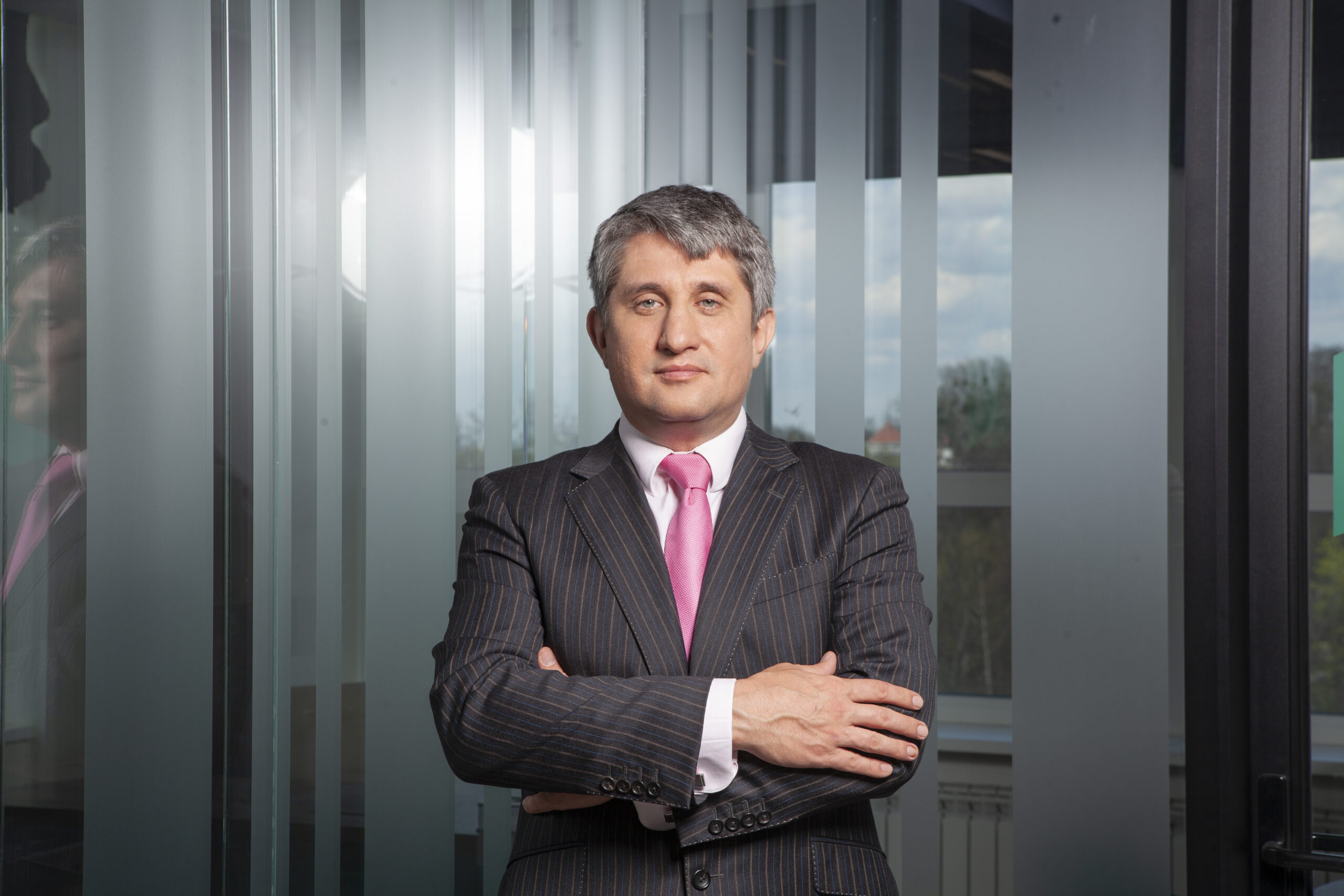
After an investor demo day in early 2022, Roman Sulzhyk, head of investment at early-stage venture capital firm Resist.UA, found himself staring at a vat of solid rocket fuel brewing in a garage in a Kyiv suburb.
The tech was impressive, and so was the team — a handful of programmers and chemists, one of whom had been, in her own words, “about to go work at McDonald’s” before getting picked up by the startup.
These brilliant “kids” (as Sulzhyk calls them) had discovered that reducing the size of certain chemical components from 50 nanometers to 30 made the fuel polymerise far more efficiently.
“If we agree on the valuation,” Sulzhyk told the team, “you’ll have the money in your account within the week. We’ll shake hands today, and deal with the paperwork later.”
According to Sulzhyk, Western funds in Ukraine exist within a spectrum of risk tolerance, ranging from “crazy” risk tolerant to risk neutral. The most successful founders pitching to these Western investors typically are those who already have a track record. They not only know how to build a pitch deck and how to work with investors; they have built startups before.
But, as Sulzhyk told Resilience Media in an interview this month in Kyiv, in defence tech in Ukraine, there’s a “huge layer” underneath that one, a strata of first-time founders who might want to work with investors and could benefit from the contact beyond funding, but they don’t know how.
The experience that these founders come to the process with is limited, to say the least. They may not know what a minority investor is. They may not even speak English, which makes working with international partners a challenge.
Sulzhyk sees his role as making investors and the innovators readable to each other.
“I’m getting to those guys through word of mouth,” he said. They’re really excited, he adds. “They say, ‘Roman from Resist is very easy — you can talk to him, he can help you get to the next stage.’ That’s where we’re able to penetrate, where maybe others can’t.”
Winning the Peace
Before the Russian invasion, Sulzhyk would have never anticipated that Ukraine would receive the degree of international interest that it has for defence startups. Before 2022, he worked in banking, including time as a trader at JP Morgan (which he said still uses a grid computing system Sulzhyk developed and patented) and Deutsche Bank. When the war broke out, he was a board member at Privatbank, where he organised the migration of all the bank’s data to Europe to protect it.
Then, like many other civilians in Ukraine, he said he started asking himself the perennial question in relation to the country and its fight against Russia: “What is the most impact I can make?”
The answer, he decided, was to build the kind of institution that didn’t yet exist in Ukraine: a fund that would back the country’s emerging defence-tech founders early, on terms most Western investors wouldn’t touch, with the added context of a long-term view: what will Ukrainian industry look like twenty years from now, and who will be running it?
Resist.UA made 7 investments from its first fund, with $10 million in assets under management, he said. It’s now raising €50 million for its second fund and has already made two investments from it, follow-on rounds for companies in the first fund, with some of the money going through an SPV, he added. The firm doesn’t disclose all of the companies in its portfolio, but two that have been made public are M-Fly and Farsight Vision, one of the biggest defence tech companies to emerge out of the war.
Sulzhyk has had a front-row seat to the massive uptick in interest in Ukrainian military technology.
At Brave1’s first investor demo day in 2022 (when it was still called “Army of Drones”) he recalled that there were only five companies presenting and just three investors in the room: “I was one of them.”
As a mark of how much things have changed, at the demo day Sulzhyk most recently attended, there were sixty investors but still just ten companies. Most of the investors were from outside the country.
People, Not Products
Sulzhyk said his investment philosophy comes down to picking the right people. This means focusing on spaces where talented founders can make an impact.
“There are like a thousand companies doing FPV drones,” he noted. “It’s impossible to pick the one that will become a billion-dollar company. I don’t play that game.”
Rather, Resist.UA focuses on enablers and components: gimbals, rocket fuel, and areas with higher barriers to entry than FPVs. Rapid feedback loops between Resist.UA and military on the ground give the firm direct visibility into which pieces of kit are performing well, and where the gaps are.
“It’s not necessarily big inventions they’re going to milk as a patent for the next 20 years,” he said. “We’re looking at … the capability to quickly adapt, innovate … I think that’s ultimately where the value is.”
A lot of investors talk about backing people – the logic being that talent will rise to the top in the rough and tumble world of trying to build a successful startup in the precarious world of technology. Sulzhyk leans into this, too, but there is more to his focus on founders that is even more foundational. Bringing the big picture, long-term view into focus, Sulzhyk believes defence-tech entrepreneurs will be a huge influence in post-war Ukrainian society, so investments need to follow from that premise, too.
“Do I want this kid to have a 100-million-dollar company? Do I want my son working for that guy in 20 years? That’s my main investment thesis,” he said. “Obviously the technology matters, but the quality of the teams is the main thing we look at.”
Initially after the fall of the Soviet Union, the Ukrainian economy and government – similar to other ex-Soviet countries – saw the rise of entrepreneurs who made the jump from running industries as part of the Soviet apparatus, to running those same industries as a new class of oligarchs. Sulzhyk’s bet is that the current generation of founders may finally replace that post-Soviet oligarch class for good.
But with that comes another huge challenge: rebuilding while improving on what has been lost. With the war now in its fifth year, damage is growing by the day, and UN estimates, published on the anniversary of the full-scale invasion in February, now put the reconstruction cost at $588 billion (approaching double what the World Bank estimated in 2022). The European Investment Bank said in 2022 that the reconstruction costs could be as high as $1 trillion, a figure it might well revise now.
This means that rebuilding the country, and industries like defence tech within it, will require giant sums of money.
Sulzhyk believes that “at least” $100 billion over five years would be “huge” and represent a promise for the future. However, if foreign private investment is closer to $10-20 billion, it will convey very different optics, that “Ukraine is uninvestable,” he said.
A look at actual monies going into the country put those figures into context and perhaps how far the country is from achieving the “huge” he and others are hoping for. Investment from the government-backed ERBD into Ukraine has been growing every year and in 2025 was €2.9 billion ($3.4 billion). The UK estimated that in 2024 (it doesn’t have 2025 figures) it put $1 billion of foreign direct investment into Ukraine. The EIB is raising at least €100 billion for reconstruction, it said in 2024.
This paper from the Stockholm School of Economics lays out some of the challenges that Ukraine has faced up to now in expanding its FDI, which will also need to be addressed.
The SPAC window of opportunity
Some funding specifically for defence tech, meanwhile, is coming in other forms. In March 2026, Ukrainian drone autonomy company Swarmer listed by way of a SPAC on the Nasdaq Global Exchange in the United States. The first-ever public listing for a Ukrainian defence company saw the startup’s share price pop, and at the time of publication, Swarmer is trading with a market cap of around $530 million. People will be watching to see how this develops, given the company is still young, unprofitable, and currently dependent on business from essentially one customer.
Focusing on the positive takeaways, Sulzhyk believes that Swarmer’s IPO performance speaks to pent-up demand from investors wanting to invest in more Ukrainian military technology.
“Before the IPO, there was no liquid instrument that you could actually trade to get exposure to Ukrainian military technology,” he said. “Swarmer is the first one to give that exposure. It’s the first drop of water in an oasis.”
Senior Ukrainian executives in the space are now getting multiple SPAC approaches a week, he said. SPACs are run by special purpose acquisition entities (blank check companies) specifically to list companies that might otherwise not be considered financially or organisationally ready to go public. This presents more risk, but also more opportunity, and some public market investors seem okay with that.
And so is Sulzhyk. “If [startups] use these opportunities to get access to this capital, I know they’ll use it wisely,” he said. He predicts “a slew” of Ukrainian defence tech IPOs before the end of 2026 – “at least five.”
He acknowledges that there are downsides too around the hype. As we’ve seen with SPACs in technology before, not all startups who list may be legit or ready for prime time, and less-principled investors will exploit the current interest. He also knows that the hype will eventually die down, so this is why he thinks that good startups that can use the money might be wise to act.
“It would be stupid not to use the window,” he said. “It’s the first time in 30 years one has opened up — [and] some people are going to walk through who are less scrupulous.”
In five years, Sulzhyk’s hope is that Resist.UA will be mentioned alongside Horizon Capital and Dragon Capital, the two firms currently synonymous with serious early-stage investment in Ukraine. But for Sulzhyk, this isn’t just investment to make money. It’s an investment in Ukraine’s survival and its future.
“We’re empowering the future captains of industry of Ukraine,” he said. “If I can help bring a few of those billions into the country, then my life will have been worthwhile.”