Monday 8 June, 2026
[email protected]
Resilience Media
  • News
    • Events
    • Interview
    • Startups
    • Venture
    • Weekly Digest
  • Resilience Conference
    • Resilience Conference Warsaw 2026
    • Resilience Conference Copenhagen 2026
    • Resilience Conference London 2026
  • About
  • Guest Posts
    • Author a Post
  • Subscribe
No Result
View All Result
  • News
    • Events
    • Interview
    • Startups
    • Venture
    • Weekly Digest
  • Resilience Conference
    • Resilience Conference Warsaw 2026
    • Resilience Conference Copenhagen 2026
    • Resilience Conference London 2026
  • About
  • Guest Posts
    • Author a Post
  • Subscribe
No Result
View All Result
Resilience Media
No Result
View All Result

Tiberius says it’s successfully tested Sceptre munitions that behave like more costly missiles

The projectiles have an altitude of 65k feet and range of 150m -- all shot from a basic 155mm howitzer

Ingrid LundenbyIngrid Lunden
April 22, 2026
in News
Share on Linkedin

One of the big themes running through recent conflicts in Ukraine and the Middle East has been how older, expensive “exquisite” weapons are being counteracted by a wave of new defence tech that is faster, cheaper and more advanced with autonomy and other capabilities. Today comes the latest instalment in that story, one that helps NATO-allied forces — already heavy with legacy equipment — update in a more cost-effective way. 

You Might Also Like

Ofcom examines whether telecoms security rules are slowing adoption of AI cyber defences

Middle powers in the age of Anthropic’s Mythos

Swiss startup Custodia launches offline AI appliance for sensitive workloads

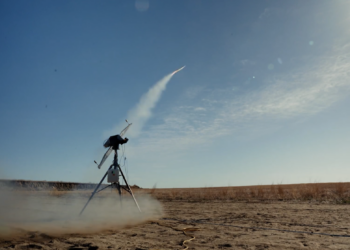
Tiberius Aerospace said that it has completed the first successful demonstration of a new projectile that can be launched from standard howitzers but perform on part with more costly missile systems. 

Tiberius — a UK and US startup — said that the projectile was launched as part of the tests it’s carrying out of its flagship Sceptre liquid munitions. The “liquid-fuelled ramjet projectile” gets launched from a 155mm howitzer but works like a precision-guided munition. 

Tiberius said that the testing that was recently completed in New Mexico, in the US, saw the projectiles reach ranges of up to 150 kilometres. (This is roughly the distance, for example, between London and Calais, or between the Ukraine border and Kursk or Belgorod in Russia.) The plan is to continue testing to increase the range further.

The projectiles are capable of travelling at speeds of around Mach 3.5 and going up to altitudes of 65,000 feet, making the projectiles capable of bypassing common jamming and other electronic warfare interference. The projectiles can support payloads of up to 5.2 kilograms and they have demonstrated circular error probability of less than 5 metres, the company added. 

Most importantly, the munitions can be manufactured in existing factories, reducing the capital expenditure and operating costs needed to get into production. 

Previous to founding Tiberius, its co-founders, CEO Chad Steelberg and CSO Andy Baynes, cut their teeth in diverse, non-military businesses like Google and Apple, working in fields as diverse as consumer electronics, AI and voice technology.

The turn to defence came at a time when many technologists have watched events unfolding in Ukraine and considered how they could bring their own skills to bear to help. Customers, missions and sales cycles are all new territory, but what stays the same is the win of meeting an important milestone in the building of complicated, groundbreaking systems.

“This is a genuine world first breakthrough,” Steelberg said in a statement. “These tests prove not only the technology, but a new way of delivering capability at pace, at scale and at significantly lower cost. Having successfully proved our design and engineering methodologies, we now need to move to much larger ranges to deliver the next phase of testing, validation and certification.  Sceptre is an ambitious and complex project, but these successful US test firing results prove we are quickly advancing along the right trajectory.”

It’s not clear how a lot of the startup’s R&D is being funded. PitchBook notes it has only raised $4.5 million to date. (Our guess is that there could be more activity going on there that is not being disclosed.)

Tiberius said the Sceptre system’s “modular, open architecture” makes it easier to upgrade, and it works on common fuels, including diesel variants JP-4 and JP-8. It noted that development of the equipment can be managed through Grail, the company’s operating system that it launched last year to help plan and develop more efficient manufacturing plans for next-generation equipment. Grail was in the spotlight also earlier this month, when Tiberius announced that it had been upgraded to also help manufacture equipment for Ukrainian defence pipelines.

Tags: GrailSceptreTiberius Aerospace
Previous Post

Atmos Space Cargo raises $30M to help get to space and back

Next Post

In the era of precise mass, FPVs are outgrowing the pilot

Ingrid Lunden

Ingrid Lunden

Ingrid is an editor and writer. Born in Moscow, brought up in the U.S. and now based out of London, from February 2012 to May 2025, she worked at leading technology publication TechCrunch, initially as a writer and eventually as one of TechCrunch’s managing editors, leading the company’s international editorial operation and working as part of TechCrunch’s senior leadership team. She speaks Russian, French and Spanish and takes a keen interest in the intersection of technology with geopolitics.

Related News

a group of cell towers sitting under a cloudy blue sky

Ofcom examines whether telecoms security rules are slowing adoption of AI cyber defences

byCarly Page
June 4, 2026

Ofcom has launched a review into whether existing telecoms security rules are making it harder for operators to adopt AI-driven...

Colorful software or web code on a computer monitor

Middle powers in the age of Anthropic’s Mythos

byPaddy Stephens
June 4, 2026

As AI rapidly develops, many are facing a tougher job market – and not just entry-level software engineers. International prize-winning...

Custodia co-founder Thomas Brooks

Swiss startup Custodia launches offline AI appliance for sensitive workloads

byCarly Page
June 4, 2026

A Swiss startup is betting that growing concerns around AI privacy, data sovereignty, and cloud dependence have created a market...

gray concrete building under white sky during daytime

AI to cement the future of industry

byIngrid Lunden
June 3, 2026

A UK startup called Gigaton has built an AI platform to optimise how cement is manufactured, cutting costs and carbon...

Taiwan’s drone dream, deferred by Chinese nationalists

Taiwan’s drone dream, deferred by Chinese nationalists

byChris Horton
June 2, 2026

Taiwan is deeply divided when it comes to facing up to China. It has turned the island's defence strategy into...

Oko Camera announces new Ukrainian-made thermal imager for drone systems

Oko Camera announces new Ukrainian-made thermal imager for drone systems

byJohn Biggs
June 1, 2026

Oko Camera has launched a new thermal imaging series aimed at the growing demand for AI-enabled autonomous systems on the...

Estonia deploys first anti-drone systems on Russian border

Estonia deploys first anti-drone systems on Russian border

byJohn Biggs
June 1, 2026

  Estonia has begun deploying its first fixed drone detection and monitoring systems along its Russian border as the Baltic...

Helsing launches Area 9 research unit and unveils European robotics platform

Helsing launches Area 9 research unit and unveils European robotics platform

byCarly Page
June 1, 2026

Helsing has launched a new advanced research division and unveiled its first European-built robotics research platform as the defence AI...

Load More
Next Post
black drone during daytime

In the era of precise mass, FPVs are outgrowing the pilot

Rivan raises €28.7M to increase synthetic fuel production in Europe

Rivan raises €28.7M to increase synthetic fuel production in Europe

Most viewed

InVeris announces fats Drone, an integrated, multi-party drone flight simulator

Uforce raises $50M at a $1B+ valuation to build defence tech for Ukraine

Auterion, the drone software startup, eyes raising $200M at a $1.2B+ valuation

Palantir and Ukraine’s Brave1 have built a new AI “Dataroom”

Twentyfour Industries emerges from stealth with $11.8M for mass-produced drones

Senai exits stealth to help governments harness online video intelligence

Resilience Media is an independent publication covering the future of defence, security, and resilience. Our reporting focuses on emerging technologies, strategic threats, and the growing role of startups and investors in the defence of democracy.

  • About
  • News
  • Resilence Conference
    • Resilience Conference Copenhagen 2026
    • Resilience Conference Warsaw 2026
    • Resilience Conference 2026
  • Guest Posts
  • Subscribe
  • Privacy Policy
  • Terms & Conditions
  • Mission Statement & Code of Practice
  • Press

© 2026 Resilience Media

No Result
View All Result
  • Home
  • About
  • Subscribe
  • Events
  • Guest Posts
  • Interview
  • News
  • Resilience Conference London 2026
  • Resilience Conference Copenhagen 2026
  • Resilience Conference Warsaw 2026

© 2026 Resilience Media

This website uses cookies. By continuing to use this website you are giving consent to cookies being used. Visit our Privacy and Cookie Policy.