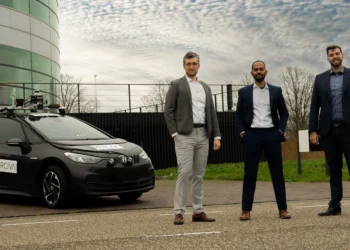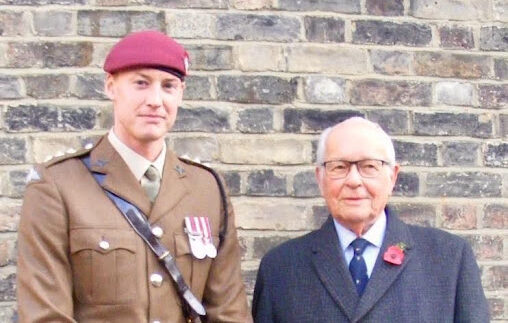
Editors’ note: Hugo Jammes, a founding partner of EDT Ventures and former head of the UK’s National Security Strategic Investment Fund who regularly writes Guest Posts for Resilience Media, sat down with his grandfather John Jammes, a 99-year-old veteran of the French Resistance, to talk about historical memory, the psychology of threat, the technology of survival, and what today’s leaders are getting dangerously wrong. (Grandson and grandfather are pictured above.) The conversation has been very lightly edited for clarity.
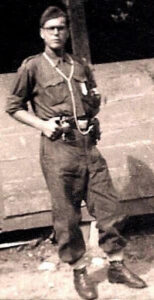
Those who know me know that my grandfather is one of my all-time heroes. Born in 1926, he is one of the last living veterans of the French Resistance and a recipient of the Croix de Guerre.
John came of age in a family for whom service was not a political abstraction but a lived inheritance.
When occupation came in 1940, he was thirteen years old. He began by distributing Resistance leaflets through his school, graduated to running clandestine messages across the countryside by bicycle under curfew, and by the summer of 1944 had joined the Maquis – the armed guerrilla units – fighting alongside his father (a French Infantry Officer) in the countryside around Loches. He ambushed German convoys, documented war crimes whose photographs were later used at the Nuremberg trials, and rescued and sheltered downed Allied airmen. By the end of the war, his unit had captured over 80 German soldiers.
This was all before the age of 18. For decades, he declined to speak publicly about his wartime service, fearing he would not be taken seriously. It was only in his later years, watching his surviving comrades disappear, that he concluded silence had become a disservice to the dead. He is 99 years old and now lives in the UK. .
Hugo: John, you’ve been reluctant to speak about your wartime experience for much of your life. Why?
John Jammes: For a very long time I was afraid no one would take me seriously. You tell stories of what happened and people look at you – they are polite, they nod – but you can see that some part of them thinks you are shooting a line. Exaggerating. Performing the old soldier. It took me decades to feel comfortable speaking. What eventually changed was watching my comrades die, one by one, and realising that when they went, their stories went with them. At that point, it became a duty. Not a pleasure – a duty.
Your father was a French officer. He was warning of war with Germany as early as 1937. What do you remember of that period?
He was quite clear about it, not least having served in the First World War and continued serving in the intervening period. He had studied the situation, he understood German rearmament, he understood what Hitler represented. And the politicians around him – in France, in Britain, everywhere – simply could not accept the reality. They looked at the same evidence and concluded the opposite. It wasn’t stupidity, exactly. It was a kind of willed blindness. The truth was too unpleasant, so they chose not to see it.
And the parallel you draw to the present day is not a comfortable one.
I don’t draw it to be comfortable. I draw it because it is accurate. What Putin is doing is not, in its essential character, different from what Hitler did. He is an aggressor. He tests and he probes and he advances, and the Western response has been the same mixture of appeasement and denial in many instances. The actors change. The psychology does not. What is happening now shows a clear parallel between an aggressor and potential aggressors, and countries in the West that are not prepared for the reality of sustained conflict. History clearly repeats itself.
We talk a lot about societal resilience today – what lessons can we learn from your generation in how to become more resilient?
In France, when I was young, patriotism and resiliency were explicit. It was taught in schools. Dying for your country was presented as the highest duty a citizen could perform. You may find that shocking now. Perhaps it is too stark. But the consequence of removing that idea entirely is that you produce a generation that has no psychological preparation for the possibility of conflict. And that generation may not fight. Not because they are cowardly – that is too simple – but because they have never been asked to internalise duty as something that could outweigh self-preservation.
How did you motivate yourself to resist and how did occupation affect you?
Humiliation. That is the word. The enemy does not need to kill everyone. He simply curtails your freedom, in front of your eyes, in the streets of your own city. He makes you feel powerless in your own home. For someone with a patriotic upbringing, this was viscerally intolerable. It was the thing that made resistance feel not like heroism, but like the only logical response.
But most people couldn’t resist.
Most people could not, and I do not condemn them. A man with children has to feed them. He has to keep his job. Sometimes he had to work alongside the enemy simply to survive. Only those who had made a prior commitment – at some deep level, often before they were even conscious of making it – were psychologically prepared to act when the moment came. The others were not weaker people. They were simply unprepared.
How does that map onto what you observe today?
Politicians cannot motivate populations who do not believe war is possible. And they cannot tell people the truth about war because the truth is not electorally convenient. It is a trap. The only way out of the trap is leadership that accepts short-term pain – tough decisions, harder conversations, a more honest account of the world – for the sake of long-term survival. And at the moment, I do not see that leadership.
What would you say directly to today’s Prime Minister and Defence Secretary?
Read history. And not as an academic exercise: read it to draw practical lessons. Accept that war is a constant possibility, not a chimera, not something that happens to other people in other eras. Build that reality into your budgets, into your policy, into your schools. Yes, funding for defence is politically painful. I understand that. But the alternative is what my generation experienced. And I assure you, the cost of that is considerably higher.
Let’s talk about technology. The Resistance depended on a multitude of capabilities that made them effective. What did that look like on the ground?
We relied on several things. Plastic explosive was transformative. You could mould it, conceal it, transport it in quantities that would have been impossible with conventional explosives. The Sten gun cost something like seven shillings and tenpence to manufacture [the weapons were produced in England and then sent to France]. Seven shillings and tenpence I believe. And yet it gave a single fighter a level of personal firepower that changed the calculus of the occupation entirely. We also received Bren guns, PIATs, and the American Bazookas, all through supply drops from the UK.
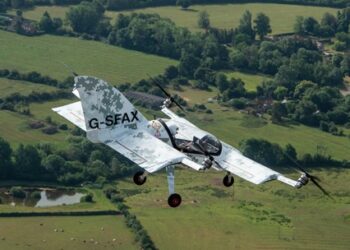
But the most impactful was the Lysander. A small aircraft, capable of landing and taking off from a short field at night. The Lysander was the instrument that made the connection between occupied France and London (and the Special Operations Executive) real and operational. Without it, the Resistance would have been far more isolated. It brought agents in, took agents out, carried supplies and was a lifeline for our activities.
And yet you have concerns about where technology is taking us now and the way in which modern conflict is evolving.
The speed of change is the issue. At every point in history, technology has moved faster than the human capacity to adapt to it psychologically and morally. We have usually managed – just – to catch up.
But the gap is widening. I am told that one of the pioneers of artificial intelligence himself considered stopping his own work because he feared the consequences. [Note: Jammes is likely referring to Geoffrey Hinton, who resigned from Google in 2023 over AI risks.] Think about that. The man who built the thing was frightened of it. If that is where we are, then the question of who controls these technologies, and towards what ends, is not a technical question. It is the question of this century.
Alliances were clearly critical to your experience in the Resistance. What do you think about our core alliances today, in particular reflecting on President Macron’s speech on 13th July 2026 where he said: “At a time when Europe is rearming, to think that the course of history lies in each of us separately accumulating capabilities is an absurdity.”
NATO’s credibility rests entirely on one thing: the unconditional commitment of the United States to the defence of its allies. That conditionality is now in question. And the moment it becomes conditional – the moment an adversary believes there are circumstances under which the Alliance is vulnerable – the deterrent collapses. Every nation, ultimately, acts in its own interest. That is not cynicism, it is realism. But it means that European nations cannot afford to treat American support as a given or allow ruptures within European Alliances to undermine our ability to deter aggression. European Alliances are now more vital than ever – cohesion and cooperation within European Allies is absolutely vital. This will also help keep our Alliance with America strong – as they will see us as a more credible partner.
John, you are 99 years old. You have seen the worst of what the last century produced and survived it. What do you offer the next generation as a guiding principle?
Never despair! That is the only motto worth having. Technology may well escape human control if we do not find the wisdom to govern it. The old patterns of aggression will repeat – they already are. The calibre of leadership is often insufficient. All of that is true. And yet despair is not the answer, because despair is the one thing that guarantees the worst outcome. I see steel in some of the younger generation. This is where I place my hope.
John Jammes served in the French Resistance during the Second World War and is 99 years old. Hugo Jammes is a founding partner of EDT Ventures and previously served as head of the National Security Strategic Investment Fund (NSSIF). EDT Ventures is a pan-European early growth fund specialising in dual-use technologies.