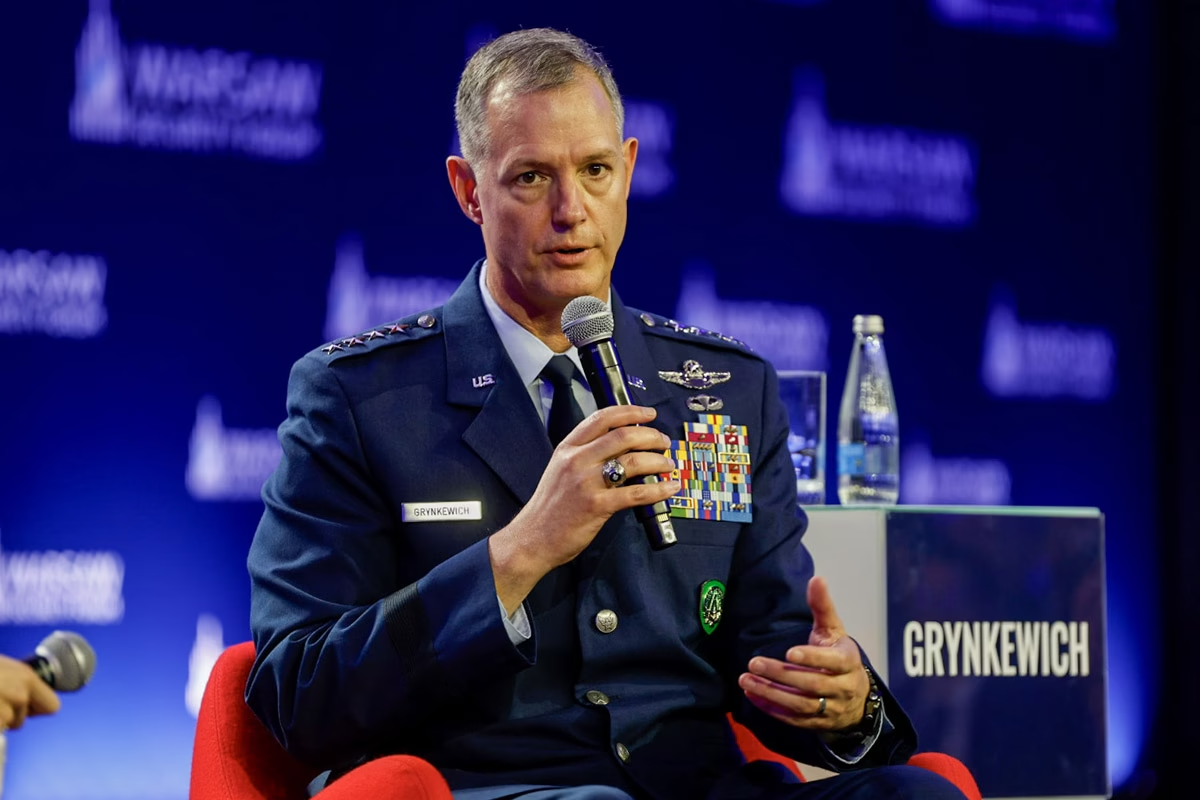
Last week in Warsaw, NATO’s Supreme Allied Commander Europe, General Alexus Grynkewich, did something SACEURs rarely do: he told the public how the Alliance intends to win. Speaking at the Warsaw Security Forum, he laid out a “theory of victory” endorsed by all 32 Allies and built around three verbs.
Block the initial assault, with land forces fixing enemy formations at the point of contact and denying any seizure of Alliance territory. Blunt the follow-on, using sensors, autonomous systems and multi-domain operations to strip the attacker of momentum. And if the attack continues or reserves are committed, break “anything and everything that supports, sustains, and controls that force”: logistics, command, reinforcements.
“We will, in short, ensure any attack, against any Ally, proves utterly futile,” he said. Most of the coverage stopped at “ready to fight tonight”.
The more interesting part of the speech was what it implied about who builds the tools.
A signal, not a war plan
Grynkewich was careful to call this a shared vision rather than an operational plan. The classified version was finalised months ago; publishing the logic is itself the deterrent act. “Our first goal is deterrence – avoiding conflict,” he said, and the way NATO proposes to deter is by denial, not punishment. The Alliance is not promising to defeat Russia as a state. It is promising that no attack will gain a foothold, hold ground, or be worth the cost.
By limiting its aims to the force deployed against it, NATO puts the burden of escalation on the aggressor and keeps the ability to match every rung of the ladder. It also defines the problem in tactical and operational terms. The open question is what the Alliance can bring to the fight, in what quantity, and how fast.
Mass you can afford, and eyes everywhere
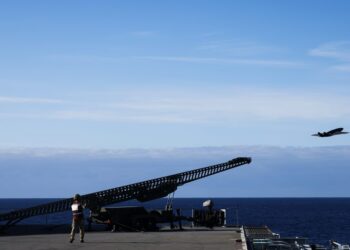
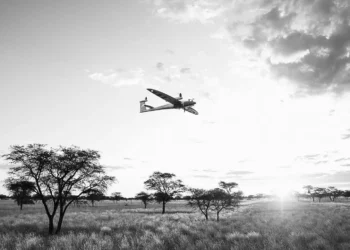
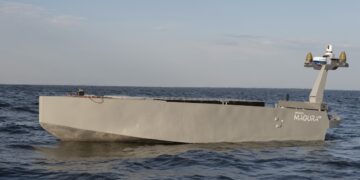
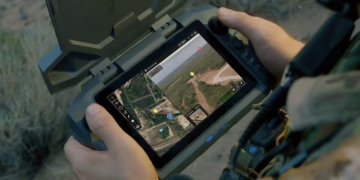
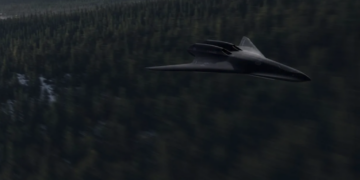
The closest thing to an operational answer is the Eastern Flank Deterrence Initiative: an extensive “autonomous zone” along the border, a wall of aerial drones and ground robots meant to hold a Russian advance without heavy allied losses, backed by long-range strikes on command posts and air defences in Kaliningrad and Belarus. Drones and AI do not replace the F-35; they supplement it. It is a concept that runs across every domain, land, sea, air, cyber and space, with air and maritime superiority as the enabler and non-kinetic pressure alongside kinetic.
Two core technological demands follow, and Grynkewich named both. The first is “an overpowering mass of affordable and scalable systems” layered with high-end precision munitions. NATO’s approach to deterrence is now a consumption strategy, and the Alliance needs effectors it can lose by the thousand.
The second is constant observation: intelligence and “advanced algorithms” to see an attack forming and position forces early, sensor networks, and a “warfighting cloud” that moves classified targeting data between allies in near real time. SACEUR listed sensor networks, the combat cloud and long-range precision strike as the investment priorities. Read together, they are a demand for interoperability: mass is useless if the cloud cannot task it, and the cloud is useless if thirty-two national systems cannot speak to it.
The ecosystem is the deterrent
Deterrence by denial is only credible if the adversary believes the mass can be regenerated and the technology adapted constantly, quickly and under enemy pressure. An opponent planning a long war does not only count stockpiles; it counts production lines, supply chains and how fast a system is iterated once the enemy adapts to it.
Inventory matters less than the rate, and the rate has two parts: a scalable capacity to ramp up production, and a cycle of constant innovation that moves new technology from the lab to the front line in months rather than years. The ecosystem that builds this is no longer a supplier to NATO, not even an external enabler; it is now an integral part of the Alliance’s deterrence and warfighting strategy. And it can only be built with dynamic players and dynamic capital behind them.
But coercion does not need an invasion. Grynkewich himself raised the Strait of Hormuz, where fuel prices already weigh on Europe’s modernisation budgets, and Russia’s sabotage and drone incursions sit well below the threshold of block, blunt and break. A denial strategy therefore has to cover more than the battlefield. The ecosystem that builds it must also make Europe’s energy, supply chains and infrastructure hard to hold hostage, and adapt to the never ending creativity of the Coercer.
What this asks of founders and investors
The first implication is a change of self-image. Startups, scale-ups and the investors behind them are no longer only suppliers to the Alliance; under this theory of victory they are an interior part of it. They are part of NATO’s deterrence and warfighting strategy, helping to change the enemy’s cost-benefit calculation by denying him gains and showing credibly the cost the Alliance can impose in return.
The second is where the capital should go. Affordable, scalable effectors; sensing and the cloud that tasks them; long-range precision strike: these are the Alliance’s current priorities. Behind each sits an unglamorous layer the Alliance cannot surge without: components, manufacturing capacity, energy and interoperable software. That upstream layer is where a VC-backed company can move faster than a prime and where the next decade of returns is likely to sit.
The third is speed and standards. Ukraine has shown that the side that iterates faster wins the drone war; NATO is now saying so from the podium. Founders should design for allied interoperability from day one and for replacement, not permanence. Investors should fund scale-up, not only invention, and accept that a functioning ecosystem needs patient capital for the boring parts.
Grynkewich’s closing line was that the Alliance “has got this”. Whether it does is a question that involves everyone, and the answer will in large part depend on the scale of the defence industrial base. The Western DIB, and above all its new, dynamic players, has moved from supplying someone else’s deterrent to standing at the heart of deterrence itself.
Tom Kühnel leads Government Affairs at Project A.