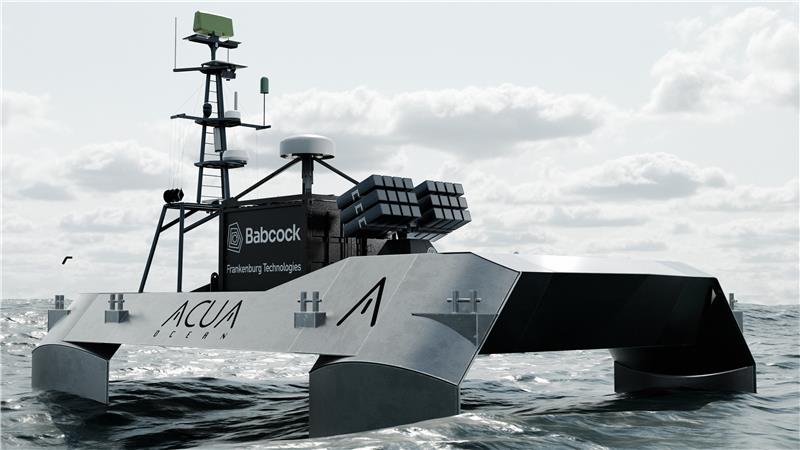
Visions of a hybrid navy capable of defending against swarms of drones and other new threats are getting closer to reality, as legacy primes continue to forge partnerships with more cutting-edge startups in defence tech. In the latest development, Frankenburg and ACUA Ocean Technologies signed a memorandum of understanding (MoU) with Babcock International Group to collaborate together on autonomous maritime defence solutions for naval customers.
Babcock’s multi-domain launcher system will work with Frankenburg’s precision-guided missile systems mounted on ACUA Ocean’s uncrewed surface vessels, a solution that not only protects against threats at sea but also incoming threats long before they get the chance to make land, reducing the impact of falling debris on infrastructure or human life.
This is a further step on a partnership that was forged earlier in the year, when Babcock and Frankenburg announced a partnership to develop a low-cost maritime counter drone system to protect ships, ports, and offshore assets against one way attack drones. ACUA Ocean’s autonomous launch platform preserves the low-cost pledge, they said.
“Affordable missile defence is heading farther out to sea,” said Daniel Hallett, UK MD for Frankenburg Technologies, in a statement. “By equipping ACUA’s uncrewed vessels with Frankenburg’s mass-manufacturable missiles and Babcock’s launcher technology, we aim to create a persistent and low-cost way to protect the UK’s ships, ports and critical maritime infrastructure against mass drone attacks.”
SMEs: smaller but with scaled up ambitions
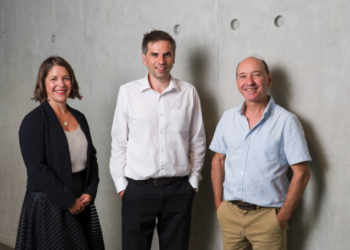
Mike Tinmouth, COO and co-founder of ACUA Ocean, told Resilience Media that the partnership came out of Babcock’s SME charter. The defence firm in March announced a commitment to work more closely with innovative SMEs, and those who were there might have been able to catch the signs of a working relationship down the line: Tinmouth was a panel speaker at the launch event.
No timelines have been given on when we can expect to see the first products of the MOU. Tinmouth said ACUA is working with Frankenberg towards a future demonstration.
“We are looking to work with the best in class of all different states and forms,” said Tinmouth.
ACUA is busy with other projects, too. Recently, it showed off how its USV flagship platform, the SkyRanger R70 drone, demonstrated an autonomous launch with Teledyne FLIR’s SkyCarrier UAS platform — a project funded by the Ministry of Defence’s UK Defence Innovation programme.
The Pioneer Mk2, with a payload of 7 tonnes, has a typical operating speed of 3-4 knots (optimal for submarine detection and towed/aerial sensors) and can stay at sea for around 100 days powered by a hybrid diesel-electric system.
“The direction of travel of the hybrid navy is exactly what we had foreseen and what we expected,” Tinmouth said. “We were able to do more with that, and autonomy enables us to replace the dull, dangerous, and dirty jobs of the past with new high-tech roles onshore.”
It’s no accident that ACUA Ocean ended up in naval defence given that both parents of the two co-founders, brothers Tinmouth and CEO Neil Tinmouth, served in the navy. And both previously worked in areas that complement what ACUA is tackling. Neil was part of a team that won the Shell Ocean Discovery XPrize for autonomous ocean mapping, while Mike’s experience includes mentoring on innovation in the military.
There has been a lot of criticism over the shortfall in funding for the MoD in the recently published Defence Investment Plan, spurring multiple resignations from top brass, but Tinmouth sees opportunities for startups.
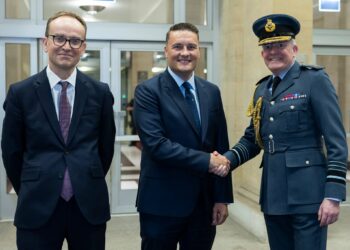
“The announcement of the Defence Investment Plan could not have come sooner,” Tinmouth said. “John Healey is a proven operator in the defence case. He understands the defence case, so we are very excited by his announcement as the Chancellor and the new Secretary of State for Defence Wes Streeting.”
Tinmouth said he’d like to see the UK’s MoD become the “best first customer of SME technology.”
“[The UK has] to continue to put in place the mechanisms whether that’s commercial, whether that’s assurance, whether that’s speed of acquisition,” he said. “We need to get ourselves in a position where we’re able to rapidly scale and test and trial, and also acknowledge that not everything works first time.”
And although the vendors are SMEs, the sums shouldn’t be smaller as a result, he added.
“We’ve got to move away from writing small cheques for £100,000,” said Tinmouth. Realistic orders would be in the region of multiple millions of pounds for “kit and equipment that we’re going to need on the front line for our warfighters, for our service personnel.”
In defence of the government, Tinmouth did say he felt that the MoD did understand the need and that it was working to reach this point. “This is a phenomenal time to be in the world of ocean robotics, but also in defence tech,” he said.