
Saturday 7 March, 2026
[email protected]
Resilience Media
  • About
  • News
  • Resilience Conference
    • Resilience Conference Warsaw 2026
    • Resilience Conference Copenhagen 2026
    • Resilience Conference London 2026
  • Guest Posts
    • Author a Post
  • Subscribe
No Result
View All Result
  • About
  • News
  • Resilience Conference
    • Resilience Conference Warsaw 2026
    • Resilience Conference Copenhagen 2026
    • Resilience Conference London 2026
  • Guest Posts
    • Author a Post
  • Subscribe
No Result
View All Result
Resilience Media
No Result
View All Result

Periphery and Midgard partner to secure robots against capture and reverse engineering

Fortifying firmware on the front line.

Paul SawersbyPaul Sawers
March 2, 2026
in News
Periphery CEO Toby Wilmington

Periphery CEO Toby Wilmington

Share on Linkedin

Modern conflict has pushed autonomous machines into some of the most hostile operating environments. Drones are intercepted mid-flight, ground robots are abandoned under fire, and naval systems drift beyond recovery.

You Might Also Like

Ukrainian autonomy company The Fourth Law unveils an anti-Shahed drone

Ukraine’s autonomous weapons makers push for industrial scale

MSC got the urgency right. The hard part comes next

When those physical systems are compromised, however, it’s not the metal or motors that hold the greatest value, but the software and data inside them — the navigation logic, swarm coordination and embedded intelligence that provide the tactical advantage.

Securing that intelligence before systems reach the field is the focus of a new partnership between Leeds-based embedded security startup Periphery and Midgard Dynamics, a Ukrainian defence robotics engineering company. The two companies have signed a global deal to integrate Periphery’s military-grade AI threat management software directly into Midgard’s autonomous systems.
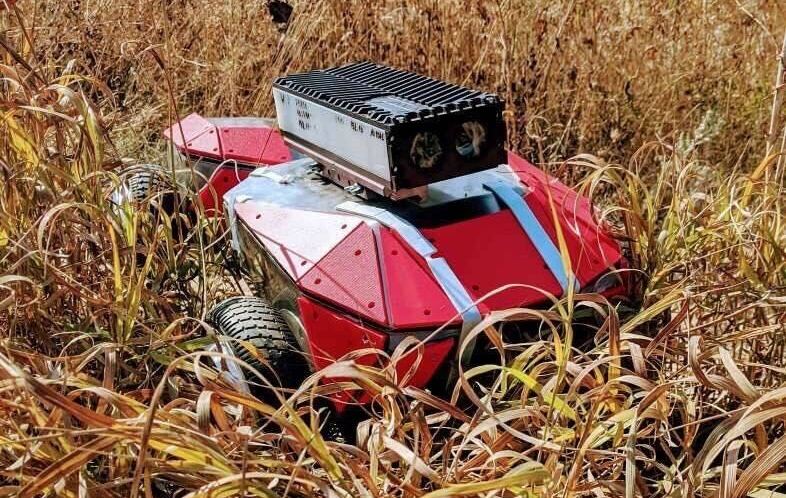
Midgard Dynamics' robot
Midgard Dynamics’ robot

Locking down the logic

Midgard Dynamics has spent more than a decade developing navigation, sensor, communications, and drone swarm technologies for defence applications. In recent years, its systems have been tested in live operational environments where adversaries attempt to intercept, jam, or seize hardware.

This is where Periphery enters the fray, hardening those systems at the firmware level before deployment. Its AI-powered threat management model is condensed and stored directly on the device itself, forming part of a security architecture designed to prevent unauthorised access or extraction of sensitive code.

“This on-device protection prevents IP loss and tampering, as well as speeding up compliance timelines, enabling devices to reach the market faster,” Periphery co-founder and CEO Toby Wilmington explained to Resilience Media.

The risk of sophisticated actors exploiting captured or reverse-engineered systems is far from fantasy. Military drones and autonomous platforms are built around proprietary navigation algorithms, communications protocols and embedded control systems — the blueprints for how they perceive, coordinate and act. When an adversary gains access to that software, they can analyse, replicate or even improve on the original design.

‘We are surrounded by thousands of robotic systems, and recent experience shows that any toy or amateur drone can be reprogrammed to become a lethal weapon.’

A high-profile example came in December 2011, when Iranian forces captured a U.S. Lockheed Martin RQ-170 Sentinel surveillance drone and brought it down largely intact; Tehran later claimed to have studied aspects of its systems and produced derivative designs. Iran’s state media later broadcast video footage it said was extracted from the captured drone itself — showing imagery recorded by the aircraft’s onboard sensors — underscoring that a downed platform can yield sensitive technical insight as well as operational data.

Such incidents show what’s at stake: software and sensor data are strategic assets that adversaries can exploit long after the physical system has fallen into their hands.

“Evolving threats on a global scale from malicious actors, including nation states, have made critical infrastructure and defence technologies prime targets, and their protection is a matter of national security,” Wilmington said. “In contested environments, like warzones, precious IP is more vulnerable than ever, and exposed or captured devices can grant opponents the ability to easily replicate capabilities, or understand how to exploit or disable other devices.” Wilmington has some experience of this preceding Periphery: he previously worked for BAE Systems in cybersecurity and helped build NATO’s incident response capabilities.

‘Sovereign resilience’

Ukraine has become a key testing environment for autonomous systems. One common approach has been to take inexpensive drones, modify them, and then rapidly deploy those modified systems at scale. The line between consumer robotics and weaponised systems has narrowed, said Midgard’s founder and CTO, Dr Anton Varavin. As such, protecting the software inside these platforms is now as important as building the hardware itself.

“We are surrounded by thousands of robotic systems, and recent experience shows that any toy or amateur drone can be reprogrammed to become a lethal weapon,” Varavin said. “The new challenge is protecting the one thing that distinguishes a home assistant from an effective weapon: a small piece of code or data. Our experience in creating effective robotic combat systems, and our partner Periphery’s undisputed expertise in information security, make it possible to create a barrier that will separate our peaceful life with robots from the systems of war.”

For Periphery, Midgard represents its first publicly announced partnership, though the company says it is also working with global OEMs across mobility, energy, aerospace, defence and medical sectors.

As autonomous systems proliferate across modern battlefields, the strategic advantage could lie in who can protect the intelligence embedded inside them. Hardware may be recoverable, or at least can be built again. Code, once exposed, is not.

“This partnership ensures that Midgard’s systems and partners are secure-by-design, and resilient in deployment,” Wilmington said. “The outcome is sovereign resilience, autonomous platforms that cannot be easily replicated, subverted, or turned against their operators.”

Tags: AIautonomous devicesautonomyCybersecurityMidgard DynamicsPeripheryUkraine
Previous Post

Auterion, the drone software startup, eyes raising $200M at a $1.2B+ valuation

Next Post

Rajmund T. Andrzejczak and Marcin Hejka to speak at Resilience Conference Warsaw

Paul Sawers

Paul Sawers

A seasoned technology journalist, most recently Senior Writer at TechCrunch where his work centered on European startups with a distinctly enterprise flavour. At Resilience Media, Paul focuses substantively on the worlds of open source and infrastructure, looking at technology that helps people and society live outside the sticky ecosystems of Big Tech.

Related News

Ukrainian autonomy company The Fourth Law unveils an anti-Shahed drone

Ukrainian autonomy company The Fourth Law unveils an anti-Shahed drone

byJohn Biggs
March 6, 2026

Ukraine-based autonomy company The Fourth Law has unveiled Zerov, an autonomous interceptor drone built to engage long-range strike UAVs in...

Ukraine’s autonomous weapons makers push for industrial scale

Ukraine’s autonomous weapons makers push for industrial scale

byLuke Smith
March 6, 2026

In the past five months in Ukraine, Major Maksym Gromov's unit launched 608 autonomous Lupynis drones against Russian adversaries. Four...

asphalt road between trees

MSC got the urgency right. The hard part comes next

byRobin Dechant
March 6, 2026

A few weeks on from the Munich Security Conference, something many of the Resilience Media community no doubt attended, I...

NATO Innovation Fund appoints a president, Ari Kristinn Jónsson

NATO Innovation Fund appoints a president, Ari Kristinn Jónsson

byIngrid Lunden
March 5, 2026

The NATO Innovation Fund, the VC formed out of the strategic alliance of NATO countries that counts most (but not...

SkySafe Wants to Be the Air Traffic Control for Drones

SkySafe partners with major energy sector player to build out drone defence

byJohn Biggs
March 5, 2026

Southern States LLC and SkySafe announced a partnership to integrate real time drone detection and airspace intelligence into Southern States’...

Uforce raises $50M at a $1B+ valuation to build defence tech for Ukraine

Uforce raises $50M at a $1B+ valuation to build defence tech for Ukraine

byIngrid Lunden
March 5, 2026

The United Kingdom and Ukraine look like they may have minted their first defence tech ‘unicorn’. Uforce (stylised ‘UFORCE’) —...

Anthropic, OpenAI, and the new rules of Defence AI

Anthropic, OpenAI, and the new rules of Defence AI

byCarly Pageand1 others
March 3, 2026

Anthropic is facing the prospect of being frozen out of US government work after refusing to relax safeguards on how...

Auterion, the drone software startup, eyes raising $200M at a $1.2B+ valuation

Auterion, the drone software startup, eyes raising $200M at a $1.2B+ valuation

byIngrid Lunden
February 27, 2026

German defence tech startups are seeing a lot of activity at the moment, and one of them is using that...

Load More
Next Post
Rajmund T. Andrzejczak and Marcin Hejka to speak at Resilience Conference Warsaw

Rajmund T. Andrzejczak and Marcin Hejka to speak at Resilience Conference Warsaw

Anthropic, OpenAI, and the new rules of Defence AI

Anthropic, OpenAI, and the new rules of Defence AI

Most viewed

InVeris announces fats Drone, an integrated, multi-party drone flight simulator

Twentyfour Industries emerges from stealth with $11.8M for mass-produced drones

Senai exits stealth to help governments harness online video intelligence

Harmattan AI raises $200M at a $1.4B valuation from Dassault

Uforce raises $50M at a $1B+ valuation to build defence tech for Ukraine

Palantir and Ukraine’s Brave1 have built a new AI “Dataroom”

Resilience Media is an independent publication covering the future of defence, security, and resilience. Our reporting focuses on emerging technologies, strategic threats, and the growing role of startups and investors in the defence of democracy.

  • About
  • News
  • Resilence Conference
    • Resilience Conference Copenhagen 2026
    • Resilience Conference Warsaw 2026
    • Resilience Conference 2026
  • Guest Posts
  • Subscribe
  • Privacy Policy
  • Terms & Conditions

© 2026 Resilience Media

No Result
View All Result
  • About
  • News
  • Resilence Conference
    • Resilience Conference Copenhagen 2026
    • Resilience Conference Warsaw 2026
    • Resilience Conference 2026
  • Guest Posts
  • Subscribe
  • Privacy Policy
  • Terms & Conditions

© 2026 Resilience Media

This website uses cookies. By continuing to use this website you are giving consent to cookies being used. Visit our Privacy and Cookie Policy.