Good afternoon from the team at Resilience Media
The war in the Gulf has brought into public view the asymmetry that exists between legacy systems and startup technology. Today we look at two stark examples of that. First, Resilience Media contributor Tom Pashby examines Operation Epic Fury, the $11B war which is proving to be a missile defence conflict. The US and UK are finding that despite having missile defence capabilities and integrated systems, a significant number of Iranian ballistic missiles are getting through; and Iran has large numbers of reserves. Read more of Tom’s analysis excerpted below.
Juxtaposing that is the news out of Ukraine that The Fourth Law announced its own autonomous anti-Shahed interceptor drone. Editor at Large John Biggs brought us the story of Yaroslav Azhnyuk’s low-cost interceptor, which matches the low cost munitions Russia uses against Ukrainian Defense Forces. Read an excerpt in the Startup Watch section below.
We also published the second monthly column by Robin Dechant, Partner at General Catalyst, “Munich Security Conference got the urgency right. The hard part comes next.” Coming from a manufacturing background, Robin’s latest piece takes his learnings from his time in the industry and how they apply beyond the headlines from the conference. Read it here.
Investment into the defence tech ecosystem continues at a rapid pace. This week saw Augur, Hadean, Isembard, and more announce new funding rounds, which we outline below in our Deals section.
Elsewhere on Resilience Media:
- EDTH is Hackathon-ing our way to a new defence ecosystem
- Trojan force: Hidden backdoors may lurk inside AI models, report says
- Trump cyber strategy outlines tougher stance on cybercrime and adversaries
- Ukraine’s autonomous weapons makers push for industrial scale
- Guest Post: The dangerous economics of drone warfare
Resilience Conference Warsaw
As we near our Early Bird ticket deadline, we are thrilled to announce another round of speakers for Resilience Conference Warsaw: Atmos Space Cargo Co-founder & CEO, Sebastian Klaus; Izabela Albrycht, Director, AGH University / FORT Krakow DIANA Accelerator Poland; Srđan Kovačević, CEO, ORQA; and Vlad Galu, Co-founder and CTO, Refute.
We pay for our events through tickets and sponsorship. We don’t have paid content, and we don’t take government money. This allows us to remain independent and curate challenging and impactful content. You can support our work by sponsoring our events. To discuss this, please contact me. You can buy tickets here.
I’ll be back in your inboxes next week. Thanks for reading.
-Leslie Hitchcock, co-founder and Publisher, Resilience Media

Augur, a ‘grey-zone’ national security startup, raises $15M
- Augur, a London national security startup co-founded by Palantir alums that is building an AI-based analytics platform to “read” data from sensors in public venues and other physical spaces to detect threats, has raised $15 million in seed funding to expand its business.
Hadean, the AI battle simulation startup, closes bridge round ahead of a Big B
- London-based Hadean began life several years ago as an AI gaming startup working on VR and video simulations, but it found new wind in its sails when it pivoted to defence and resilience technology. Business has boomed, so much so that we understand it may have received an interesting acquisition offer last year (it turned it down). Now, Hadean has raised around $15 million in funding as it continues to see activity across government in the UK and the US.
Isembard raises $50M, plans to open 25 ‘AI-powered factories’
- Isembard, a London startup that’s built a platform to help hardware makers in defence, aerospace and robotics manufacture components and more, is supercharging its efforts to build a new wave of AI-powered factories. The London startup today announced a fresh $50 million in Series A funding, only that it will be using to open 25 new “AI-powered factories” for its aerospace and defence customers.
Lux Aeterna raises $10 million to build reusable, returnable satellites
- Lux Aeterna, a Denver based space infrastructure startup, just raised a $10 million seed round led by Konvoy Ventures with participation from Decisive Point, Cubit Capital, Wave Function, and several follow on investors including Space Capital, Dynamo Ventures, and Channel 39. The funding will accelerate development of Delphi, the company’s returnable satellite platform designed to survive atmospheric reentry and fly again. The company has already sold out payload capacity for its first mission, scheduled for the first quarter of 2027.
Scout Ventures raises $125 million to expand investment in defence and dual-use tech
- Scout Ventures has closed its fifth fund with $125 million in commitments, according to an announcement released March 10. The Austin-based venture capital firm the fund will be used to invest in companies building technologies tied to national security and defence.

US and UK ballistic missile defence capabilities brought into focus as Iran lashes out against region
Tom Pashby, Contributor
The ballistic missile defence capabilities of the US, UK and other allies have been put to the test as the Iranian armed forces fire missiles and drones at targets in its neighbouring countries across the Persian Gulf, in response to the ongoing US and Israeli attacks against Iran that started on 28 February 2026.
“Major combat operations” by the US military – codenamed Operation Epic Fury – were triggered seemingly out of the blue, with mixed messages around the wider rationale for attacking Iran. The US Secretary of State said it was to prepare against retaillations after Israel warned the US it was about to attack Iran; the US President said it acted on its own intelligence of an imminent threat around nuclear capabilities and Iranian aggression.
Be that as it may, the operation has been somewhat clearer on its bigger objectives: preventing Iran from obtaining a nuclear weapon (and the means to make one); regime change; and destroying its ballistic missiles.
Two of these have seen mixed outcomes. Iran’s supreme leader Ayotollah Khamenei was killed, but he was soon replaced by his hardline son. Nuclear capabilities, meanwhile, posed a complicated picture even before the operation kicked off and some have cast doubt on what Iran’s nuclear capabilities look like today.
Yet the third of these – the ballistic missiles – has been one of the more persistent threats, and is the one that has enmeshed further countries in the conflict. It was a ballistic missile headed for Turkey that NATO intercepted earlier this month. It was ballistic missiles threatening UK citizens abroad in the Gulf that compelled the UK to open its own bases to the US Air Force to launch “defensive” strikes against targets inside Iran aimed at sites associated with Iran’s ballistic programme. And it’s ballistic missiles that continue to make headlines daily in reports of Iranian strikes.
To be clear, some Iranian missiles are being intercepted; and the country is pursuing a second track of attack weapons, also launching a large number of uncrewed aerial systems (UAS) – seemingly Shahed drones and variants – across a number of its campaigns.
But there are indications that its ballistic artillery may not yet be exhausted. One report released earlier this month from Alma, a research group in Israel, cited IDF (Israel Defence Force) figures that estimated Iran had some 2,500 missiles as of February 2026, along with facilities to develop more. These, author and Alma head of research Tal Beeri notes, are primarily short-range and medium-range ballistic missiles (respectively up to 1,000km and 1,000-3,000km), but it adds that there are multiple reports that say Iran’s long-range missile programme (over 3,000km) is “currently in advanced stages of development.”
Videos published on social media and on news websites appear to show other ballistic weapons successfully penetrating integrated air and missile defence (IAMD) systems in areas linked or allied to the US.

Ukrainian autonomy company The Fourth Law unveils an anti-Shahed drone
John Biggs, Editor at Large
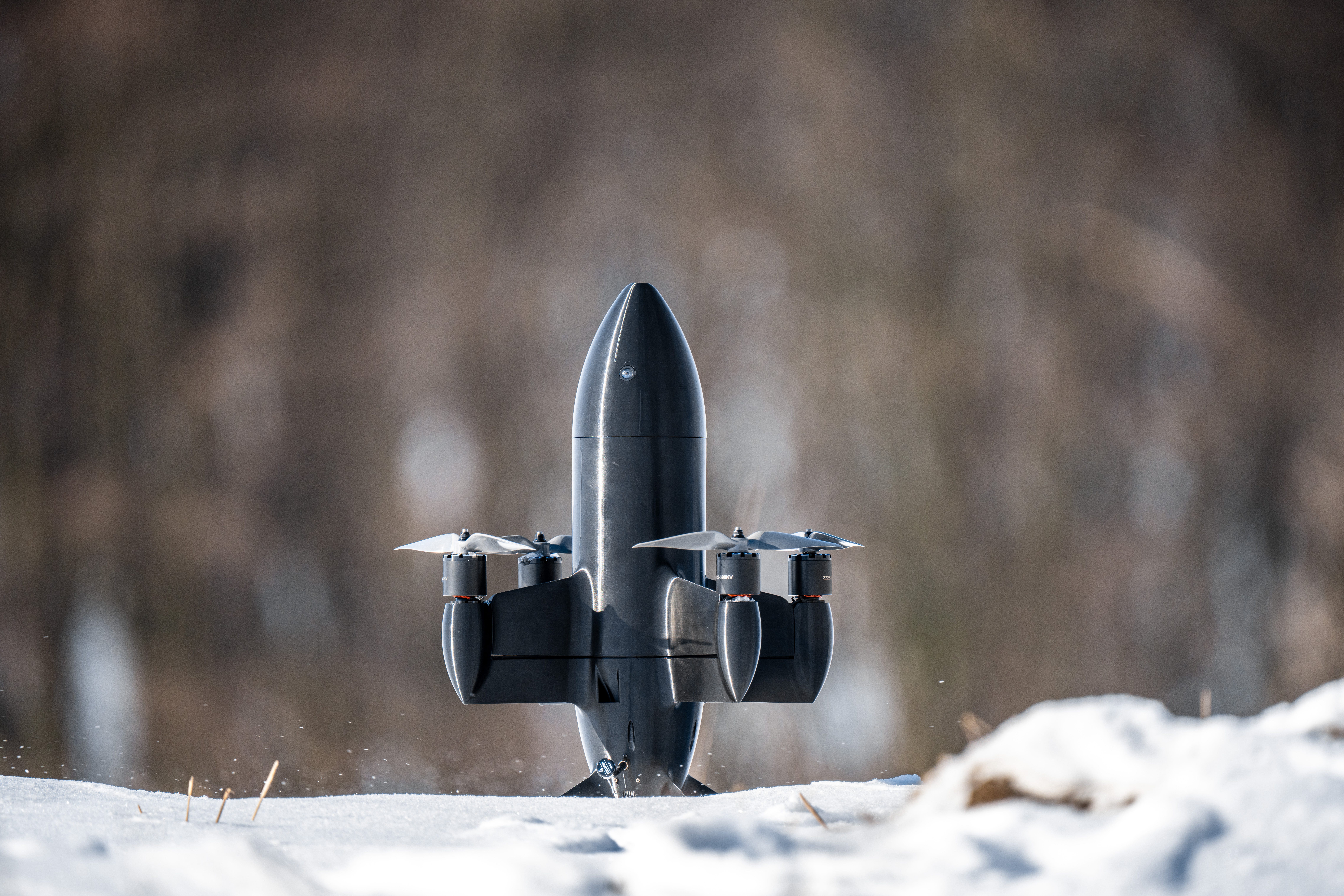
Ukraine-based autonomy company The Fourth Law has unveiled Zerov, an autonomous interceptor drone built to engage long-range strike UAVs in the Shahed class. The platform was developed as a response to the growing use of low-cost Iranian-designed drones that Russian forces have deployed extensively during the war.
The Fourth Law was established in Kyiv in 2023 by entrepreneur Yaroslav Azhnyuk together with a group of engineers and military veterans. The firm focuses on autonomous robotics for defense and maintains operations in Ukraine, the European Union, and the United States.
Shahed-type drones have played a central role in Russian strike campaigns against Ukraine, targeting energy systems, military facilities, logistics centers, and other infrastructure. Their comparatively low price has complicated traditional air defense planning, since intercepting them with conventional missiles can impose far higher costs on the defending side. The Fourth Law says Zerov was designed to fill that gap by offering an interceptor suited for repeated, large-scale engagements.
“In an era where drone warfare is reshaping conflicts from Europe to the Middle East, Zerov-8 is the latest of what massively scalable autonomous drone interception technology can provide,” said Yaroslav Azhnyuk, founder and CEO of The Fourth Law.
“We trained the system to see targets where the human eye or standard sensors fall short,” he said.