Ukraine’s defense tech sector has quietly become one of the most important early-stage investment markets in Europe. In 2025, more than fifty Ukrainian defense technology companies raised over $105 million USD in private capital, according to figures presented at the BRAVE1 Invest Meetup and confirmed by several independent reports.
“That puts Ukraine among the strongest early-stage defense investment markets in Europe,” said Artem Moroz, head of investor relations for BRAVE1, the government-connected VC group dedicated to growing Ukraine’s defencetech stack.
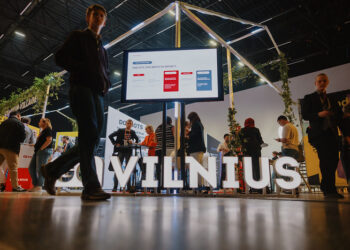
Moroz talked about this rush into the Ukrainian ecosystem at a BRAVE1 meetup in Kyiv. He noted that early-stage defense tech companies across Europe, including the United Kingdom, attracted around 200 million USD at pre-seed, seed, and Series A in 2025. Ukrainian startups account for roughly a third of that total, and some sources put the share closer to half. In other words, a country at war is now one of the central producers of early-stage defense innovation on the continent.
“These are not donations or aid,” he said. “These are investments — real capital from people who believe that Ukrainian defense tech will become a global leader.”
”For me, this belief and this capital form the foundation of long-term national resilience: a strong, independent Ukraine built on advanced Ukrainian defense capabilities,” he said.
Ukraine by the numbers
The raw numbers tell a simple story. In 2023, Ukrainian defense startups raised about $5 million USD. That figure rose to more than $40 million USD in 2024, then to more than $105 million in 2025. The trajectory is steep, and there is no sign yet that it is flattening.
Most of this capital has gone into early rounds. Typical pre-seed and seed checks sit in the $200,000 to $400,000 dollar range at the low end, and $1 to $1.5 million dollars at the higher end. In 2025, investors also started to back a new tier of $2.5 to $5 million dollar rounds, indicating that some Ukrainian companies have moved beyond proof of concept toward scaling products that are already in use on the battlefield.
Behind the numbers is an unusual public-private structure. BRAVE1 describes itself as a defense tech cluster and coordination platform. It runs grants, accelerators, demo days, and investor meetups. It also connects startups with the Ukrainian Ministry of Defense and other buyers for testing and frontline feedback.
At the same time, Ukraine has spent several years building a legal and tax framework that can keep startup jurisdiction at home. Diia City, a special regime for technology companies, offers more flexible corporate structures and competitive tax terms. That is beginning to show up in the pipeline. The expectation for 2026 is that more pre-seed and seed deals will be closed directly under Ukrainian law rather than being forced into foreign structures.
The investor base is broadening. Local and regional funds such as Freedom Fund VC, Green Flag Ventures, MITS Capital, Resist UA, D3 Venture Capital, Varangians, Defender, Angel One, UA1, and others have been active in 2025. Alongside them, a growing set of foreign funds and angel networks from Denmark, Sweden, Norway, Germany, Czechia, the Netherlands, Poland, the United Kingdom, and the United States have begun to treat Ukrainian defense tech as a core thesis rather than a one-off bet.
Looking to 2026, several trends are already visible in the current deal data and in internal plans shared at the BRAVE1 Invest Meetup. First, as some companies reach meaningful revenue, Moroz expects larger incumbents to move beyond pilot projects and toward more serious mergers or acquisitions. That will bring closer integration between established defense manufacturers and the startup cohort, which is one of the preconditions for a durable industrial base.
Second, Moroz expects to see at least one Series B round above 50 million dollars, which would validate the ability of Ukrainian startups to raise true growth capital rather than stopping at early-stage rounds. Third, follow-on rounds from existing investors are likely to increase as seed and Series A companies hit milestones and as foreign funds gain more confidence in Ukrainian legal and banking infrastructure.
The final piece is exports. Many of the current products target Ukrainian requirements, but there is already steady interest from European and other allied buyers who are watching performance in the field. International sales and collaboration agreements are expected to widen in 2026, which would give Ukrainian firms foreign currency revenue and a hedge against domestic budget cycles.
Early-stage defense tech is not a guarantee of victory. It is, however, one of the few areas where Ukraine has managed to turn the pressure of war into a durable advantage. The $105 million raised in 2025 is a signal that this advantage is starting to be recognized across European and global capital markets. The next question is whether larger rounds, deeper industrial cooperation, and sustained political support will follow at the speed that the situation requires.