Sunday 15 March, 2026
[email protected]
Resilience Media
  • About
  • News
  • Resilience Conference
    • Resilience Conference Warsaw 2026
    • Resilience Conference Copenhagen 2026
    • Resilience Conference London 2026
  • Guest Posts
    • Author a Post
  • Subscribe
No Result
View All Result
  • About
  • News
  • Resilience Conference
    • Resilience Conference Warsaw 2026
    • Resilience Conference Copenhagen 2026
    • Resilience Conference London 2026
  • Guest Posts
    • Author a Post
  • Subscribe
No Result
View All Result
Resilience Media
No Result
View All Result

DefHack takes defence tech to the streets

Jälle, building a camouflage supercloth out of old lithium batteries, was the big winner on the day

Fiona AlstonbyFiona Alston
December 18, 2025
in News, Startups
Share on Linkedin

The recent DefHack: Resilience edition hackathon in Tallinn, Estonia was all about extendability. Builders and startups showed off interesting projects in areas like sustainability in defence, ideas that touch the everyday person and the average community and the role they play in defence. Signal jamming, civilian crisis response, thermal camouflage, and disinformation all took stage.

You Might Also Like

US and UK ballistic missile defence capabilities brought into focus as Iran lashes out against region

Scout Ventures raises $125 million to expand investment in defence and dual-use tech

The signal is the weapon: How mobile networks became infrastructure for modern war

The 48-hour hackathon was organised by the Ministry of Defence of Estonia, the Estonian Business School and clean tech accelerator Beamline. The theme was resilience and start-ups and projects were to be “innovative solutions for material reuse, circular supply chain design, product redesign, and environmentally sustainable disposal methods in the defence sector.”

But in one significant way, it was not your typical hackathon: many of the 12 teams were preloaded with ideas and populated with members counting years of experience at dual-use companies. 

(Disclosure: Resilience Media was a proud media partner of the event.) 

Kodus, a platform to prepare civilians for wartime by training for ‘resilience’ among communities, caught the eye of Darkstar’s Kasper Gering.

“I especially liked this team as what they are doing is exactly right,” he said. “We already have our defence forces and our defence league with established roles for wartime, but what Kodus is doing is adding an extra layer on top, because we have lots of people who have a strong will to defend.” 

He said that there was a study commissioned recently in Estonia where 62% of the population said they are willing to participate in defence activities. Specifically, 12% in direct military roles, 23% in supportive roles to military (e.g., rear-area support, logistics, etc.), and 26% in non-military defence activities (e.g., the medical field or organizing evacuations). Also, a whopping 82% of the population considers armed resistance necessary in the event of an attack. “So there really is an untapped resource,” he added.

Gering was joined on the jury by Major General Ilmar Tamm, Commander of the Estonian Defence League; Lieutenant Colonel Asso Treksler, Commander of the Logistics Battalion at the Estonian Defence Forces; and Mart Habakuk, Chancellor of Estonian Business School. 

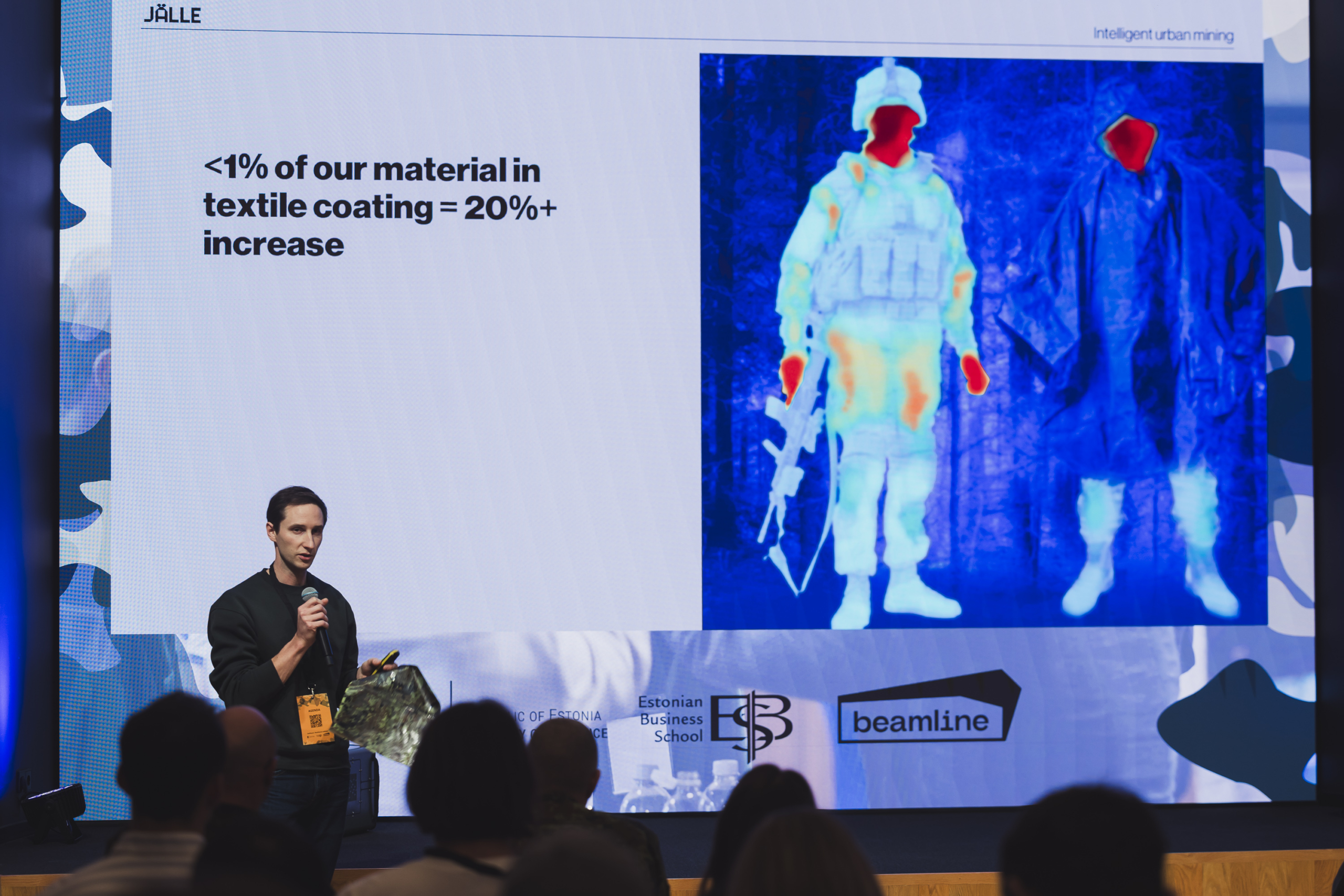
Jälle Technologies, the overall winners of the event, brought a very interesting project to life over the weekend. Already established in the climate tech space, Jälle recycles materials from batteries (the name means “again” in Estonian). Founded in 2023 the start-up recently raised a €2 million funding round that included funding from Kiilto Ventures and 2C Ventures, angel investment and grants from Enterprise Estonia (EIS) and the Environmental Investment Centre (KIK)

The EU is aiming for a 70% recycling efficiency to be achieved by recyclers of lithium-based batteries by 31 December 2030. Jälle Technologies is tackling the problem by transforming used batteries into reusable and sustainable metals and graphene-like materials. 

During the hackathon, this graphene was used to prove its efficiency in reducing thermal energy detection when applied to clothing. 

With its focus coating a piece of army apparel material, Jälle focused on four main categories: thermal camouflaging, electromagnetic interference, shielding, and strength of material. Impressing the jury with the initial results, they walked away with the top spoils which included €1,000 worth of legal advice, tickets to EstMil.tech 2026 and a plan to tackle the breathability of the coated material. 

“We’ll be looking into actually electro spinning our carbon material into a fibre,” said Eriki Ani, the CEO. 

Among the other projects under construction during the hackathon were Swiss drone company Avientus, which has developed a quiet electric drone aimed at delivering supplies to challenging areas. 

Considering a move to Estonia to get involved in defence due to the Swiss neutrality laws, Avientus is now set up. Part of the second place prize they collected is office space in Tallinn. 

Other notable projects included LessonLock, an offline reporting system that delivers lessons from the frontline; ResilientMesh, a dual-use, device-agnostic, low-cost, AI-driven mesh network for disaster or wartime environments; EDIE Estonian Defence Innovation Exchange for defence procurement; and Trinode Systems, which is building customized AI solutions to enhance decision-making, automate workflows, and improve operational efficiency. 

Tags: defence techEstoniahackathonsustainability
Previous Post

Exein, the embedded security startup, nabs €100M at ~€700M valuation

Next Post

Welcome to the greyzone of warfare in space

Fiona Alston

Fiona Alston

Fiona Alston is a defence tech, innovation and business journalist based in Estonia. With over a decade of experience covering tech, business and sustainability for Irish and European publications, she has a knack for bringing interesting and technical stories to an everyday audience.

Related News

US and UK ballistic missile defence capabilities brought into focus as Iran lashes out against region

US and UK ballistic missile defence capabilities brought into focus as Iran lashes out against region

byTom Pashby
March 12, 2026

The ballistic missile defence capabilities of the US, UK and other allies have been put to the test as the...

Scout Ventures raises $125 million to expand investment in defence and dual-use tech

Scout Ventures raises $125 million to expand investment in defence and dual-use tech

byJohn Biggs
March 11, 2026

Scout Ventures has closed its fifth fund with $125 million in commitments, according to an announcement released March 10. The...

The signal is the weapon: How mobile networks became infrastructure for modern war

The signal is the weapon: How mobile networks became infrastructure for modern war

byJohn Biggs
March 11, 2026

Mobile World Congress (MWC) has been around since 1987. The conference, part trade fair, part consumer electronics expo, and part...

Hadean, the AI battle simulation startup, closes bridge round ahead of a Big B

Hadean, the AI battle simulation startup, closes bridge round ahead of a Big B

byIngrid Lunden
March 11, 2026

London-based Hadean began life several years ago as an AI gaming startup working on VR and video simulations, but it...

Hackathon-ing our way to a new defence ecosystem

Hackathon-ing our way to a new defence ecosystem

byFiona Alston
March 11, 2026

It takes a village to raise a child, but when it comes to building the next generation of defence in...

Lux Aeterna raises $10 million to build reusable, returnable satellites

Lux Aeterna raises $10 million to build reusable, returnable satellites

byJohn Biggs
March 10, 2026

Lux Aeterna, a Denver based space infrastructure startup, just raised a $10 million seed round led by Konvoy Ventures with...

Credit: Mcmurryjulie via Pixabay

Trojan force: Hidden backdoors may lurk inside AI models, report says

byPaul Sawers
March 10, 2026

What if an AI model carried hidden instructions that only activate when triggered by a particular input? That’s the subject...

The launch of Isembard’s innovative approach to manufacturing

Isembard raises $50M, plans to open 25 ‘AI-powered factories’

byIngrid Lunden
March 9, 2026

Isembard, a London startup that’s built a platform to help hardware makers in defence, aerospace and robotics manufacture components and...

Load More
Next Post
Welcome to the greyzone of warfare in space

Welcome to the greyzone of warfare in space

Scout Ventures GP Brad Harrison talks about funding the future of defence

Scout Ventures GP Brad Harrison talks about funding the future of defence

Most viewed

InVeris announces fats Drone, an integrated, multi-party drone flight simulator

Uforce raises $50M at a $1B+ valuation to build defence tech for Ukraine

Auterion, the drone software startup, eyes raising $200M at a $1.2B+ valuation

Twentyfour Industries emerges from stealth with $11.8M for mass-produced drones

Senai exits stealth to help governments harness online video intelligence

Palantir and Ukraine’s Brave1 have built a new AI “Dataroom”

Resilience Media is an independent publication covering the future of defence, security, and resilience. Our reporting focuses on emerging technologies, strategic threats, and the growing role of startups and investors in the defence of democracy.

  • About
  • News
  • Resilence Conference
    • Resilience Conference Copenhagen 2026
    • Resilience Conference Warsaw 2026
    • Resilience Conference 2026
  • Guest Posts
  • Subscribe
  • Privacy Policy
  • Terms & Conditions

© 2026 Resilience Media

No Result
View All Result
  • About
  • News
  • Resilence Conference
    • Resilience Conference Copenhagen 2026
    • Resilience Conference Warsaw 2026
    • Resilience Conference 2026
  • Guest Posts
  • Subscribe
  • Privacy Policy
  • Terms & Conditions

© 2026 Resilience Media

This website uses cookies. By continuing to use this website you are giving consent to cookies being used. Visit our Privacy and Cookie Policy.