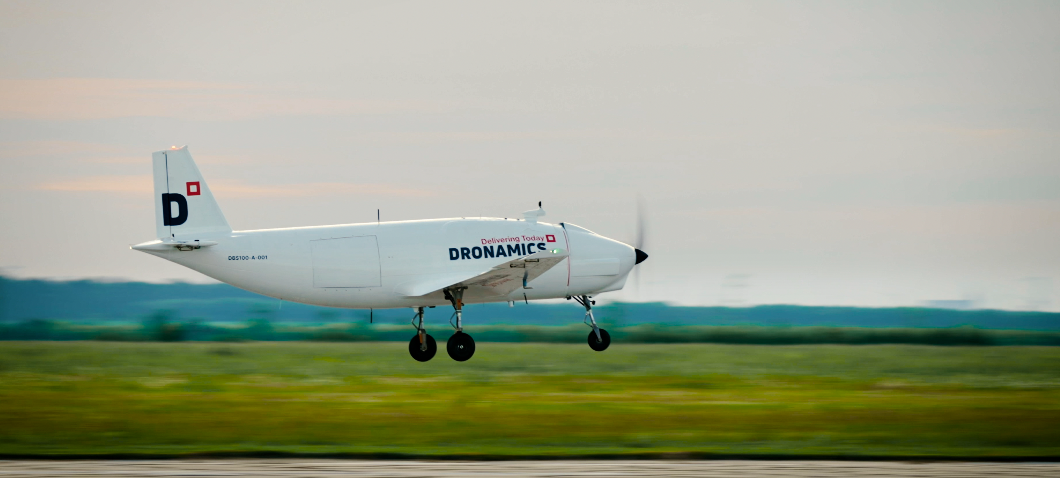
Dronamics started as a cargo drone company, and it is now betting that the same airframe can do much more than move boxes.
In a recent conversation, Svilen Rangelov, co founder and CEO of Dronamics, laid out his plan to build a long range platform that is cheap enough for cargo customers, then adapt it for higher value missions, from disaster relief to defence logistics and airborne sensing.
The core product is built for the “middle mile,” not doorstep delivery. Rangelov says last mile delivery already has people and vans ready to do the job and that the gap is moving small loads quickly between towns and regional hubs. Dronamic’s aircraft have a stated payload of 350 kilograms and a range of roughly 2,500 kilometres. The expectation is that one of their drones can service a wide region and by building centralized warehouses one location could service a wide range of customers.
Rangelov also wants to change the way we think about air cargo. Traditional air cargo has been built around waiting for very large aircraft to fill up, which makes it a last resort for many shippers. His view is that the economics change if you design the aircraft around the volume of a small delivery van, then fly it into the edge of a town where ground logistics already exist.
What changed in the past year is the customer set. Rangelov comes from a family steeped in Bulgaria’s military world, he says he always knew defence “plays by a different set of rules.” But he argues Europe’s push to prioritise European made systems has created an opening for a strategic sized, class three drone built and produced in Europe.
Dronamics is not yet flying commercial routes. Rangelov says the company plans to start cargo operations later this year in Bulgaria, and that it expects its first government contracts in the first half of the year. On the defence side, he sees immediate utility in military logistics, especially where road networks and cross border friction make moving equipment slower than it should be.
The more ambitious idea is to turn the platform into a sensor carrier. Rangelov described work to integrate radar payloads that could detect enemy drones at long range, effectively creating a distributed early warning layer. He framed it as a “mini AWACS” concept, with lower cost, fewer personnel at risk, and wider coverage through a fleet rather than one scarce, high value aircraft. He said Dronamics is working with European radar manufacturers and will share more soon.
For now, the company is working to prove repeatable operations in cargo and demonstrate the non-cargo capabilities that pull the platform toward defence, emergency response, and industrial missions. If successful, Rangelov and his team will have built the first European homegrown, strategic sized drone platform that can move goods, move sensors, and support mobility in a region that has historically been underserved logistically thanks to decades of poor road management.
“The vast majority of the world is actually punished by very long distances and we wanted to solve that curse of the long distance,” he said. “So domestic, regional movements can cover all of Europe from a single warehouse, all of the 48 states in the U.S. from a single warehouse.”