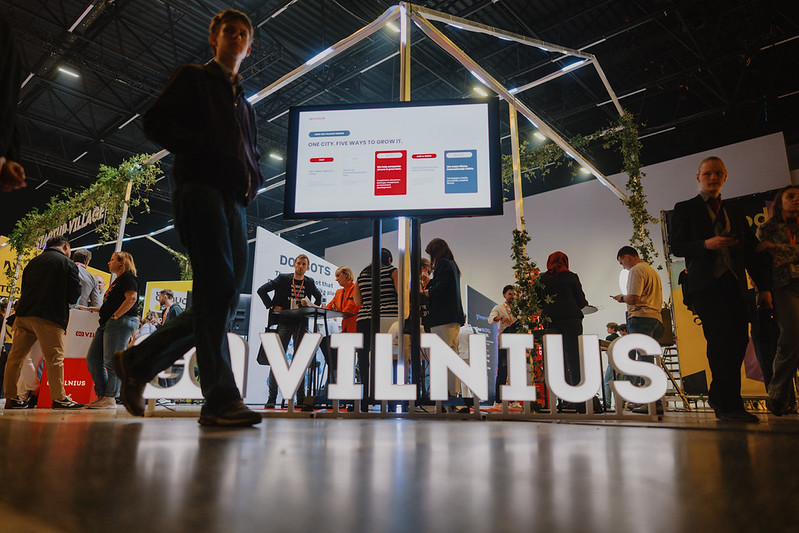
Earlier in September, Resilience Media was in Vilnius to find out more about some of the defence companies shaping the Lithuanian defence tech sector. The trip coincided with the annual tech conference Startup Fair.
The week got off to rather an “alarming” start as on Monday night, when the public alert system notified the public with a yellow warning of a “potentially detected drone.”
Turns out there was a drone, which entered Lithuanian airspace via Belarus, which was swiftly shot down by NATO fighter pilots. It was later confirmed that it was carrying an explosive payload that was neutralised by a bomb disposal team.
Crisis averted, and resolve focused, it was on to the companies building things to combat this very issue: an active threat from the East.
Blackswan Space
In better news coming out of the capital last week, space tech company Backswan Space announced that it had raised a €2.5 million round led by Iron Wolf Capital. The announcement was made by Marius Klimavičius, founder and CEO, as part of a panel of a breakfast meeting, organised by Aneli Capital, Nasdaq Vilnius, Iron Wolf Capital and Heartcore Capital, to kick off the Investor Camp. The company is developing hardware and software products for autonomous satellite operations, and it also announced that it would be launching its product into space in 2027. A launch date has been long-awaited: the company is already seven years in the making and only now feeling the fruits of its labour. We will take an exclusive look into the company next week during the official announcement.
RSI Europe
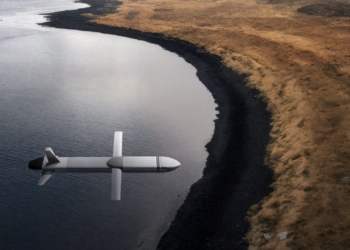
RSI Europe is a profitable company that is taking the defence sector by storm. Its remote striking products were deployed on the front lines in Ukraine within the first year of the company’s existence, amid Russia’s full-scale invasion, all while being entirely bootstrapped. CEO and co-founder Tomas Milašauskas had a news update for us.
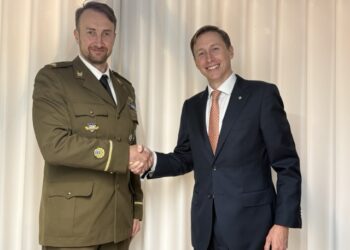
Together with the Minister of Economy and Innovation Edvinas Grikšas, RSI has signed a large-scale agreement to invest up to €50 million into the Panevėžys district of the city where it will expand its capacity to develop and manufacture advanced defence systems.
Broswarm
Long after the war in Ukraine finally ends (whenever that might be), evil will continue to lurk beneath its soil. Buried landmines in their thousands litter the kill zone and they will not magically disappear when the troops retreat.
I met with Broswarm CEO and co-founder Ernestas Žvaigždinas to hear about the Vilnius-based startup creating a land mine detection solution to remove harm for humans and animals.
Broswarm, founded in 2023 by Žvaigždinas his brother Karolis, Ramūnas Augulis and Mindaugas Talaikis, is developing a radar payload for drones that uses radio-wave reflections and synthetic-aperture radar techniques to detect underground landmines, regardless of the materials they are made from.
This is an example of how drone technology is being used in military scenarios but for non-combat and non-ISR purposes. The system is designed to scan approximately one hectare per hour, with swarm deployment. This is substantially faster than manual metal-detector searches.
The company has raised €1.3 million to date has the backing of ScaleWolf and business angels through NGL Ventures. It also won the 14th NATO Innovation Challenge in 2024.
Žvaigždinas told me that he is on the lookout for a drone company to partner with, something low-speed in the precision survey-drone category rather than a combat-drone manufacturer.
Startup Fair
During a Startup Fair panel made up of Jakob Knutssøn, Monopulse, Laurynas Šatas, Aklyvus Photonics, Rapolas Markevičius, PDKINEMATICS and moderated by Justinas Pašys, NGL Ventures explored what it takes to build and scale a defence tech company in Europe.
Obviously speed of procurement was a big topic. No-one seems to have solved that yet. Knutssøn noted that one of the biggest disadvantages for those wanting to sell to NATO militaries is that none of the technology can have any Chinese components. This means that every producer is “fighting over the same three or four suppliers, so it takes forever to get the parts.”

Knutssøn also said companies can’t restrict themselves when selling to NATO countries, if they “want to succeed and make a billion-dollar company” from day one you need to make “your business plan around selling to all NATO countries, and not only European NATO countries, all NATO countries, and in our case, we also say friendly nations. So that’s Japan, for instance.”
Pašys asked about the role of prime contractors. The big question is whether these outsized incumbent suppliers are “your competitors, your partners, customers, potential acquirers, or all.”
Šatas’ response was firmly on the last of these.
“All, always all, at different timelines. You cannot live without them,” he said. “You need to find ways to collaborate and make the best use of your technologies, capabilities, and knowledge to become a useful enabler. That’s the only option of scaling quickly in defence technology.”
Speaking of scaling, Markevičius spoke quite frankly on that topic and how it seems that technological progress has been trumped by success in scaling.
“Everyone thinks that five years of war probably resulted in some super crazy fancy technologies, and my take is that it didn’t,” he said. “Ukrainian technologies are at a similar level as European technologies. The only thing that they did miraculously is the scale. The Ukrainian defence tech innovation is not the products; it’s the scale that they can deliver. I think that’s what we should aim for in Europe as well.”
Resilience wins the pitch battle
Defence and resilience featured in the Startup Fair pitch battle with the top spots going to Halide Energy, manufacturers of long-duration energy storage systems; 3P-Defence, developing modular counter-drone systems; and space tech startup UVIRESO. The winners are invited for negotiations with Aneli Capita, BSV Ventures, Coinvest Capital and Lithuanian, Latvian and Estonian business angel networks for €5 million investments.