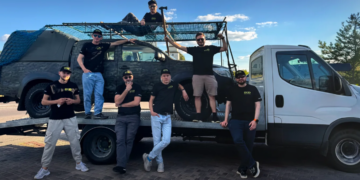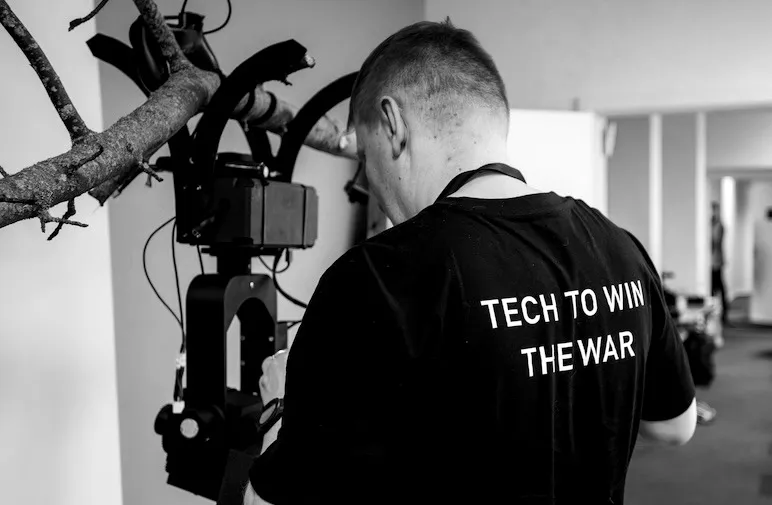
Last week, Estonian defence tech group Darkstar ran their largest hackathon yet. The event was at an undisclosed location in Estonia and gathered over 230 people travelling in from around the region and across Europe, a total of 16 countries, along with soldiers from Ukrainian frontline units as mentors.
Of course, in Estonia, a hackathon gets the benefit of mentors who have held senior positions in many of Europe’s most successful startups. Having some of Europe’s most experienced and talented engineers, Ukrainian frontline forces, and experts from across the region working on real life problems was unique to watch.
This is hacking at its most real.
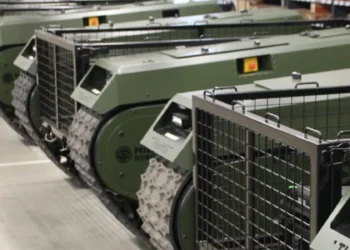
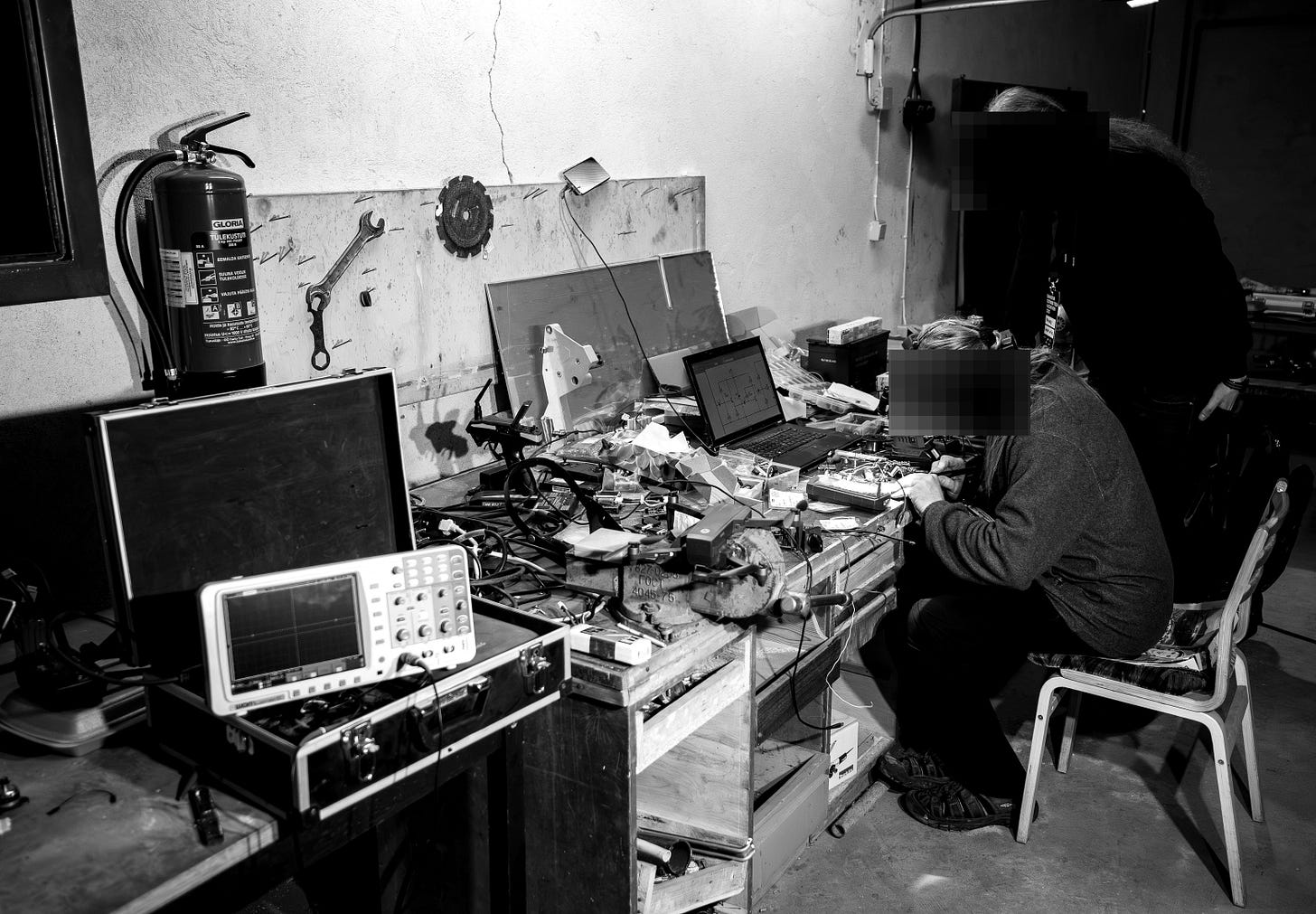
The building was filled with hardware, tables with rows of 3D printers hummed whilst teams were drilling and welding metal sheets and others sat hunched over laptops coding. One room had teams working on disinformation and propaganda, other teams on drones. Tables were littered with gimbles, engines, headsets, and even a subsea drone that a team had built that day. Some of the rooms looked like fully established offices, with people crowded around multiple screens pouring over maps, satellite images, and dense lines of code. Another room was strewn with motors and axles, bits of UGVs and robotic turrets, with a team building out a laser turret. This is hacking at its most real.
As I walked into the building, a Ukrainian founder called Viktor sat me down and fitted a VR headset over my head. Without any warning from him, I was suddenly in a Ukrainian frontline trench under attack from a drone. People were scattering as I could hear the drone getting nearer from behind me. There was an explosion. A man nearby started screaming, half of his leg missing and blood pouring onto the mud. Another explosion, then Russian soldiers started to advance. I saw men being shot as they clambered into the trench. The arm of the man whose view I was sharing was shot and blood sprayed into my eyes.
It was startling, totally immersive, and left me shaken for the rest of the day. This is a training tool Viktor has developed with psychologists to help prepare Ukrainian army recruits for deployment. He told me how over 30% of new soldiers freeze or run away when they first go into battle. As part of their training, they watch these VR videos again and again to condition their brains to prepare them mentally for battle. It is the repetitive nature of the training that is key, to get their minds used to the emotional response. This set the tone for the next two days.
‘Will this work? Would you use this?’
The pitches at the end of the weekend lasted 90 minutes as 32 teams presented their work in quick succession. Assumptions were tested with the Ukrainians soldiers in the audience – ‘will this work? Would you use this?’
With an estimated 23% of Ukrainian land contaminated by mines, two of the teams were focussed on mine clearing. Both presented autonomous vehicles that could be programmed to clear mines without risk to personnel. During the pitches, one team drove a full scale UGV onto the stage as the presenter did his pitch.
There was also a focus on drone detection to cope with increasingly sophisticated fiber optic and AI controlled drones. One team built a working real time radar detection unit, whilst others were tuning into the electromagnetic frequency of drone engines.
Another team looked at how to track military assets on a blockchain. As well as being able to track assets, it can identify units that are losing more assets than usual to help root out corruption. The solution was conceived and built by a team from Lithuania, Estonia, Ukraine, and the UK.
With 51 attacks on undersea cables in 3 years causing 2bn Euros of damage, two teams were looking at how to protect infrastructure underwater. One presented an autonomous underwater drone they had built and tested over the weekend. They’ve been working on this topic for 2 years, and are focussed on reducing the cost of a unit from the current $1m to nearer $100,000. The one they built over the weekend was the cheapest, fastest drone they have built. Having shown it works, they were asking for support from the Ukrainian military to test it further, and funding from the Estonian government as a grant or investment.
Deep strike drones have become key to the war, taking out Russian infrastructure well over the border. But they cannot easily be tracked, so as the team explained ‘we don’t know if they’ve succeeded until we see reports on the Russian news.’ This team worked on undetectable radio communications so the drones can send coordinates or other data back to the operators to confirm the outcome of their mission.

There was an array of serious and ingenious solutions for sensing fibre optic drones. A focus of many of the teams was on producing equipment that already exists in the field, but for significantly lower cost. It was impressive to see prototypes based on Raspberry Pi and other off-the-shelf components offering deployable capabilities for the low hundreds of Euros instead of tens or hundreds of thousands.
We were two hours from the Russian border
The Darkstar events take place two hours from the Russian border. The attendees feel a real threat, and mix regularly with Ukrainian soldiers. Plenty of the teams were producing hacks designed to be lethal or which addressed the safety of Ukrainian troops. One idea prevented ordnance from exploding on a drone until it was a safe distance from the team launching it, addressing what the team explained was the huge risk taken by soldiers fitting explosives to drones.
The Darkstar team understood and reminded people that this was about exploring problems and building solutions, but also about building networks. People from the 16 countries worked together, spent the weekend together, and built new teams and contacts. This sort of network makes Europe more resilient and is essential.
Ragnar Sass, of Darkstar, told the audience that ‘the point of this is to help Ukraine to win, and to win we cannot look past lethal technologies. But also, Estonia needs your input and needs new modern weapons systems to be ready for anything. We help you and you help us, and together we can destroy Mordor.’
The hackathon was raw, with uniformed Ukrainian soldiers standing outside talking in the snow over the sound of teams nearby testing drones and UGVs. The Ukrainian soldiers were young, modest, charming, and intelligent. They always thank people for their support, though we corrected them and thanked them for protecting us. At the end of the event, they received a very long, very passionate ovation.