
Sunday 15 March, 2026
[email protected]
Resilience Media
  • About
  • News
  • Resilience Conference
    • Resilience Conference Warsaw 2026
    • Resilience Conference Copenhagen 2026
    • Resilience Conference London 2026
  • Guest Posts
    • Author a Post
  • Subscribe
No Result
View All Result
  • About
  • News
  • Resilience Conference
    • Resilience Conference Warsaw 2026
    • Resilience Conference Copenhagen 2026
    • Resilience Conference London 2026
  • Guest Posts
    • Author a Post
  • Subscribe
No Result
View All Result
Resilience Media
No Result
View All Result

Frankenburg has raised up to $50M at a $400M valuation, say sources

The Baltic counter-drone startup is finding momentum amid an increased concern over drone incursions from adversaries

Ingrid LundenJulia GiffordbyIngrid LundenandJulia Gifford
January 28, 2026
in News
Frankenberg CEO Kusti Salm at Resilience Conference 2025

Frankenberg CEO Kusti Salm at Resilience Conference 2025

Share on Linkedin

There are multiple thousands of kinetic and battle-ready drones being produced for use in Ukraine every month, but not just by Allied countries – by adversaries, too. Whatever use drones might have in future active combat beyond Ukraine, that drone race is putting a spotlight on startups building protection against incursions. In one of the latest developments, Frankenburg — a startup building low-cost, AI-based anti-drone missile systems — is ramping up. And to fuel that growth, Resilience Media has learned that it has raised capital approaching $50 million at a valuation of around $400 million.

You Might Also Like

US and UK ballistic missile defence capabilities brought into focus as Iran lashes out against region

Scout Ventures raises $125 million to expand investment in defence and dual-use tech

The signal is the weapon: How mobile networks became infrastructure for modern war

Multiple sources say the round is closed and will be announced soon. The funding is bringing in a slate of new investors, they added, and may lay the groundwork for a bigger round possibly as soon as later this year. Current backers of the startup include London’s Blossom Capital, Shellona Ltd, Estonian private equity firm MM Group, and the CEO of Milrem Robotics, Kuldar Vaarsi.

Big investors and supporters of defence tech in Europe have included General Catalyst and Plural, both of which declined to comment for this story.

Other investors that Resilience Media contacted explicitly said they were not involved in the round.

Kusti Salm, the CEO of Frankenburg, declined to comment for this story. We will continue to update this story as we learn more.

The investment is not only an important milestone for Frankenburg; it also underscores some bigger themes in defence technology moving into 2026.

Why counter-drone technology?

Frankenburg, based across Estonia and Latvia, was started in early 2024 after prominent Baltic technology founders and investors got behind the idea of building fast-to-produce, cheaper anti-drone missile systems specifically in aid of Ukraine.

But in the two years since, drones have grown more sophisticated; swarm-based use has become more commonplace in the war-torn country; and unwelcome drones and other objects are increasingly appearing in other countries’ airspace. And so more countries have started to think more about how to arm themselves with more updated defence technology against drone incursions on their own territories.

That has led to more attention for a range of companies. Some take a “soft-kill” (software-based) approach using radio magnetic spectrum. Some like Frankenburg build hardware and software – others in the space include Latvia’s Origin Robotics and LMT; Estonia’s DefSecIntel Solutions; Cambridge Aerospace in the US; and Atreyd from France – and approaches range from missile systems like Frankenburg’s to concepts for “drone walls”.

Frankenburg’s moment

There have been some milestone funding rounds for defence tech, including General Catalyst-backed Helsing last year raising at a what was believed to be a €12 billion valuation. For Frankenburg, a round of this size at this valuation is a big step.

The startup has disclosed than $5 million in seed funding, according to PitchBook data, with a post-money valuation of around $161 million (€160 million).

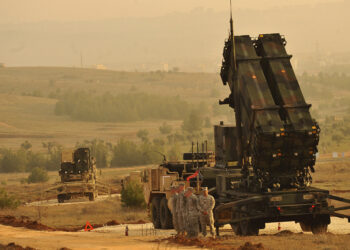
But with the bigger focus on counter-drone systems, it’s found momentum. Frankenburg has used the modest amount it has raised so far to expand its geographical footprint (such as this UK headquarters established in December 2024) and build and test its systems (it showed off this Shahed interceptor in Latvia in December 2025). Earlier in January, it announced a partnership with Babcock, the UK prime, to develop a maritime counter-drone system to protect ships, ports and off-shore assets.

Frankenburg’s star bench

For a Baltic defence startup, Frankenburg has an impressive network of people connected to it.

Taavi Madiberk — who is credited as the (sole) co-founder and is now the company’s non-executive chairman — is also the CEO and founder of next-generation energy storage/battery startup Skeleton Technologies. Martin Herem, an Estonian retired military commander, is an advisor. Milrem Robotics’s Vaarsi is also a board member in addition to strategic investor. And Salm, who joined as CEO in September 2024, has a pretty impressive resume, too: he’s currently a director at the NATO Innovation Fund (itself a prominent defence tech investor) and he was previously the permanent secretary in Estonia’s Ministry of Defence, among other roles.

This raft of people has helped the company launch, and has likely opened funding doors.

The funding climate remains hot for defence startups

Last year saw a record amount of money get channeled into startups in defence and the wider category of resilience, which, depending on how you cut it, was between $49.1 billion (PitchBook) and a more conservative $7.1 billion (Crunchbase).

This is due to multiple reasons: the geopolitical threat climate; the evolving technology of weapons; and the changing military mindset around accessing startups to stay on top of that innovation. All of this has led to more willingness and money to fund defence tech, and an easier route for bidding for and winning contracts.

Salm telegraphed as much during an interview at Resilience Conference last year, where he noted how bids have become significantly more compressed, while money availability has expanded.

It’s the “first time in 70 years we are in this situation, where there is private money available for developing defence technology and weapons,” he said on stage.

Meanwhile, business development has massively shifted.

“Conventionally the way the defence market works is that the customer comes in with their requirement,” Salm continued. “And the requirement is not a drawing on a whiteboard. It’s 800 pages of spec.” These days, you are more likely to see founders playing a role in defining requirements, he said. Speed of production, affordability and a flexible approach to “minimum viable product” are all considered.

One small cloud…

Some believe that the enthusiasm and disruptive new approaches may be resulting in too much haste. “We hear their product is not really performing that well and their commercial traction and revenues are not that great,” grumbled one investor when asked about the company. Others, clearly, disagree.

 

Tags: counter-droneDronesEstoniaexclusiveFrankenburgfundingLatvia
Previous Post

Ukraine says drone campaign logged nearly 820,000 verified strikes in 2025, with UAVs driving majority of battlefield interactions

Next Post

Weekly Digest: Drones now destroy 80% of Russian targets in Ukraine, Frankenburg raises $50M at $400M valuation

Ingrid Lunden

Ingrid Lunden

Ingrid is an editor and writer. Born in Moscow, brought up in the U.S. and now based out of London, from February 2012 to May 2025, she worked at leading technology publication TechCrunch, initially as a writer and eventually as one of TechCrunch’s managing editors, leading the company’s international editorial operation and working as part of TechCrunch’s senior leadership team. She speaks Russian, French and Spanish and takes a keen interest in the intersection of technology with geopolitics.

Julia Gifford

Julia Gifford

Julia Gifford is a Canadian-Latvian writer and communicator, a tech advocate who gets excited about telling the world about Europe’s tech excellence and impactful initiatives from the region. She has recently published her first book, Treasures of Latvia, and has previously written for Tech.eu, Labs of Latvia, and more.

Related News

US and UK ballistic missile defence capabilities brought into focus as Iran lashes out against region

US and UK ballistic missile defence capabilities brought into focus as Iran lashes out against region

byTom Pashby
March 12, 2026

The ballistic missile defence capabilities of the US, UK and other allies have been put to the test as the...

Scout Ventures raises $125 million to expand investment in defence and dual-use tech

Scout Ventures raises $125 million to expand investment in defence and dual-use tech

byJohn Biggs
March 11, 2026

Scout Ventures has closed its fifth fund with $125 million in commitments, according to an announcement released March 10. The...

The signal is the weapon: How mobile networks became infrastructure for modern war

The signal is the weapon: How mobile networks became infrastructure for modern war

byJohn Biggs
March 11, 2026

Mobile World Congress (MWC) has been around since 1987. The conference, part trade fair, part consumer electronics expo, and part...

Hadean, the AI battle simulation startup, closes bridge round ahead of a Big B

Hadean, the AI battle simulation startup, closes bridge round ahead of a Big B

byIngrid Lunden
March 11, 2026

London-based Hadean began life several years ago as an AI gaming startup working on VR and video simulations, but it...

Hackathon-ing our way to a new defence ecosystem

Hackathon-ing our way to a new defence ecosystem

byFiona Alston
March 11, 2026

It takes a village to raise a child, but when it comes to building the next generation of defence in...

Lux Aeterna raises $10 million to build reusable, returnable satellites

Lux Aeterna raises $10 million to build reusable, returnable satellites

byJohn Biggs
March 10, 2026

Lux Aeterna, a Denver based space infrastructure startup, just raised a $10 million seed round led by Konvoy Ventures with...

Credit: Mcmurryjulie via Pixabay

Trojan force: Hidden backdoors may lurk inside AI models, report says

byPaul Sawers
March 10, 2026

What if an AI model carried hidden instructions that only activate when triggered by a particular input? That’s the subject...

The launch of Isembard’s innovative approach to manufacturing

Isembard raises $50M, plans to open 25 ‘AI-powered factories’

byIngrid Lunden
March 9, 2026

Isembard, a London startup that’s built a platform to help hardware makers in defence, aerospace and robotics manufacture components and...

Load More
Next Post
Weekly Digest: Drones now destroy 80% of Russian targets in Ukraine, Frankenburg raises $50M at $400M valuation

Weekly Digest: Drones now destroy 80% of Russian targets in Ukraine, Frankenburg raises $50M at $400M valuation

cloudy skies

Europe’s cloud future is about collaboration

Most viewed

InVeris announces fats Drone, an integrated, multi-party drone flight simulator

Uforce raises $50M at a $1B+ valuation to build defence tech for Ukraine

Auterion, the drone software startup, eyes raising $200M at a $1.2B+ valuation

Twentyfour Industries emerges from stealth with $11.8M for mass-produced drones

Senai exits stealth to help governments harness online video intelligence

Palantir and Ukraine’s Brave1 have built a new AI “Dataroom”

Resilience Media is an independent publication covering the future of defence, security, and resilience. Our reporting focuses on emerging technologies, strategic threats, and the growing role of startups and investors in the defence of democracy.

  • About
  • News
  • Resilence Conference
    • Resilience Conference Copenhagen 2026
    • Resilience Conference Warsaw 2026
    • Resilience Conference 2026
  • Guest Posts
  • Subscribe
  • Privacy Policy
  • Terms & Conditions

© 2026 Resilience Media

No Result
View All Result
  • About
  • News
  • Resilence Conference
    • Resilience Conference Copenhagen 2026
    • Resilience Conference Warsaw 2026
    • Resilience Conference 2026
  • Guest Posts
  • Subscribe
  • Privacy Policy
  • Terms & Conditions

© 2026 Resilience Media

This website uses cookies. By continuing to use this website you are giving consent to cookies being used. Visit our Privacy and Cookie Policy.