Russia’s invasion and war in Ukraine is now well into its third year. Darkstar has built a platform to find and hone innovations to support the home team and finally help Ukraine win.
The coalition of some 30 founders, developers, and investors from Estonia and other countries in Europe has a €25 million fund in the works to back the most promising defence tech startups (with €15 million committed so far). And last month, Darkstar held its latest bootcamp to source and showcase the latest defence technologies.
Darkstar’s most immediate aim and focus, in the words of co-founder Ragnar Sass, is quite singular. The “one mission” of Darkstar, he said introducing the event in Kyiv, is helping Ukrainians “kill the enemy and win the war.”
But the bigger picture is just as important: it is laying the groundwork to build up the defences for Europe and the whole NATO bloc, and to do it as quickly as possible.
“This war is all about fast learning loops,” Sass noted earlier. One of Ukraine’s most advanced brigades, he added, has a data team of 70+ people.
Across five days, 17 participating startups got a chance to demonstrate their products, receiving feedback from both military personnel and investors.
The pace of technology development has been a cornerstone of how the war in Ukraine has played out. As Sass noted, Ukraine has been using the first drone interceptors powered by AI. These have to-date taken down more than 100 Shahed drones launched by Russia.
“Finally, AI and ML tools are making a real battlefield impact,” he notes, “getting closer to enabling real autonomy [beyond] target identification, tracking and last-mile delivery.”
But innovation has not been one-sided, and that’s what makes the work Darkstar does especially important.
Both sides are “racing” to develop jet-engine-powered drones, he said, which will render existing interceptors obsolete. “The cat-and-mouse cycle is getting faster – it used to take 3 months to counter new tech, now it might be just 1.”
The bootcamp in Kyiv followed the regular format that Darkstar has used for past events, which have also included hackathons in Estonia, a hackathon in Finland, and previous bootcamps in Kyiv.
But during the past year in Ukraine, perhaps because of the action on the ground (and in the air) Darkstar has taken on a deeper role.
“It is a great community,” says Denys Yermolenko, the teen co-founder of Xnet.
We first met Denys a few months ago at the previous Darkstar bootcamp in Kyiv, and so we asked about the progress his company has made since then.
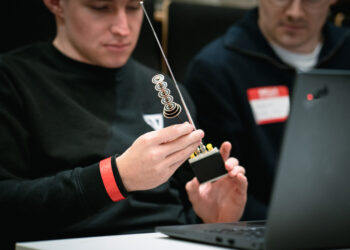
Out of his pocket, he casually pulled out a shotgun cartridge with a Kevlar net folded inside it. The product is a scalable instrument to counter drones. When shot, the mesh extends in front of the UAV and traps the rotor blades.
Recently, Xnet partnered with a producer of shotgun shells and is now about to ramp up the production of these cartridges. After showing us his latest model, Denys – who turned 18 this year (startup founders can be as young as 14 under Ukraine law) – moved on to talk to a US Armed Forces veteran.
Xnet’s way to counter drones did not materialise out of thin air. Kinetic defence is growing in popularity as the electromagnetic spectrum turns into the most contested domain.
Since the widespread use of FPV drones on the frontlines, the cat-and-mouse game between drones and drone jammers has become a defining feature of modern war.
Due to their modular construction, FPV drones can be swiftly adapted to emerging electronic warfare techniques. In response, drone jamming has become significantly more sophisticated – and bulky. Now a typical jammer is transmitting high-power noise across a broad range of frequencies, covering the drone’s communication channels.
Spectrator, a Ukrainian team that participated in the bootcamp, is solving this problem in a different way. Their system scans and identifies the communication frequencies being used by drones and jams the signals accordingly by using low-energy attacks.
Yehor, an engineer on the team who declined to give his surname, demonstrates this by turning on two drones operating on different frequencies. First one, then another band shows up in the user interface. Yehor toggles two buttons, and the drones quickly stop buzzing – the communication link between the drones and controllers is broken.
Spectrator’s device is smaller than a traditional jammer. In one case, Yehor says, Russian forces had trouble locating it on the battlefield. They did destroy Spectrator’s jammer – but only after destroying everything around it, too.
Another participant of the bootcamp operates on the opposite side of the barricade. Meet COALAS::Systems, a Ukrainian startup producing radio equipment which allows drones to cover long distances using unorthodox radio frequencies.
For instance, the company produces a kit to control a drone using the RF bands in a range usually utilised for marine communications and – at least so far – it is not easily jammable. The total for this set barely exceeds $300. Another array, developed by COALAS::Systems, is operating at a higher bandwidth and secures the control over drones at distances up to 84 kilometers. Selling these kits, the company has already grossed roughly $150,000 last year.
The company, which recently received a Military Choice award from Ukraine’s Defence Builder accelerator, decided to participate in Darkstar because it is now developing a new ambitious project. “NADRA is an advanced radio control solution with support of GPS-free geolocation, synchronous control over the group of drones and resilient data encryption,” said the startup’s cofounder Ievgen.
It is not just the Ukrainian startups that participated in this edition of Darkstar’s bootcamp. An Estonian startup called Dalos develops a platform for digital radio frequency communications that allows the user to send a video signal from a UAV to the pilot at a range of more than 20 kilometres, using frequency bands that are currently rarely used.
Dalos was flanked by a Latvian company called Submerge Baltic, an autonomous underwater drone producer that has, since 2022, been working on products for scenarios playing out in the Baltic Sea. Darkstar has now enabled the company to come to Ukraine and test their drones in the Dnipro river.
In the past half a year, the most senior Ukrainian government officials have aimed to create win-win partnerships between Ukrainian and European defence innovation companies.
As for what comes next, some have questioned whether there has been an over-focus on drones, although that still seems to be where some of the biggest threats, and thus innovations, are coalescing.
“We saw promising products that will help to build totally new capabilities,” said Sass. “Imagine a drone that can carry 1,000 kilogrammes. [That would] completely change traditional aviation.”