Friday 1 May, 2026
[email protected]
Resilience Media
  • About
  • News
  • Resilience Conference
    • Resilience Conference Warsaw 2026
    • Resilience Conference Copenhagen 2026
    • Resilience Conference London 2026
  • Guest Posts
    • Author a Post
  • Subscribe
No Result
View All Result
  • About
  • News
  • Resilience Conference
    • Resilience Conference Warsaw 2026
    • Resilience Conference Copenhagen 2026
    • Resilience Conference London 2026
  • Guest Posts
    • Author a Post
  • Subscribe
No Result
View All Result
Resilience Media
No Result
View All Result

Resilience Conference 2025: The Adoption Gap

John BiggsbyJohn Biggs
November 6, 2025
in Resilience Conference
Share on Linkedin

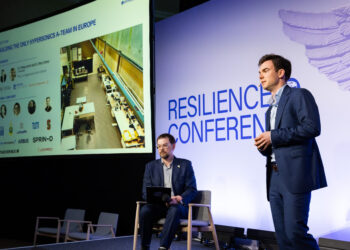
At this year’s Resilience Conference in London, co-founder Leslie Hitchcock opened with a plain truth: “Getting defense tech from investment to deployment is very hard.”

You Might Also Like

Jacek Siewiera: a future NATO conflict will be fought against civilian targets

Sten Tamkivi: Poland’s defence start-ups should be seen as future GDP drivers

Where are Poland’s defence unicorns?

The panel set out to explain why, and how to fix it. On stage were Ryan Benitez, chief commercial officer at NATO DIANA, John Ridge, chief adoption officer at the NATO Innovation Fund, and Jennifer Nelson, executive vice president at IQT.

Nelson traced the adoption problem to the gap between demos and real users. “We’re not just creating this sort of innovation theater, but actually taking that technology and getting it into the hands of the users.” She said InQTel built teams that study end customers and translate needs for startups. It sounds simple. It is not. “We’ve doubled down on it,” she said, after twenty-six years of doing the work.

Benitez described DIANA’s push to match scale with capital. “One of the mandates that we have at NATO DIANA is to build out a trusted network of investors,” he said. The program is working with about three hundred companies this year, which means the money and the mentors must keep pace. Wartime pressure only sharpens that need. “It’s about our ability to rapidly spin up something off cycle,” he said. “Let’s rapidly stand up the experimentation and get the feedback loop going with the end users.”

Ridge explained why normal product-market fit does not carry you in defense. “That is not the same when you’re selling into government,” he said. End users, requirement writers, contracting, and finance are split. “You’ve got this really convoluted chain that you need to work through and it takes time and it takes effort.”

The NATO Innovation Fund built a mission platform group to push through three things at once, adoption with real users, protection on cyber and clean cap tables, and responsible use. He also pointed to primes, old and new, as a path to market for startups that sell subsystems or new manufacturing methods.

The discussion kept coming back to speed. Ridge said war changes behavior. It removes delay and brings engineers close to operators. He warned that peacetime habits do the opposite. “We drag them further and further apart and put lots of well meaning people in the gap.” His bluntest point was about money. “If you don’t have uncommitted money in your program, you cannot afford to do proper innovation.”

Panelists agreed that some governments are getting this right. They tagged the Netherlands, the Nordics, and Estonia as places where forward momentum was strong. Benitez flagged DIANA’s Rapid Adoption Service, which lets nations with slow or complex procurement use DIANA for prototyping buys. “We can source from the DIANA portfolio and make that happen very quickly,” he said.

Capital stacks matter too. Different investors do different jobs. Ridge noted that large funds can bridge into growth rounds, corporate funds can open supply chains and platform slots, and public investors like NIF bring adoption muscle. “We shouldn’t all be trying to do each other’s business,” he said. Nelson added a caution. Not every investor needs to track every program. Founders should lean on trusted co-investors who live close to the mission and can guide where time is best spent.

The call to action was clear. “It does not count until it’s adopted,” Ridge said. Benitez put faith in founders once the path is open. “If we give them the problem set, they will figure it out.” Nelson closed the loop with a reminder that the ecosystem must carry some weight. “Startups are a crucial part of the national security apparatus,” she said. “But they need support, and they need to be advised in a way that works for what they’re looking to accomplish, and for the investors who have put money into those startups.”


Tags: Dr Jennifer NelsonIQTJohn RidgeNATO DIANANATO Innovation FundNIFRyan Benitez
Previous Post

Resilience Conference 2025: How Defence Startups Can Disrupt the Incumbents

Next Post

Digest 47: The lesson from Haraka Storm: Europe’s defence startups must be allowed to stumble if they’re ever to stand ready

John Biggs

John Biggs

John Biggs is an entrepreneur, consultant, writer, and maker. He spent fifteen years as an editor for Gizmodo, CrunchGear, and TechCrunch and has a deep background in hardware startups, 3D printing, and blockchain. His work has also appeared in Men’s Health, Wired, and the New York Times. He has written nine books including the best book on blogging, Bloggers Boot Camp, and a book about the most expensive timepiece ever made, Marie Antoinette’s Watch. He lives in Brooklyn, New York. He runs the Keep Going podcast, a podcast about failure. His goal is to share how even the most confident and successful people had to face adversity.

Related News

Jacek Siewiera: a future NATO conflict will be fought against civilian targets

Jacek Siewiera: a future NATO conflict will be fought against civilian targets

byResilience Media
April 24, 2026

The wars in Iran and Ukraine have underscored how civilian infrastructure will become a feature of future conflicts. And Poland’s...

Sten Tamkivi: Poland’s defence start-ups should be seen as future GDP drivers

Sten Tamkivi: Poland’s defence start-ups should be seen as future GDP drivers

byResilience Media
April 24, 2026

Sten Tamkivi, a partner at Plural and an early Skype executive, joined Resilience Media publisher Leslie Hitchcock on stage during...

Where are Poland’s defence unicorns?

Where are Poland’s defence unicorns?

byResilience Media
April 24, 2026

"Where are the Polish unicorns in defence?" asked Marcin Hejka, managing partner at OTB Ventures, one of Poland's largest deep-tech...

Klaus Hommels of Lakestar talks about defence consolidation and the future of procurement

Klaus Hommels of Lakestar talks about defence consolidation and the future of procurement

byJohn Biggs
April 15, 2026

Investor and entrepreneur Klaus Hommels, founder of Lakestar, sees a new era of European defence spending and investment. His comment?...

Serhii Kupriienko to speak at Resilience Conference Warsaw

Karl Rosander (Nordic Air Defence) and Maciej Klimczak (Tantalit) to speak at Resilience Conference Warsaw

byLeslie Hitchcock
April 9, 2026

Resilience Conference Warsaw takes place on April 15 for a gathering of the defence tech ecosystem in Poland. The event...

Weekly Digest: Battlefield to Nasdaq – Inside Swarmer’s public listing; CEO Serhii Kupriienko to speak at Resilience Conference Warsaw

Weekly Digest: Battlefield to Nasdaq – Inside Swarmer’s public listing; CEO Serhii Kupriienko to speak at Resilience Conference Warsaw

byLeslie Hitchcock
March 26, 2026

This is a copy of our Weekly Digest newsletter. Subscribe for free here to receive this newsletter in your inbox. ...

Serhii Kupriienko to speak at Resilience Conference Warsaw

Serhii Kupriienko to speak at Resilience Conference Warsaw

byLeslie Hitchcock
March 26, 2026

Resilience Conference Warsaw is fast approaching on April 15. The one-day event will convene the defence tech ecosystem in Poland...

Announcing the Resilience Conference Warsaw Agenda

byLeslie Hitchcockand1 others
March 19, 2026

We are excited to announce the agenda for Resilience Conference Warsaw, 15 April 2026. This is the first conference of...

Load More
Next Post
Digest 47: The lesson from Haraka Storm: Europe’s defence startups must be allowed to stumble if they’re ever to stand ready

Digest 47: The lesson from Haraka Storm: Europe’s defence startups must be allowed to stumble if they’re ever to stand ready

Food on the Frontline: Ukraine to Deploy Autonomous Smart Kitchens via Robotics Firm Circus Defence

Most viewed

InVeris announces fats Drone, an integrated, multi-party drone flight simulator

Uforce raises $50M at a $1B+ valuation to build defence tech for Ukraine

Auterion, the drone software startup, eyes raising $200M at a $1.2B+ valuation

Senai exits stealth to help governments harness online video intelligence

Palantir and Ukraine’s Brave1 have built a new AI “Dataroom”

Twentyfour Industries emerges from stealth with $11.8M for mass-produced drones

Resilience Media is an independent publication covering the future of defence, security, and resilience. Our reporting focuses on emerging technologies, strategic threats, and the growing role of startups and investors in the defence of democracy.

  • About
  • News
  • Resilence Conference
    • Resilience Conference Copenhagen 2026
    • Resilience Conference Warsaw 2026
    • Resilience Conference 2026
  • Guest Posts
  • Subscribe
  • Privacy Policy
  • Terms & Conditions

© 2026 Resilience Media

No Result
View All Result
  • Home
  • Subscribe
  • About
  • Events
  • Guest Posts
  • Interview
  • News
  • Resilience Conference London 2026
  • Resilience Conference Copenhagen 2026
  • Resilience Conference Warsaw 2026
  • Startups
  • Venture
  • Weekly Digest

© 2026 Resilience Media

This website uses cookies. By continuing to use this website you are giving consent to cookies being used. Visit our Privacy and Cookie Policy.