Monday 27 April, 2026
[email protected]
Resilience Media
  • About
  • News
  • Resilience Conference
    • Resilience Conference Warsaw 2026
    • Resilience Conference Copenhagen 2026
    • Resilience Conference London 2026
  • Guest Posts
    • Author a Post
  • Subscribe
No Result
View All Result
  • About
  • News
  • Resilience Conference
    • Resilience Conference Warsaw 2026
    • Resilience Conference Copenhagen 2026
    • Resilience Conference London 2026
  • Guest Posts
    • Author a Post
  • Subscribe
No Result
View All Result
Resilience Media
No Result
View All Result

Resilience Conference 2025: How Defence Startups Can Disrupt the Incumbents

John BiggsbyJohn Biggs
November 6, 2025
in Resilience Conference
Share on Linkedin

Delian Alliance Industries is a Greek defense startup founded by engineers with big-tech backgrounds.

You Might Also Like

Jacek Siewiera: a future NATO conflict will be fought against civilian targets

Sten Tamkivi: Poland’s defence start-ups should be seen as future GDP drivers

Where are Poland’s defence unicorns?

“I spent six years with Apple, one of our key software engineers was seven years with Facebook,” said CEO Dimitrios Kottas. The team formed in 2021 in response to shifting security risks in Europe. Their first customers are the Greek Ministry of Climate Crisis and the Hellenic Army.

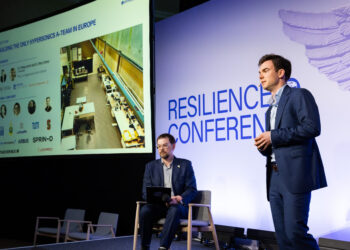
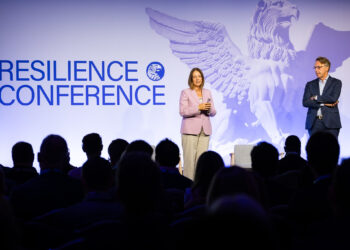
We spoke to Kottas on stage at the Resilience Conference in London this year. He told us that his product focus is integration.

“The main solution we provide is connecting any of their sensors, either legacy radars, cameras on drones, legacy cameras, in one single software brain,” he said.

Around that software, the company builds supporting hardware, including surveillance towers, portable comms boxes, and edge computers. The goal is to deliver an end to end system rather than a single component.

Why Greece? Cost, access, and speed.

“It was simpler for us to start there,” Kottas said. “I don’t believe there is a lot of value in providing specific components. You unlock the value when you provide an end to end solution, where you become a full system integrator. To do that, it’s very expensive in the US.”

He added that Greece was a proving ground and that his ambitions were definitely outsized.

“We picked a small European and NATO nation where we could figure out building a defense company. We’re building a prime,” he said.

They’re well on their way. The company has raised $22 million to date. A fifth of the team are British citizens, and much of the software is now written in the UK.

Kottas was blunt about the state of the art in defence tech and he didn’t mince words on stage.

“There are middle powers or large powers right now that build lethal robots. They call them drones, but effectively they are lethal robots. The genie is out of the bottle.” He argued for a measured approach. “It’s wrong to promise full autonomy for weapon systems,” he said.

The company’s position is human in the loop.

“The viable path right now is to start with level three systems and gradually walk our way up to level four systems while maintaining the human in the loop.” He pointed to lessons from self driving. “The automotive industry and the whole tech industry have spent more than 15 years trying to build level five systems. They still have not managed to do that at large scale.”

On mission and urgency, Kottas described the wake up call that led him to leave Silicon Valley.

“I was watching footage of small units getting wiped out by drones as if someone plays a video game. I lost my sleep on that, as a roboticist. I decided to act.” He views the coming years as a broad technical rebuild. “We are sitting in front of a giant infrastructure project, the revamp of air defenses. Many nations have relied on the axiom that they can maintain air superiority. That is being questioned.”

On Europe’s edge, he sees urgency and focus. “For many of those member states, preparing for a potential near peer conflict is not sci fi,” he said. That reality shapes teams and timelines. It also raises the bar for capital and procurement. Europe has early stage money, but few funds that will write large checks for deep tech. Procurement still favors incumbents in many countries. “That made sense during peacetime. I don’t think it’s going to make sense going forward.”

The takeaway is simple: Delian wants to grow from a small market proof into a prime that delivers an integrated sensor to decision stack. Human in the loop stays. Scope creep on autonomy does not.

“Educating governments and policymakers on what is feasible with autonomy and what is not is part of the job,” Kottas said.

Tags: Delian Alliance IndustriesDimitrios Kottas
Previous Post

From Cost-Plus to Code-First: The Radical Shift in Europe’s Defence Tech

Next Post

Resilience Conference 2025: The Adoption Gap

John Biggs

John Biggs

John Biggs is an entrepreneur, consultant, writer, and maker. He spent fifteen years as an editor for Gizmodo, CrunchGear, and TechCrunch and has a deep background in hardware startups, 3D printing, and blockchain. His work has also appeared in Men’s Health, Wired, and the New York Times. He has written nine books including the best book on blogging, Bloggers Boot Camp, and a book about the most expensive timepiece ever made, Marie Antoinette’s Watch. He lives in Brooklyn, New York. He runs the Keep Going podcast, a podcast about failure. His goal is to share how even the most confident and successful people had to face adversity.

Related News

Jacek Siewiera: a future NATO conflict will be fought against civilian targets

Jacek Siewiera: a future NATO conflict will be fought against civilian targets

byResilience Media
April 24, 2026

The wars in Iran and Ukraine have underscored how civilian infrastructure will become a feature of future conflicts. And Poland’s...

Sten Tamkivi: Poland’s defence start-ups should be seen as future GDP drivers

Sten Tamkivi: Poland’s defence start-ups should be seen as future GDP drivers

byResilience Media
April 24, 2026

Sten Tamkivi, a partner at Plural and an early Skype executive, joined Resilience Media publisher Leslie Hitchcock on stage during...

Where are Poland’s defence unicorns?

Where are Poland’s defence unicorns?

byResilience Media
April 24, 2026

"Where are the Polish unicorns in defence?" asked Marcin Hejka, managing partner at OTB Ventures, one of Poland's largest deep-tech...

Klaus Hommels of Lakestar talks about defence consolidation and the future of procurement

Klaus Hommels of Lakestar talks about defence consolidation and the future of procurement

byJohn Biggs
April 15, 2026

Investor and entrepreneur Klaus Hommels, founder of Lakestar, sees a new era of European defence spending and investment. His comment?...

Serhii Kupriienko to speak at Resilience Conference Warsaw

Karl Rosander (Nordic Air Defence) and Maciej Klimczak (Tantalit) to speak at Resilience Conference Warsaw

byLeslie Hitchcock
April 9, 2026

Resilience Conference Warsaw takes place on April 15 for a gathering of the defence tech ecosystem in Poland. The event...

Weekly Digest: Battlefield to Nasdaq – Inside Swarmer’s public listing; CEO Serhii Kupriienko to speak at Resilience Conference Warsaw

Weekly Digest: Battlefield to Nasdaq – Inside Swarmer’s public listing; CEO Serhii Kupriienko to speak at Resilience Conference Warsaw

byLeslie Hitchcock
March 26, 2026

This is a copy of our Weekly Digest newsletter. Subscribe for free here to receive this newsletter in your inbox. ...

Serhii Kupriienko to speak at Resilience Conference Warsaw

Serhii Kupriienko to speak at Resilience Conference Warsaw

byLeslie Hitchcock
March 26, 2026

Resilience Conference Warsaw is fast approaching on April 15. The one-day event will convene the defence tech ecosystem in Poland...

Announcing the Resilience Conference Warsaw Agenda

byLeslie Hitchcockand1 others
March 19, 2026

We are excited to announce the agenda for Resilience Conference Warsaw, 15 April 2026. This is the first conference of...

Load More
Next Post

Resilience Conference 2025: The Adoption Gap

Digest 47: The lesson from Haraka Storm: Europe’s defence startups must be allowed to stumble if they’re ever to stand ready

Digest 47: The lesson from Haraka Storm: Europe’s defence startups must be allowed to stumble if they’re ever to stand ready

Most viewed

InVeris announces fats Drone, an integrated, multi-party drone flight simulator

Uforce raises $50M at a $1B+ valuation to build defence tech for Ukraine

Auterion, the drone software startup, eyes raising $200M at a $1.2B+ valuation

Senai exits stealth to help governments harness online video intelligence

Palantir and Ukraine’s Brave1 have built a new AI “Dataroom”

Twentyfour Industries emerges from stealth with $11.8M for mass-produced drones

Resilience Media is an independent publication covering the future of defence, security, and resilience. Our reporting focuses on emerging technologies, strategic threats, and the growing role of startups and investors in the defence of democracy.

  • About
  • News
  • Resilence Conference
    • Resilience Conference Copenhagen 2026
    • Resilience Conference Warsaw 2026
    • Resilience Conference 2026
  • Guest Posts
  • Subscribe
  • Privacy Policy
  • Terms & Conditions

© 2026 Resilience Media

No Result
View All Result
  • Home
  • Subscribe
  • About
  • Events
  • Guest Posts
  • Interview
  • News
  • Resilience Conference London 2026
  • Resilience Conference Copenhagen 2026
  • Resilience Conference Warsaw 2026
  • Startups
  • Venture
  • Weekly Digest

© 2026 Resilience Media

This website uses cookies. By continuing to use this website you are giving consent to cookies being used. Visit our Privacy and Cookie Policy.