A startup with ambitions to become the first defence tech “neo” prime in Africa has armed itself with $12 million in funding from several prominent US venture capital firms to build out its business.
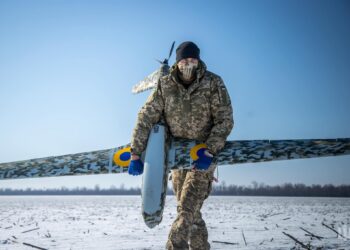
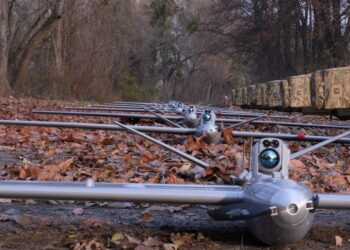
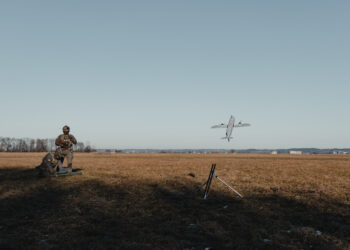
Abuja, Nigeria-based Terra Industries has a big vision to create a vertically-integrated company that produces surveillance drones for air, land, and sea operations; operating systems to control those vehicles; and command and control platforms to operate fleets and analyse the data that comes from them. (No kinetic weapons on the roadmap at this point.)
Although Terra describes itself as coming “out of stealth” today, it’s already gotten started on that business: Nathan Nwachuku, the CEO who co-founded Terra with Maxwell Madukasays (CTO) told Resilience Media that the startup has already signed tens of millions of dollars in contracts and is already protecting some $11 billion in assets for its users, which include private companies, governments and related agencies.
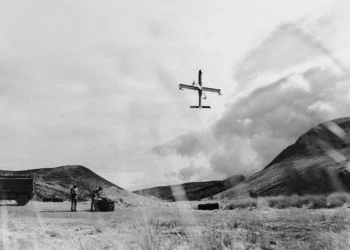
The company’s list of current technology covers long- and mid-range drones, autonomous sentry towers, unmanned ground vehicles, maritime surveillance systems, and a software platform called ArtemisOS. Current customers include the Geometric Power Plant in Aba, two hydropower plants in northern Nigeria, and gold and lithium mining operations in Nigeria and Ghana; it says it is now moving more into counterterrorism and border security.
That traction has helped it attract investment from some of the more prominent names in defence tech venture capital. 8VC is leading Terra’s latest $11.75 million round, with Valor Equity Partners, Lux Capital, SV Angel, Leblon Capital, Silent Ventures, Nova Global, and angel investors including Micky Malka also participating.
Nwachuku said that an earlier, previously-undisclosed investment included Eliot Pence, who is now the CEO and founder of Canadian defence startup Dominion AI but was previously the head of Anduril’s international business for many years.
From what we understand, Terra’s valuation is just under $100 million with the latest funding.
Global changes, local startup
Terra’s funding is coming at the confluence of global trends in technology and defence. The rise of defence tech as a salient category has been a story running for several years in the Western world, with the rise of companies like Anduril, Helsing, and dozens of others raising hundreds of millions of dollars in funding, often from VCs new to the field, to build drones and other AI-powered technology to power the next generation of defence.
Their work has ready customers: active conflicts underway such as the seemingly-relentless war in Ukraine demand help, in the form of weapons and tech, to fight against Russia. That has also led a number of militaries to consider how to re-arm in a more intelligent way. But it has also started to raise a lot of questions for countries about how to re-arm and think about a more resilient future overall, with their own sovereign capabilities to safeguard against whatever geopolitical and economic tides might rise or fall.
That rise in defence tech has met an adjacent use case across the African continent, said Nwachuku. Individual countries face wars and threats from other countries, he said, but one of the biggest and most disruptive forces has been terrorism carried out in different forms aimed at destabilising society, including the destruction of critical assets like energy infrastructure and kidnapping. Sub-Saharan Africa in particular also happens to be home to some significant natural reserves in oil and minerals that make it a target for other reasons.
To that end, Terra’s initial aim has been to build equipment for surveillance to help protect against those groups rather than kinetic weapons. While that is a very crowded market when you consider the global stage, Terra believes it has a strong mandate to be another new player on the scene for two reasons: it’s important for the continent to have its own sovereign technology, and one key reason why is because a sovereign company can build more effective solutions.
“Are we truly sovereign if we are dependent on other powers to protect our infrastructure?” Nwachuku prompted, giving his own answer to the question: it is, in his words, to look inward. “Anduril is the biggest neo prime in the US, and Helsing is in Europe. It’s clear that Africa needs its own sovereign prime, too. I want to build the first truly sovereign system for the continent.”
He notes that while individual countries in Africa have purchased from companies out of the US, China, Russia, Europe and Israel to build up their defence forces, “it hasn’t been working because their tech is not built for the continent” and its particular terrain and particular problems. “Billions of dollars have been spent on systems,” he said with a short laugh. “They buy drone equipment that doesn’t fly even once.”
On another level, Terra says that it is firm in how data is stored and used: data stays within the country where it is gathered. This has helped the company win business over bids from companies in China, he said, where the insistence is to send everything there for processing, an unpalatable option for the customers.
Blinded
Nwachuku had an interesting entry point to working on defence tech. He is actually blind in one eye — a result of a schoolyard accident when he was 15. The thrown object that blinded Nwachuku nearly killed him. When he woke up recovering from the injury, he said, he had an epiphany to do something that would make an impact.
Two years on, he initially enrolled in university in the US — at Carleton University to study software engineering — but dropped out in the first year in the wake of the Covid-19 pandemic and decided to build an edtech platform for schools to run remote learning. A few years into that business, as people returned more comprehensively to in-person classrooms, he decided he wanted to do something else that felt “more important” to Africa.
The crisis of constant internal fighting from terrorism was an obvious target: in the last decade, the continent has lost hundreds of billions of dollars due to terror attacks, he said. (And no the pun of “Terra” and “terror” is not intentional, he confirmed.)
The company’s sovereignty is also extending to who is building the startup. Terra is hiring for operations across Africa, but it is also tapping the African diaspora in the US with offices to open in San Francisco and London. A lot of talent, he said, “got out” of Africa to work for big tech companies in these cities. Because many of them do not want to move back to their home countries, the logic is to build out offices in these international locations to attract them to working on fixing African problems regardless.
Although there has been some hesitancy in some corners of the tech world to work on defence tech, that issue that has not been a problem for Terra, Nwachuku said.
“The problem with most of the resistance is that [those hesitant] have not felt war,” he said. “Most of them live in places where they haven’t even seen someone get killed. It’s hard to reconcile defence if you haven’t seen the need for it. But if you have a family member who has lost someone to terrorist attacks or kidnapping, you feel differently.”
Defence tech is not a low-barrier-to-entry business, and so while the company is producing revenues, it’s likely going to be raising more funding in the near future to continue along its ambitious roadmap. Investors have been enthusiastic, Nwachuku said.
“Nathan and Maxwell have assembled a brilliant team to tackle a vital problem for the continent. We are excited to support their mission,” said Alex Moore, a partner at 8VC, who is also on the company’s board.