Thursday 19 February, 2026
[email protected]
Resilience Media
  • About
  • News
  • Resilience Conference
    • Resilience Conference Warsaw 2026
    • Resilience Conference Copenhagen 2026
    • Resilience Conference London 2026
  • Guest Posts
    • Author a Post
  • Subscribe
No Result
View All Result
  • About
  • News
  • Resilience Conference
    • Resilience Conference Warsaw 2026
    • Resilience Conference Copenhagen 2026
    • Resilience Conference London 2026
  • Guest Posts
    • Author a Post
  • Subscribe
No Result
View All Result
Resilience Media
No Result
View All Result

Weekly Digest: Hypersonic weapons race accelerates as NATO eyes Russian and Chinese missile threats

Issue 59: Plus a lot of funding announcements from Farsight Vision, The Fourth Law, Terra, and SatVu; the Auterion and Airlogix partnership; and the first speakers for Resilience Conference Warsaw

Leslie HitchcockbyLeslie Hitchcock
February 19, 2026
in Weekly Digest
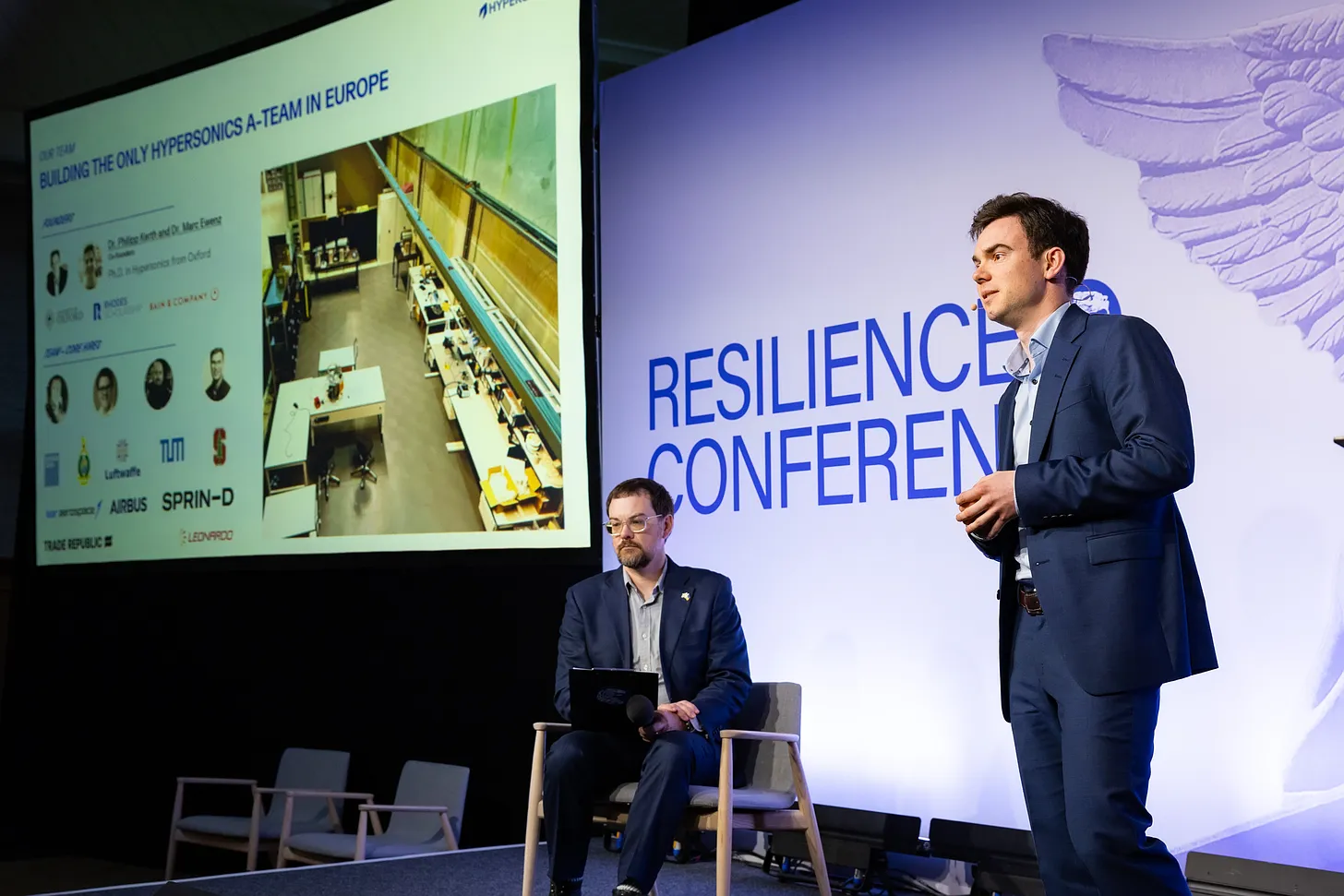
Philip Kerth, Founder & CEO, Hypersonica and Matt Burns, Resilience Media, on stage during the Launch at Resilience Conference startup showcase 2025.

Philip Kerth, Founder & CEO, Hypersonica and Matt Burns, Resilience Media, on stage during the Launch at Resilience Conference startup showcase 2025.

Share on Linkedin

This is a copy of our Weekly Digest newsletter, a free newsletter sent once per week from Resilience Media. Subscribe here to receive it in your inbox. 

You Might Also Like

Europe recommits to itself as US uncertainty looms over Munich Security Conference

Announcing the Resilience Conference 2026 Event Schedule

Weekly Digest: Drones now destroy 80% of Russian targets in Ukraine, Frankenburg raises $50M at $400M valuation

Good afternoon from the team at Resilience Media.

We’ve been watching hypersonic technologies closely at Resilience Media: with Zach Shore, President of Hermeus, and Philip Kerth, CEO of Hypersonica appearing on our stage at Resilience Conference 2025. The need to include hypersonic capabilities in NATO militaries became even more clear following the November 2024 Russian Oreshnik missile attack on Ukraine. Founders and investors are responding to the urgency.

After appearing on our stage as part of the second Launch at Resilience Conference cohort, Hypersonica announced a Series A round led by Plural and SPRIND. Hermeus showed successful ground tests for its Quarterhorse Mk 2.1 engine in a video released last week. Contributor Tom Pashby has been reporting on hypersonics and kinetics for Resilience Media; an excerpt of their most recent piece which examines the threat from Russian and Chinese advancements in the space is in the Hypersonics section below.

It’s been another big week for deals. Ukrainian startups Farsight Vision and The Fourth Law both raised from Axon, SatVu brought in £30M to take its thermal satellite constellation technology even further into the defence space, and Terra raised another $22M to keep scaling the first African prime.

There were a lot of partnership announcements coming events alongside the Munich Security Conference. Notably, Ukrainian President Volodymyr Zelenskyy was in attendance, signifying their importance to the defence of democracy: Auterion and Airlogix announced their manufacturing agreement in a signing ceremony and Quantum Frontline Systems held a factory opening.

Lastly, EDT Ventures General Partner Hugo Jammes is back with his monthly column, this time inspired by the book If Russia Wins. In this piece, Jammes examines the book and Munich Security Conference through the lens of public policy, the role of private and venture capital, and continental willingness to deter aggression. An excerpt is in the Column section below.

Elsewhere on Resilience Media:

  • Taiwan gets serious about tech at sea
  • Helsing’s second German Resilience factory is live
  • Biometric wearables company Aware gets $7.5 million program increase from the U.S. Army
  • Ukraine planning a national mobile carrier for military use

We are starting to announce speakers for our Resilience Conference events this year, starting with Resilience Conference Warsaw, where we are thrilled to bring to the stage Jan-Hendrik Boelens, CEO and founder of Alpine Eagle and Klaus Hommels, Founder and Chairman of Lakestar. Tickets are already going fast, so get yours today before Early Bird prices end. I’ll be back in your inboxes next week. Thanks for reading.

-Leslie Hitchcock, co-founder and Publisher, Resilience Media

Tom Pashby, Contributor

The advent of hypersonic weapons – a broad category covering systems that travel at Mach 5+ including hypersonic boost glide systems, hypersonic cruise missiles and ballistic missiles – has opened a new front in anxieties about national security and defence in the West.

The anxiety is due to a combination of issues: a lack of current, deployed hypersonic weapons capability by NATO member states; acknowledgement that existing interception systems are ineffective against hypersonic targets; and the threat that some hypersonic weapons, designed for conventional warheads, can be interchangeably armed with nuclear capability.

While Russia did not put nuclear warheads on the Oreshnik hypersonic missile it fired at a Ukrainian military facility in November 2024, it did follow nuclear convention when setting it off, in order to jangle nerves: Moscow provided Washington with a 30 minute-notice of its launch, according to Reuters.

Russia’s efforts to ratchet up fear should not be underestimated. In January 2026 at a meeting of the UN Security Council, the US and UK criticised a more recent deployment of the Oreshnik by Russia. At the time, the Guardian reported that James Kariuki, the UK’s acting ambassador to the UN, said the attack threatened “regional and international security and carries significant risk of escalation and miscalculation.”

And a research paper published by the Nuclear Study Group at the Munich Security Conference this month underscored the intention of that latest strike.

In the MSC’s view of the latest long-range allegedly hypersonic missile, “Although the initial strike caused limited physical damage, the employment of a dual-use system with a reported range of up to 5,500 km was widely interpreted as a signal to Ukraine’s Western allies and as part of a broader campaign of psychological warfare,” the authors wrote.

Read the rest here.

If Russia Wins: Lessons for the UK and Europe

Hugo Jammes, Columnist

In the build-up to the Munich Security Conference (MSC), I finally read a book many had recommended. Carlo Masala’s ‘If Russia Wins’ is not simply a geopolitical thriller. It is a sharp warning to the West – a warning that reverberated through the MSC in soundbites and narratives.

The novel imagines a near-future scenario where, after securing a form of “peace” in Ukraine, Russia tests NATO by seizing the Estonian city of Narva and the island of Hiiumaa in 2028. Masala’s central message is unequivocal: Western complacency is a strategic liability, and deterrence only works when it is underpinned by political will, industrial capacity, and societal resilience.

For the UK and Europe, the book’s scenario acts as a stress test of current assumptions. It forces a confrontation with the gap between rhetoric and capability, highlighting the uncomfortable reality that adversaries exploit hesitation and uncertainty.

This article distils Masala’s cautionary tale into three domains: public policy, the role of private and venture capital, and continental willingness to deter aggression.

The key messages from the MSC find a chilling echo in the novel. Both the conference and the book analyse a world where the post-1945 order has collapsed, replaced by a “multi- polarisation” that favours aggression over international law.

The ultimate conclusion of both the conference and the novel is that the peace Europeans take for granted is “contingent and fragile.” Inaction is no longer an option; survival requires immediate, decisive strategic effort rather than “complacent dialogue.”


Read on here.

Tags: fundinghypersonicsresilience conference warsawWeekly Digest
Previous Post

UK announces a £500 million defence package for Ukraine

Leslie Hitchcock

Leslie Hitchcock

Leslie Hitchcock is a seasoned media executive and co-founder of Resilience Media, an independent publication dedicated to the defence of democracy and the intersection of startups, security, and defence technology. With nearly two decades of experience in the tech industry, she has been instrumental in shaping conversations around innovation and resilience in the face of global challenges. Prior to founding Resilience Media, Leslie served as the Director of Events at TechCrunch, where she led the production of the renowned TechCrunch Disrupt conferences across major tech hubs including New York City, San Francisco, London, and Berlin, as well as a suite of events in Nairobi, Lagos, Seoul, and Tel Aviv. Her tenure at TechCrunch solidified her reputation for curating impactful events that bridge the gap between technology innovators and investors. In 2024, recognising the growing need for a dedicated platform to address the evolving landscape of defence and security, Leslie co-founded Resilience Media alongside Dr. Tobias Stone. The initiative was launched during the inaugural Resilience Conference in London, aiming to foster collaboration between the tech sector and national security communities. Resilience Media has since become a pivotal resource, offering in-depth analysis, founder profiles, and policy discussions pertinent to the defence tech ecosystem.

Related News

Wrecking-ball politics and the end of mutually-assured stability

Europe recommits to itself as US uncertainty looms over Munich Security Conference

byLeslie Hitchcock
February 12, 2026

This is a copy of our Weekly Digest newsletter, a free newsletter sent once per week from Resilience Media. Subscribe...

Announcing the Resilience Conference 2026 Event Schedule

Announcing the Resilience Conference 2026 Event Schedule

byLeslie Hitchcockand1 others
February 5, 2026

Editor’s note: This is a copy of our Weekly Digest newsletter, a free newsletter sent once per week from Resilience...

Weekly Digest: Drones now destroy 80% of Russian targets in Ukraine, Frankenburg raises $50M at $400M valuation

Weekly Digest: Drones now destroy 80% of Russian targets in Ukraine, Frankenburg raises $50M at $400M valuation

byLeslie Hitchcock
January 29, 2026

Editor's note: This is a copy of our Weekly Digest newsletter, a free newsletter sent once per week from Resilience...

white and black mountain under blue sky during daytime

Weekly Digest: Greenland stays safe, but geopolitics still drives defence tech

byLeslie Hitchcock
January 23, 2026

Good afternoon from the team at Resilience Media. As the World Economic Forum comes to a close and European NATO...

Weekly Digest: From the living room to the war room at CES 2026

Weekly Digest: From the living room to the war room at CES 2026

byLeslie Hitchcock
January 15, 2026

Good afternoon from the team at Resilience Media. This is Issue 54 of our weekly newsletter, which you can subscribe...

6 predictions for defence in 2026

6 predictions for defence in 2026

byLeslie Hitchcockand1 others
January 7, 2026

As we enter 2026, these are the key topics the Resilience Media editorial team will explore in our writing and...

MI6 warns of Russia’s grey zone tactics; space as a battleground; and Europe’s latest security mega round

byLeslie Hitchcock
December 22, 2025

Good afternoon from the team at Resilience Media The rollercoaster of geopolitics continues this week. The most credible plan yet...

Digest 51: Lithuania declares Security Emergency as ICEYE, Nu Quantum lead defence tech funding surge

Digest 51: Lithuania declares Security Emergency as ICEYE, Nu Quantum lead defence tech funding surge

byLeslie Hitchcock
December 11, 2025

Good afternoon from the team at Resilience Media As predicted, December has certainly not been a slow news month. This...

Load More

Most viewed

InVeris announces fats Drone, an integrated, multi-party drone flight simulator

Twentyfour Industries emerges from stealth with $11.8M for mass-produced drones

Senai exits stealth to help governments harness online video intelligence

Harmattan AI raises $200M at a $1.4B valuation from Dassault

Palantir and Ukraine’s Brave1 have built a new AI “Dataroom”

Frankenburg has raised up to $50M at a $400M valuation, say sources

Resilience Media is an independent publication covering the future of defence, security, and resilience. Our reporting focuses on emerging technologies, strategic threats, and the growing role of startups and investors in the defence of democracy.

  • About
  • News
  • Resilence Conference
    • Resilience Conference Copenhagen 2026
    • Resilience Conference Warsaw 2026
    • Resilience Conference 2026
  • Guest Posts
  • Subscribe
  • Privacy Policy
  • Terms & Conditions

© 2026 Resilience Media

No Result
View All Result
  • About
  • News
  • Resilence Conference
    • Resilience Conference Copenhagen 2026
    • Resilience Conference Warsaw 2026
    • Resilience Conference 2026
  • Guest Posts
  • Subscribe
  • Privacy Policy
  • Terms & Conditions

© 2026 Resilience Media

This website uses cookies. By continuing to use this website you are giving consent to cookies being used. Visit our Privacy and Cookie Policy.