There are nearly 20 billion connected devices in the world today, used by people and organisations to communicate and do more with previously “dumb” physical objects than ever before.
But when it comes to malicious hacking, those connected devices are also sitting ducks, windows into networks that are all too easy to exploit for nefarious ends. That has major implications for individuals, businesses and overall national security — and that has led to a race among technology companies to figure out how best to plug those vulnerabilities.
A cybersecurity startup from Rome called Exein has been developing tech to protect both those devices and the networks they are connected to by way of technology that is built directly into the chipsets in that connected hardware. Exein has seen some major traction for its products with its customers including Nvidia, AWS, Intel, Supermicro, Mediatek and Arm. And now, it’s announcing €70 million ($80 million) in funding on a valuation that sources close to the company tell us is more than €350 million (around $400 million) to double down on the opportunity to secure more.
London-based firm Balderton is leading the Series C equity round, with participation also from new backers Supernova and Lakestar, as well as previous investors 33N, United Ventures and Partech (which all participated in the company’s €14 million Series B in January 2024).
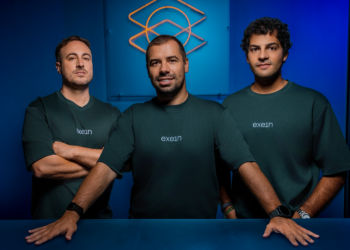
Gianni Cuozzo, the CEO and founder of Exein — a portmanteau of “execute” and “in”, he said, a reference to how its Pulsar tech sits on chipsets — said the plan will be to use the funding, in part, to support the company’s expansion into new markets in regions like Asia — specifically Japan, South Korea and Taiwan — and the US.
Some of the funding will also be used to explore newer areas of business. High on the agenda: artificial intelligence and specifically the challenge of securing the vast landscape of infrastructure that runs the Large Language Models that are powering so many generative AI services today.
It will also be looking at M&A, Cuozzo added.
Cuozzo himself comes from a government cyber intelligence background, and his observations at that time of how the world of technology was evolving were what spurred him to build Exein.
In short, there’s been a perfect storm of conditions that has led to what he believes is a major problem with connected devices.
While there was traditionally a lot of proprietary fragmentation amongst hardware in the world, Linux has emerged as the unified operating system of choice for embedded devices, making exploits of it much more scalable and thus attractive to malicious hackers. At the same time, a lot of focus in the world of cybersecurity has been on cloud security (not least because that too comes with its own major vulnerability headache). Then the rise of 5G networks has really boosted just how connected and online everything is all the time.
Phones and computers are relative secured already, Cuozzo said, compared to the nearly unprotected coffee machine, air conditioner, or printer that also sits on the same network and can just as easily be used as a back door into the same network those other devices sit on.
All the same, Exein was in stealth for the first five years of its life before launching its first commercial products in 2023.
“It was only R&D before that,” Cuozzo said. “In our market, you just cannot have unstable solutions. You have to be certified. We have customers with 10 million devices in the market. You can’t go and say, “well this isn’t 100% stable.”
Fast forward to today, though, and Cuozzo claims that Exein is the current market leader with more of its technology embedded in chipsets than its competitors (and there are many of those).
Its focus and success to date are what attracted investors. “From our first conversations with Gianni, it was clear that Exein is tackling one of the most urgent and underserved challenges in cybersecurity: securing the edge,” noted Elena Moneta, the principal at Balderton who led the investment for the firm. “The pace of adoption across high-stakes sectors signalled to us that Exein wasn’t just building a product — they were defining a new category.”
The company is built on “open core” principles, meaning it offers a free license to embed its tech in a chipset, but then charges for those who will want to actually use it. Right now its tech is embedded in 1.5 billion devices, Cuozzo said, with a conversion rate of 10% on those to paying usage. It claims to have identified and fixed more than 1 million vulnerabilities to date.
That scaling factor is set to be boosted massively in the coming years. In January, Exein announced a major deal with Taiwanese chipmaker MediaTek, and in March it also announced a partnership with the server giant Super Micro. Cuozzo told me that its on the cusp of announcing another major chipset maker customer, this time from the US, which will add another 1 billion devices to its list in the coming years.
Cuozzo believes this is just the start.
“We are moving from the equivalent of Symbian to the iPhone moment,” he said, likening it to the shift he believes will happen from network security to embedded security at the edge akin to what Exein is focused on building. “It’s a generational shift.”
Updated with higher valuation figure from sources.