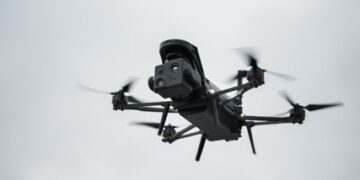
Defence is a multi-modal concept, and today a startup focused on building a stronger pipeline of intelligence data from a higher vantage point is announcing some funding. Kelluu, which is developing airship fleets for intelligence, surveillance, and reconnaissance needs, has raised a Series A of €15 million. The NATO Innovation Fund (NIF) is leading the round, its first investment in a startup in Finland.
Kelluu is not a stranger to NATO. The startup had already been through two phases of NATO’s DIANA programme, successfully showing and testing its hardware and software in numerous defence exercises attended by Alliance MoDs. Kelluu does not disclose who its customers are, but CEO and co-founder Janne Hietala said in an interview that it sells to both government and non-government customers, with the former of those growing much faster and now accounting for some 80% of revenues.
Airships in themselves are in some ways the antithesis of drones when it comes to the new wave of defence: the first airship was flown in the 1850s and used for heavy-lift applications; and they are not known for being the fastest vessels in the sky. But they have a lot of advantages that other air-based systems do not, Hietala pointed out. They are lighter than air, and require no energy to stay up, making them particularly well suited for ISR applications in artifice conditions. “It’s the physics,” he said.
There is a lot of room for development, he added. Kelluu is playing into the current market of MoDs looking for faster and cheaper production of more systems to complement, and maybe even replace, some of the more “exquisite” weapons and devices that they have been buying for years. “MoDs are looking for technology that is smaller and more manufacturable to develop persistent ISR for arctic environments,” said Hietala. Kelluu’s current generation of airships has airtime of 12 hours and can go up to 200km in range (with altitude of 1-2km). It is preparing to release the second generation of its vessels later this year that will be capable of multiple days of flight.
Kelluu was founded in 2018 and focused initially on civilian applications like forestry. The war in Ukraine changed that focus — not least because Kelluu is based in Joensuu, which is just over the border from Russia. Although it came later to defence, that business has grown much faster, Hietala said. Notably, he spoke to RM en route to Canada for yet another exercise and demonstration: about half of the dozen exercises it has carried out so far have been in arctic environments.
The company does not work in a bubble and very much sees itself as part of bigger defence solutions. It noted that Exercise Steadfast Dart 26 in February in Germany, which it describes as a “10,000 troop, 13 nation multi-domain NATO exercise,” Kelluu integrated in real-time with Palantir’s Maven Smart System to provide live video and geolocation data directly to allied forces.
“We think it’s an interesting commercial capability in eastern flank and high north,” Patrick Schneider-Sikorsky, a NIF partner, told RM. “It’s more resistant to adverse weather conditions than other ISR and can stay up for longer and can cover wide territories. Those are commercially interesting to MoDs.”