Monday 8 June, 2026
[email protected]
Resilience Media
  • News
    • Events
    • Interview
    • Startups
    • Venture
    • Weekly Digest
  • Resilience Conference
    • Resilience Conference Warsaw 2026
    • Resilience Conference Copenhagen 2026
    • Resilience Conference London 2026
  • About
  • Guest Posts
    • Author a Post
  • Subscribe
No Result
View All Result
  • News
    • Events
    • Interview
    • Startups
    • Venture
    • Weekly Digest
  • Resilience Conference
    • Resilience Conference Warsaw 2026
    • Resilience Conference Copenhagen 2026
    • Resilience Conference London 2026
  • About
  • Guest Posts
    • Author a Post
  • Subscribe
No Result
View All Result
Resilience Media
No Result
View All Result

PhysicsX raises $300M at a $2.4B valuation for AI to create and test defence and other hardware

‘Large physics model’ aims to speed up the pace of industrial design

Ingrid LundenbyIngrid Lunden
June 8, 2026
in News, Startups
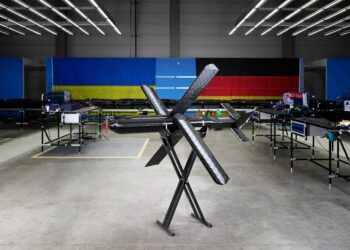
black drone in mid air
Share on Linkedin

PhysicsX, the London-based startup that has built an AI platform for hardware designers to run simulations of their work in progress, has raised a large Seres C round of funding to speed up its own expansion. It has raised $300 million, at a valuation of $2.4 billion.

You Might Also Like

Molfar lands €1.5 million lead investment for small drone-detecting radar

Ofcom examines whether telecoms security rules are slowing adoption of AI cyber defences

Middle powers in the age of Anthropic’s Mythos

PhysicsX is headquartered in London and emerged from stealth in 2023, co-founded by two Italian physicists. Robin Tuluie and Jacomo Corbo worked on aerodynamics for high-end Formula One race cars in Italy and the UK before spotting an opportunity to build an AI platform to improve the prototyping and simulation process for others.

The startup may have its roots in Europe in racing cars, but its latest round speaks to how the startup now attracts more global interest. Temasek, the investment fund wholly-owned by the Singapore government’s ministry of finance, is leading the round, with participation also from UK’s M&G Investments, Canada’s Intrepid Growth Partners, US semiconductor company Applied Materials, Atomico, General Catalyst, July Fund, NGP, Nvidia, deep tech fund Radius, and Siemens.

The resilience play here is two-fold. PhysicsX, despite the international investors, remains European and points to how startups in the region are tackling industrial-scale problems in the region. It’s also throwing a line to manufacturers specifically, by aiming to make their work more efficient, in theory giving customers the ability to create more cutting-edge products faster.

PhysicsX now says its customers include organisations in working in defence, alternative energy, aviation, data centers, and semiconductors. (Leonardo, one of its partners and customers, paired up with PhysicsX’s Corbo on stage at Resilience Conference last autumn: you can watch that here.)

Like Siemens and Applied Materials, Nvidia is a strategic investor. The AI chip giant has been leveraging its vast market presence to diversify its business for the long run (resilience of another kind). Not only is PhysicsX optimised to run on Nvidia chips but it’s a buyer of them, and the pair partner with third parties like Deutsche Telekom in ‘go to market’ solutions. Nvidia first invested in PhysicsX last year, a $20 million extension of its Series B that valued PhysicsX at just under $1 billion.

The rapid growth of PhysicsX’s valuation underscores the company’s progress. Over the last year, PhysicsX claims to have doubled its number of customers, “doubled year-over-year recognised revenue [and] tripled booked revenue.” (It does disclose specific numbers for any of these metrics.) It also now has 300 employees, which — combined with the likely large amount of computer processing power that it needs to buy and use — likely means it has a lot of costs on its books.

It also points to the huge interest that artificial intelligence companies are commanding right now. Anthropic at the start of June confidentially filed for a public listing in the US at a valuation of nearly $1 trillion. OpenAI is likely to follow suit at a similarly eye-watering figure.

It’s not just technology companies that seem to think that the use of AI in how they operate is inevitable. And that expectation, the investment that’s being laid out, and sometimes even actual usage are all leading to a lot more interest in AI companies that are building inroads into specific uses and areas.

That is where PhysicsX comes into the picture. The company started from a specific pain point that the founders saw in their own work: it costs too much and takes too long to build and test physical prototypes from scratch.

They saw an opportunity to use AI to accelerate that process, essentially applying the concept of training an AI on a giant trove of information to work like humans, in its case an AI to build and run simulations in place of humans building incremental actual prototypes.

Instead of the Large Language Models that you get from companies like OpenAI that let users produce writing, images, work plans and coding from regular-language prompts, PhysicsX has created what it calls a “large physics model” that speaks in the language of objects and materials, prompted by words and calculations that its users submit.

“What PhysicsX buys you is the ability to be able to predict the physics [of a system] with very, very high accuracy and fidelity, doing it, anywhere from 10,000 to a million times faster [than traditional prototyping],” Corbo told me in an interview in 2023.

We’ve asked the company to clarify a few points. It’s not clear how it’s charging users for its services, nor how customers actually engage with PhysicsX to create simulations: natural language? blueprints fed into a slot? pages of calculations? all or none of the above?

And we are also curious about how, longer term, PhysicsX sees the product developing. Today, the startup may be doing a lot more than high-end car design, but designers are still in the driving seat — pun intended — deciding what to test out before using PhysicsX to do the simulating.

Longer term, will this lead to “vibe designing”, where the platform might do the hard work of figuring out what to build next and then building it?

In any case, it’s a very notable round, and puts the startup very much in the spotlight as so-called “foundational AI” companies look for more commercial and higher-margin use cases for their own platforms to prop up their enormous valuations. It will be interesting to watch what verticals they move into and what they look to acquire to do that.


Tags: AIfundingindustrial technologyManufacturingNvidiaPhysicsXUnited Kingdom
Previous Post

Molfar lands €1.5 million lead investment for small drone-detecting radar

Ingrid Lunden

Ingrid Lunden

Ingrid is an editor and writer. Born in Moscow, brought up in the U.S. and now based out of London, from February 2012 to May 2025, she worked at leading technology publication TechCrunch, initially as a writer and eventually as one of TechCrunch’s managing editors, leading the company’s international editorial operation and working as part of TechCrunch’s senior leadership team. She speaks Russian, French and Spanish and takes a keen interest in the intersection of technology with geopolitics.

Related News

Molfar lands €1.5 million lead investment for small drone-detecting radar

Molfar lands €1.5 million lead investment for small drone-detecting radar

byJohn Biggs
June 5, 2026

Polish-Ukrainian defence technology company Molfar Defence Technologies has secured the first tranche of a €2 million funding round as it...

a group of cell towers sitting under a cloudy blue sky

Ofcom examines whether telecoms security rules are slowing adoption of AI cyber defences

byCarly Page
June 4, 2026

Ofcom has launched a review into whether existing telecoms security rules are making it harder for operators to adopt AI-driven...

Colorful software or web code on a computer monitor

Middle powers in the age of Anthropic’s Mythos

byPaddy Stephens
June 4, 2026

As AI rapidly develops, many are facing a tougher job market – and not just entry-level software engineers. International prize-winning...

Custodia co-founder Thomas Brooks

Swiss startup Custodia launches offline AI appliance for sensitive workloads

byCarly Page
June 4, 2026

A Swiss startup is betting that growing concerns around AI privacy, data sovereignty, and cloud dependence have created a market...

gray concrete building under white sky during daytime

AI to cement the future of industry

byIngrid Lunden
June 3, 2026

A UK startup called Gigaton has built an AI platform to optimise how cement is manufactured, cutting costs and carbon...

Taiwan’s drone dream, deferred by Chinese nationalists

Taiwan’s drone dream, deferred by Chinese nationalists

byChris Horton
June 2, 2026

Taiwan is deeply divided when it comes to facing up to China. It has turned the island's defence strategy into...

Oko Camera announces new Ukrainian-made thermal imager for drone systems

Oko Camera announces new Ukrainian-made thermal imager for drone systems

byJohn Biggs
June 1, 2026

Oko Camera has launched a new thermal imaging series aimed at the growing demand for AI-enabled autonomous systems on the...

Estonia deploys first anti-drone systems on Russian border

Estonia deploys first anti-drone systems on Russian border

byJohn Biggs
June 1, 2026

  Estonia has begun deploying its first fixed drone detection and monitoring systems along its Russian border as the Baltic...

Load More

Most viewed

InVeris announces fats Drone, an integrated, multi-party drone flight simulator

Uforce raises $50M at a $1B+ valuation to build defence tech for Ukraine

Auterion, the drone software startup, eyes raising $200M at a $1.2B+ valuation

Palantir and Ukraine’s Brave1 have built a new AI “Dataroom”

Twentyfour Industries emerges from stealth with $11.8M for mass-produced drones

Senai exits stealth to help governments harness online video intelligence

Resilience Media is an independent publication covering the future of defence, security, and resilience. Our reporting focuses on emerging technologies, strategic threats, and the growing role of startups and investors in the defence of democracy.

  • About
  • News
  • Resilence Conference
    • Resilience Conference Copenhagen 2026
    • Resilience Conference Warsaw 2026
    • Resilience Conference 2026
  • Guest Posts
  • Subscribe
  • Privacy Policy
  • Terms & Conditions
  • Mission Statement & Code of Practice
  • Press

© 2026 Resilience Media

No Result
View All Result
  • Home
  • About
  • Subscribe
  • Events
  • Guest Posts
  • Interview
  • News
  • Resilience Conference London 2026
  • Resilience Conference Copenhagen 2026
  • Resilience Conference Warsaw 2026

© 2026 Resilience Media

This website uses cookies. By continuing to use this website you are giving consent to cookies being used. Visit our Privacy and Cookie Policy.