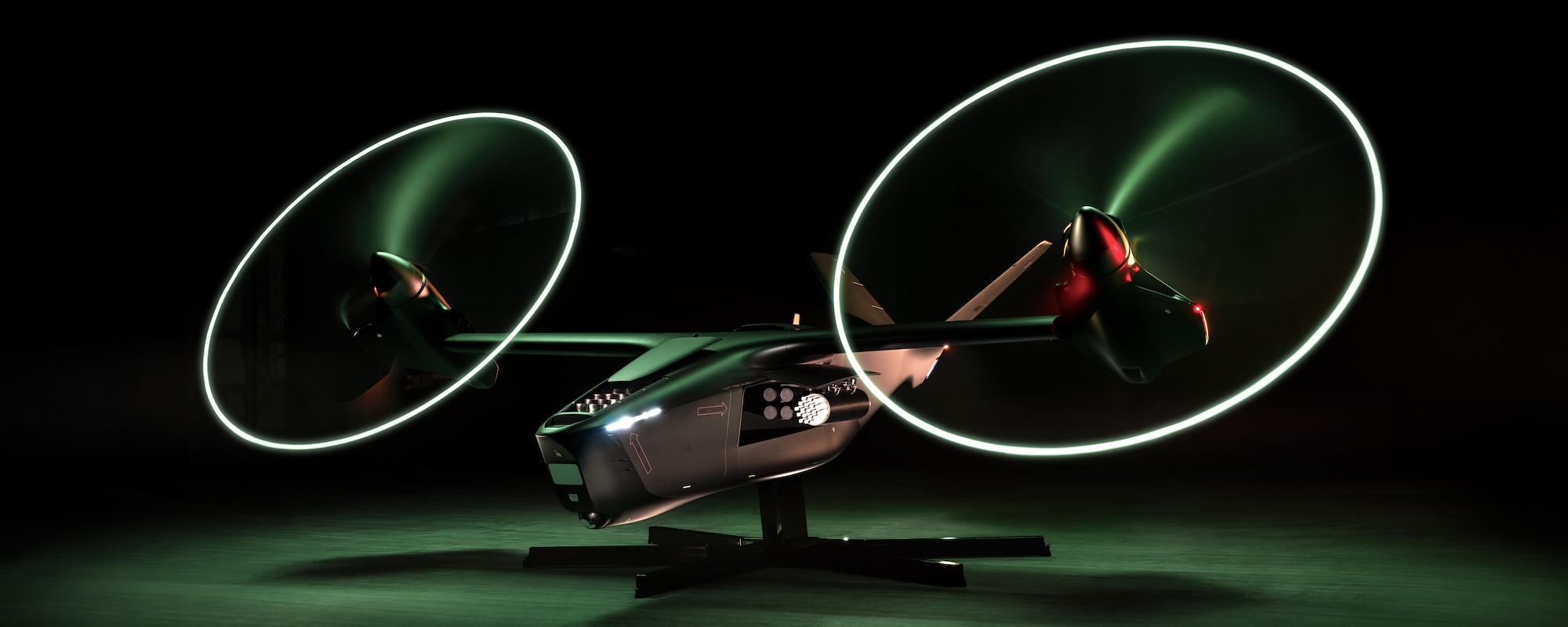
Anduril is adding another aircraft model to its range of autonomous and unmanned sea, land, air and space systems. Thunder is an autonomous ‘attack rotorcraft’ co-developed with Archer, aiming to complement (and potentially replace) the work of attack helicopters, at a time when the latter are proving to be vulnerable in drone-heavy environments.
Anduril showed off Thunder for the first time today at the Farnborough Air Show in England.
The product is a further signal of the proliferation of newer systems powered by artificial intelligence, built by the new guard of defence companies, gradually moving in to complement, if not replace altogether, expensive legacy systems.
Thunder is classified as an autonomous attack rotorcraft in the Group 5 category, UAVs able to carry the heaviest payload and fly the highest. Thunder’s tiltrotor configuration makes it able to make a vertical takeoff and landing (VTOL) but also cruise and turn in tight spaces in ways that helicopters cannot.
Building autonomous systems for the helicopter-style form factor is especially challenging because they have to navigate more obstacles than other kinds of aircraft. These include terrain, stationary objects, low-flying missiles and fire, and poor visibility due to fire, smoke and light — all at high speed and “near surface” low altitude.
Added to this, the VTOL concept has been around for years but has yet to enter the mainstream, and not just because of regulatory issues. They are expensive, resource-intensive, and not as robust as fixed-wing or helicopter craft. The challenge for Anduril and Archer will be to overcome all of that and then some, given the aim is to use this in combat environments.
Anduril said that it has “already completed multiple test flights with full-scale surrogate aircraft” and added that Thunder’s first flight is planned for 2027.
US-based Anduril is currently the world’s biggest privately-held defence tech company, valued at over $60 billion on paper, and it has carved out a place as a major “neo-prime” through very large framework deals with the US government.
So why launch Thunder at an airshow in Europe?
It partly has do to with potential customers. Ukraine remains a critical war zone, one where drones have been developed and used at the bleeding edge of innovation. That makes it a potential landing point for Thunder aircraft. At the same time, Europe is on high alert and doubling down on defence against Russia both in Ukraine — where countries are contributing billions of pounds and euros in equipment, funds and financing — and in their own territories, by boosting their defence spend.
(No customers nor pricing were disclosed today.)
It may also be partly related to how this particular craft was developed. In December, we wrote about how Anduril was teaming up with Archer, UK defence contractor GKN Aerospace and others to work on VTOL craft and related hybrid propulsion on the Isle of Wight, potentially for UK contracts.
Anduril described itself as “the lead systems integrator” in that project, and it is part of a bigger trend. Defence tech companies, even the biggest of them, have been forging partnerships with smaller and larger vendors to expand the range of what, and how, they produce. Today, Anduril said that its Lattice software is powering Thunder.
For its part, Archer has raised over $1 billion in the last year and a half to fuel projects like this one.
Thunder is described as dual-use — adaptable for military and commercial purposes — to maximise economies of scale, and it seems that Archer will be pursuing those opportunities on the commercial side.
It’s quite the reversal of fortunes: Archer had a very rough patch several years ago, cutting $1 billion off its enterprise value when it went public by way of a SPAC amid a lot of skepticism about the viability of air taxis. Things turned around in 2025: the company raised $850 million following an executive order from President Trump to prioritise air taxi development.
A little more on what Thunder can do, according to Anduril:
- There are several features in place to optimise fuel burn, including a hybrid-electric powertrain, and Optimum-Speed Tiltrotors. The OSTR, incidentally, is a patented design from Abe Karem (the engineer who is regarded as the father of UAVs).
- Thunder has bays in its main body and nose and is designed for multiple varieties of payload — missile carrier, air-launcher, patrolling aircraft, and carrier of a logistics platform in spaces congested with electronic warfare interference. One configuration example Anduril provided: “ten air-to-ground missiles (e.g. Hellfire, JAGM, Barracuda-100M), sixteen launched effects (e.g. Altius-600), or seventy-six 70mm rockets, plus an additional twelve counter-UAS effectors in the nose payload module, providing a mix of effects to address a wide variety of threats during a single sortie.”
- Thunder is designed to be teamed with crewed aircraft, Anduril noted.