US defence startup Singularity has emerged from stealth with an oversubscribed $80 million Series A round at a $400 million valuation, as it looks to bring low-cost air defence systems into large-scale production.
The round was led by Khosla Ventures and Felicis, with participation from seed investors AE Ventures and NEA, alongside Long Journey, Harpoon, Menlo Ventures, Y Combinator, Decisive Point, New Vista, Sunflower, and Soma.
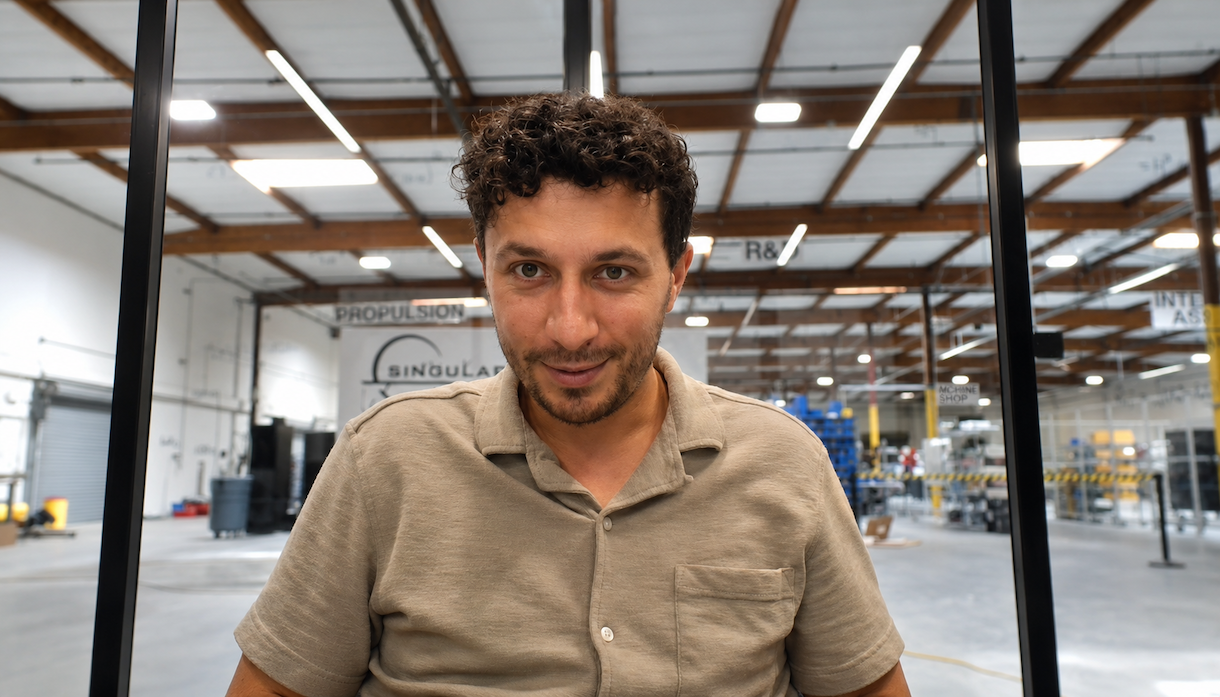
The company was founded by CEO Jack Oswald and COO Shail Giroux after a visit to Ukraine convinced Oswald that the growing threat from inexpensive drones and loitering munitions had exposed a fundamental gap in modern air defence. Oswald’s goal is to build production lines using automotive manufacturing principles rather than the traditional defence industry model of sourcing components through long supply chains.
“After meeting operators in Ukraine gravely injured by these threats, there was no other problem we could justify working on. The only measure of Singularity’s success will be lives saved,” Oswald said.
The company is developing low-cost interceptor missiles designed to defeat the growing number of drones and other low-cost aerial threats seen across Ukraine and the Middle East.
“We are building kinetic air defence missiles at much lower cost and we’ve designed them for the 95 percent threat,” Oswald said. “They are designed to take down the targets that we’re seeing in the Middle East and Ukraine, and that we project seeing at a terrifying quantity in the Pacific.”
Oswald said the company’s rapid growth has been driven by engineers who wanted to apply their experience to a mission with direct human impact.
“If you’re an engineer in LA, Texas, or Colorado, you’re probably working somewhere like SpaceX,” he said. “I grew up a space kid. I wanted to see boots on Mars. But about two and a half years ago, I realised that, as exciting as all that is, it’s much more important to take our talents and build things that are going to protect people, that are actually going to save thousands of lives.”
Singularity says that its hardware and software are developed in-house from scratch and that its team is made up of talent from SpaceX, Tesla, Anduril, and Lockheed Martin, ‘alongside experienced operators who, after decades of service, sold more than $12 billion worth of air defence systems’ so they have some experience of the industry.
While declining to discuss technical details, Oswald said Singularity’s vertically integrated approach gives it a lasting advantage over more traditional defence programmes. He added that the scale of demand seen in Ukraine illustrates why manufacturing capacity has become just as important as technical performance.
“That scale doesn’t make a whole lot of sense in the US if you’re looking only domestically. But when you look at what’s happening in Ukraine, it’s really unprecedented in terms of where air defence needs to be.”
Assembly Line Experts
Singularity has hired automotive manufacturing specialists, including former Tesla executive Cyril Londechamp, Vice President of Manufacturing, who helped establish major sections of the Model X production line before leading factory projects at Toyota. Oswald said those hires were made unusually early in the company’s life.
“It was very intentional to bring automotive production experts in,” he said. “We hired Cyril before we hired a lot of our engineering leaders. Normally, you hire development engineers first. But we’ve been talking about manufacturing execution systems, quality, and design for manufacturability across every subsystem for the last two years.”
Oswald also highlighted the unusual background of his co-founder and COO, Shail Giroux. Giroux started a robotics company focused on agricultural automation when he was just 14, bootstrapped the business while barely attending high school, and sold it for an undisclosed sum at the age of 17. After briefly enrolling at the University of California, Berkeley, he left after only a few weeks to join Anduril, where he worked before considering either a PhD or a career on Wall Street. Instead, he chose to join Oswald’s fledgling startup as an intern.
“This is the first time I’ve talked about this publicly,” Oswald said. “A few weeks after joining, he was full time, and a month or two after that, he asked me to be the best man at his wedding.”
Singularity argues that conventional defence manufacturing struggles to respond quickly when conflicts drive sudden demand. Oswald pointed to the long production timelines for systems including Patriot, THAAD, and Tomahawk missiles as evidence that current supply chains cannot expand fast enough.
According to Oswald, the problem stems from supplier networks that are difficult to expand during wartime.
“The challenge the primes have is you’re working with a web of subsystem providers, who are each working with a web of component suppliers, who are working with another web of manufacturers and contractors. That type of inertia takes years to spool up. If you turn production down and then want to ramp back up because of something like the Ukraine war, it just doesn’t happen, and then people die.”
By designing and manufacturing as much of the system internally as possible while relying on commercially available components where appropriate, Singularity believes it can avoid many of those bottlenecks.
The $80 million Series A will primarily fund completion of system development, expansion of manufacturing, and further hiring.
“We’re approaching 70 full-time people now,” Oswald said. “These are the best engineers I’ve worked with. They work incredibly hard, and they’re motivated by this mission. We’re going to continue to double down on that team.”
While Oswald would not disclose when the system will enter service, he confirmed the company has “line of sight to get the system fielded where it’s needed” within the near term.
“After 20 years backing top hard tech companies, I’ve learned that progress is best correlated with how fast a team closes the loop between design and test. Singularity gets this and has demonstrated the most aggressive test cadence in the industry,” said Sven Strohband, Managing Director and CTO at Khosla Ventures.