Tuesday 15 September, 2026
[email protected]
Resilience Media
  • News
    • Events
    • Interview
    • Startups
    • Venture
    • Weekly Digest
  • Resilience Conference
    • Resilience Conference London — Oct 2026
    • Resilience Conference Copenhagen — May 2026 (PAST)
    • Resilience Conference Warsaw — Apr 2026 (PAST)
  • Launch
  • About
  • Guest Posts
    • Author a Post
  • Subscribe
No Result
View All Result
  • News
    • Events
    • Interview
    • Startups
    • Venture
    • Weekly Digest
  • Resilience Conference
    • Resilience Conference London — Oct 2026
    • Resilience Conference Copenhagen — May 2026 (PAST)
    • Resilience Conference Warsaw — Apr 2026 (PAST)
  • Launch
  • About
  • Guest Posts
    • Author a Post
  • Subscribe
No Result
View All Result
Resilience Media
No Result
View All Result

Exein raises $270M to build embedded cybersecurity for physical AI systems

Startup says its tech is sitting on 2B+ chips, with customers including Nvidia and Mediatek

Ingrid LundenbyIngrid Lunden
September 15, 2026
in Cyber, News, Startups
Share on Linkedin

AI is powering an increasing array of hardware today, from robots and autonomous vehicles to drones and your phone. That extra functionality also opens the door to something else: a new attack surface for malicious actors. 

You Might Also Like

Open Cosmos fires up its satellite ambitions with €300M

Isembard puts critical manufacturing minutes from Whitehall

Finland’s Creoir gets backing from Gungnir Capital for its on-device speech tech

Italian startup Exein wants to tackle that problem. 

It’s made a name for itself over the last few years building technology to secure hardware at the processor level. Now, it’s raised a whopping $270 million in new investment at a $1.7 billion valuation led by US-based Headline to hone its approach specifically to work on physical systems that run on AI. 

Other new backers include Sofina, Goldman Sachs, European Investment Bank Group ETCI, KfW Capital and T.Capital. Previous investors Balderton, HV, Intrepid Growth Partners, 33N, Lakestar, Supernova Invest, Blue Cloud Ventures and Geodesic Capital also participated in the oversubscribed round.

Exein says it has already seen its tech embedded in some 2 billion chips globally, with customers including Nvidia, Leonardo, AWS, Mediatek, Arm and many more.

Its physical AI product is still a work in progress: a new agentic security architecture is due to come out by the end of this year, and a new foundation model for tracking and security physical AI is due to come out in early 2027. 

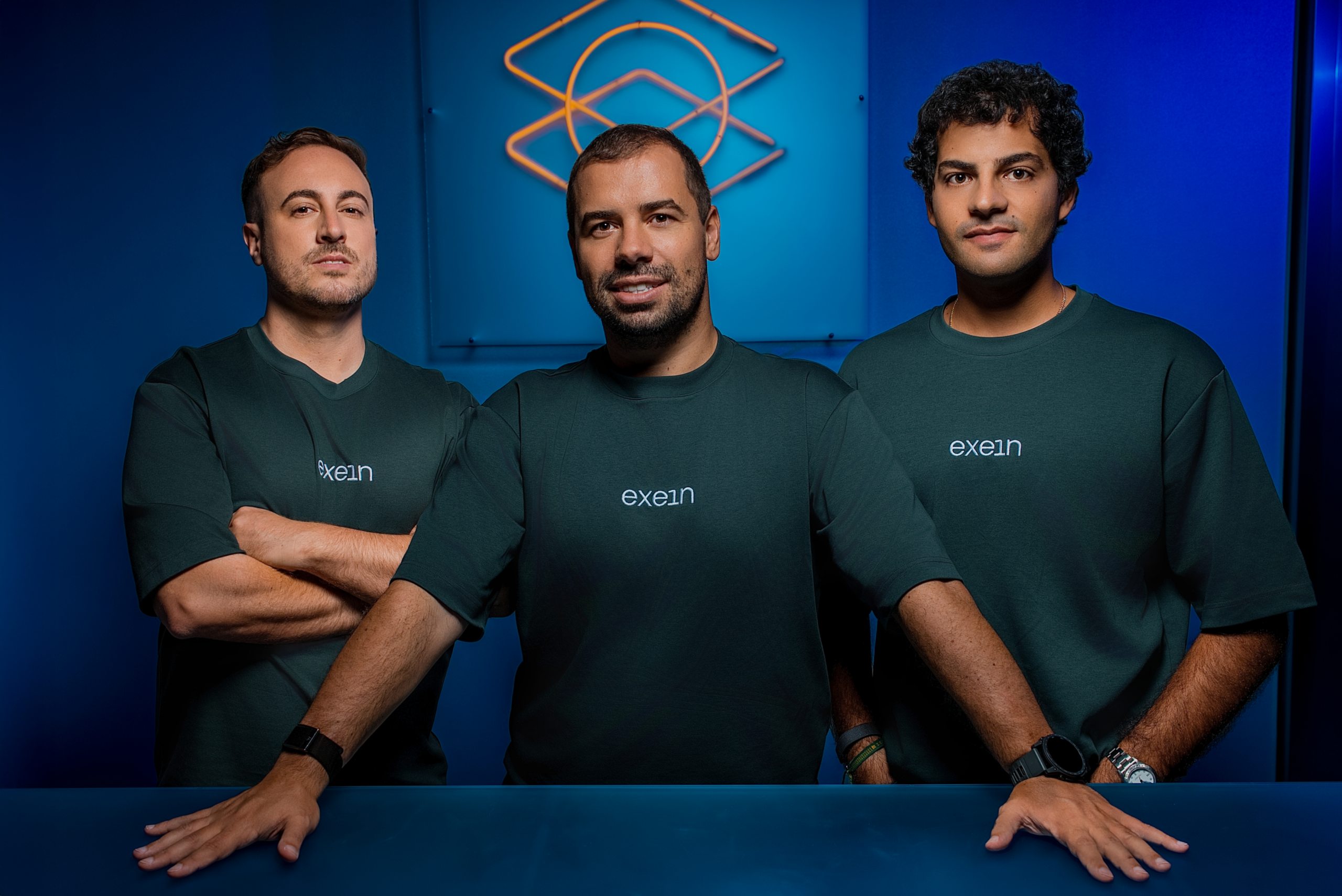
Giovanni Alberto Falcione, Exein’s CTO (pictured above, right) who co-founded the company with CEO Gianni Cuozzo CEO (centre) and CFO Gerardo Gagliardo (left), said that Exein’s focus is especially relevant to the hardware that is being built for defence and critical industries.

“This comes exactly at the right time. AI is leaving the data centre and coming to the physical world, to cameras and drones,” he said in an interview with Resilience Media. “The opportunity is for us to be the standard in this emerging market. We’re securing a good part of our life as these systems go to war.”

The funding values Exein at $1.7 billion post-money, which the startup says makes it currently the most valuable privately-held security startup in Europe. 

It’s grown fast in the last couple of years. Just over a year ago in July 2025, the company raised $80 million at a valuation we understood to be around $400 million. By December 2025, it had raised a further $115 million at a valuation of just over $800 million. The company said that ARR for the first half of 2026 grew four-fold.

Building for resilience

Growing and scaling a cybersecurity company in Europe focused on AI and hardware is a significant aspect of this funding round. The logic goes a little like this:

Europe wants to build more sovereign technology that is less dependent on nations further afield. Developing processors — the chips that power all tech — is one big part of that resilience thesis. But chips are only as powerful as they are safe, so having companies focusing on developing systems to secure them, like Exein, is essential. 

Yet even if Europe’s chip players never quite overtake Nvidia, being home to a champion leading the charge in securing hardware for everyone could prove to be a strong bargaining chip — pardon the pun — in future conversations over suppliers and partnerships. 

“Chips are one part of the supply chain but not the full picture,” Falcione said. “We support whatever is running on customers’ chipsets. Now we integrate with firmware teams to ensure compatibility and OEMs.” 

Beyond national ambitions, there are priorities that everyone is chasing around artificial intelligence that Exein’s work is addressing. 

Right now, AI is the main vector of growth in the world of technology, and so applications and hardware that are using it become major targets for cyberattacks. On the other side, state actors and other malicious hackers use AI themselves to crack into systems. By all accounts, attacks executed by AI are impossible for humans to fight on their own. In other words, it’s about AI all the way down.

And off the shelf LLMs have a lot to answer for. Recent events at major AI companies like Anthropic and OpenAI showed that models can unexpectedly jump over the guardrails, not to mention get commandeered by hacking groups to do their bidding — in one case by Russians to develop a kamikaze drone swarm. 

So while the world continues to debate how and if one can now introduce “AI safety” after the horse has bolted, these incidents only underscore the argument for doing more than securing promises for best intentions: that points to more protection at the machine level.

Exein’s new push into AI has been years in the making.

Earlier this year, Exein launched a new preemptive runtime security architecture called Photon that works at the kernel level on chips, aiming to block malicious execution at the processor level before attacks can run. The AI agents and foundation model that have yet to be released are based on that runtime technology and machine telemetry that it has amassed from existing embedded tech. 

When these do launch, the idea will be that it can then build autonomous agents to execute fixes, at the chip level, when an attack is about to take place, but also when the device is not physically behaving as it should, and to use that movement data to triangulate if a breach has occurred.

Falcione said Exein has been slowly building to where it is today but that where it is was always on the roadmap. Investors say that its focus on an area that is still little understood is one reason it stood out among others in the same space such as Sternum and Karamba, alongside other more legacy players.

“Exein came up when doing a deep dive around AI ecosystem, robotics and thinking through the value chain around physical AI,” Clarey Zhu, a partner at lead investor Headline, told Resilience Media. “The whole space is quite new, and most physical AI systems are not secured at all. But AI attacks are happening more and becoming more sophisticated. Most don’t have the visibility, let alone protection.”


Tags: AIartificial intelligencechipsExeinHeadlinesemiconductors
Previous Post

Open Cosmos fires up its satellite ambitions with €300M

Ingrid Lunden

Ingrid Lunden

Ingrid is an editor and writer. Born in Moscow, brought up in the U.S. and now based out of London, from February 2012 to May 2025, she worked at leading technology publication TechCrunch, initially as a writer and eventually as one of TechCrunch’s managing editors, leading the company’s international editorial operation and working as part of TechCrunch’s senior leadership team. She speaks Russian, French and Spanish and takes a keen interest in the intersection of technology with geopolitics.

Related News

Open Cosmos fires up its satellite ambitions with €300M

Open Cosmos fires up its satellite ambitions with €300M

byIngrid Lunden
September 14, 2026

Open Cosmos, a UK startup founded by three engineers from Spain, made a name for itself in 2015 when it...

Isembard puts critical manufacturing minutes from Whitehall

Isembard puts critical manufacturing minutes from Whitehall

byCarly Page
September 14, 2026

British manufacturing startup Isembard has opened a 160,000 square-feet factory in central London that will produce components for defence, aerospace...

Finland’s Creoir gets backing from Gungnir Capital for its on-device speech tech

Finland’s Creoir gets backing from Gungnir Capital for its on-device speech tech

byFiona Alston
September 14, 2026

Finland's Creoir, a developer of voice interface technology, has raised investment from Swedish VC Gungnir Capital. The funding is part...

NewOrbit is heading lower to get a better look at Earth

NewOrbit is heading lower to get a better look at Earth

byJohn Biggs
September 14, 2026

The UK satellite manufacturer NewOrbit has secured a Q3 2028 launch slot for NEO-1, a commercial rideshare satellite designed to...

Fortaegis raises $50M to scale secure silicon for defence

Fortaegis raises $50M to scale secure silicon for defence

byCarly Page
September 14, 2026

Amsterdam-based Fortaegis Technologies has raised $50 million to take its silicon-rooted security technology into mass production, as the company eyes...

Mach Industries raises $600 million to build weapons at scale

Mach Industries raises $600 million to build weapons at scale

byJohn Biggs
September 11, 2026

U.S.-based defense startup Mach Industries has raised another $600 million as it begins to build its autonomous weapons at scale....

Website interface with text and abstract drawing

Claude AI helped Russia-based threat actors develop autonomous kamikaze drone swarm

byCarly Page
September 11, 2026

A Russia-based threat actor used Anthropic’s Claude AI to help build an autonomous swarm of kamikaze drones capable of selecting...

A dartboard with two green darts and one orange dart embedded in it

A defence tech startup has a target on its back

byEd Hareand1 others
September 11, 2026

Increasingly, defence tech founders have no military or government background. That’s a good thing, because it’s driving innovative, out of...

Load More

Top stories

Resilience Conference London a
News

The Resilience Conference London 2026 Agenda is live

September 2, 2026
Something new, something BIG at Resilience Conference London
News

Meet the LAUNCH@RC and SCALE@RC 2026 Cohorts

September 11, 2026
Website interface with text and abstract drawing
News

Claude AI helped Russia-based threat actors develop autonomous kamikaze drone swarm

September 11, 2026
The German flag flying above the Reichstag building in Berlin, Germany
Cyber

Berlin launches crisis response after Rhysida dumps 5.79TB of allegedly stolen government data

September 7, 2026

Resilience Media is an independent publication covering the future of defence, security, and resilience. Our reporting focuses on emerging technologies, strategic threats, and the growing role of startups and investors in the defence of democracy.

  • About
  • News
  • Resilence Conference
    • Resilience Conference Copenhagen 2026
    • Resilience Conference Warsaw 2026
  • Guest Posts
  • Subscribe
  • Privacy Policy
  • Terms & Conditions
  • Mission Statement & Code of Practice
  • Press

© 2026 Resilience Media

No Result
View All Result
  • Home
  • About
  • Subscribe
  • Events
  • Guest Posts
  • Interview
  • News
  • Resilience Conference London 2026
  • Resilience Conference Copenhagen 2026
  • Resilience Conference Warsaw 2026

© 2026 Resilience Media

This website uses cookies. By continuing to use this website you are giving consent to cookies being used. Visit our Privacy and Cookie Policy.