
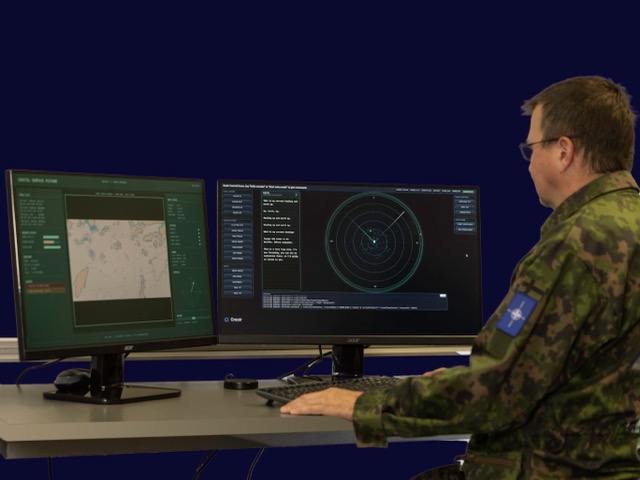
Finland’s Creoir, a developer of voice interface technology, has raised investment from Swedish VC Gungnir Capital. The funding is part of a Seed round that has an overall target of €2 million, with an expected close by the end of the year.
Despite it currently raising a Seed round, Creoir is not a startup. The Oulu-based company has been around since 2012 building voice interface technology for a variety of industrial, Internet of things, and consumer applications. It now plans to use the fresh funding to double down on defence. Resilience Media had a chat with CEO and co-founder, Antti Lilja, to find out more about it.
Creoir started out in mobile and IoT, operating as a product development house, which included work as a design partner for the likes of NXP and Infineon to create speech to text and other voice capabilities that were embedded on devices in processors, as opposed to cloud-based solutions.
Lilja admits the company has done many pivots throughout the years before looking at defence sector capabilities.
“In 2020 we decided to pivot into a product house. So we created our own product called Offline Voice Solution back then, which was later rebranded and further developed to become EdgeVUI,” he said.
The startup racked up customers in industrial automation, robotics, warehousing and logistics before noticing a distinct need in the defence sector.
“The information flow is increasing, devices are becoming more and more complex, so our technology is very much suited to that,” he explained.
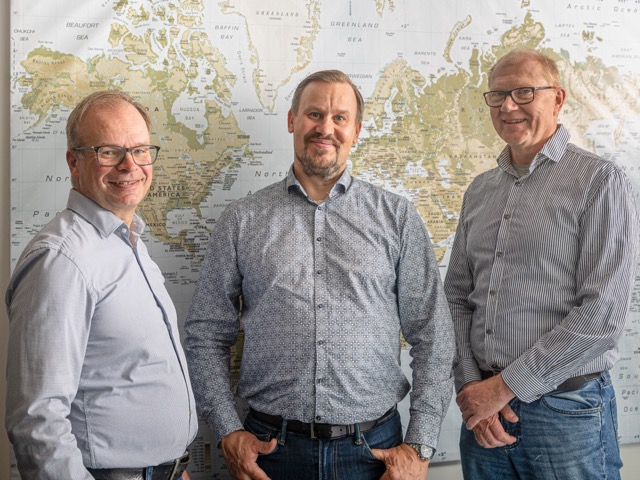
- Creoir founding team of Jaakko Mattila, COO, Antti Lilja, CEO & Co-Founder
Right: Oskari Ketola, CTO & Co-Founder
Image:Tuomo Tapanila.
EdgeVUI is on-device Voice AI technology is designed to enable speech-driven human-machine interfaces specifically for mission-critical environments with processing done on-device. That makes it especially relevant for uses where connectivity may be restricted or compromised, such as in hardware designed for combat environments.
Creoir first started to explore the opportunity in 2024 by way of a paid pilot with Saab — something set up via a former colleague who felt there was an opportunity to introduce Creoir to the right people at the prime contractor.
“They were interested in building this capability as part of their 9LV Combat Management System,” said Lilja. That in turn became the catalyst for Creoir to pivot into the defence sector to licence its technology to run on any mission-critical system.
Getting Gungnir Capital to lead the (still-open) Seed round has been strong validation that it has landed into the right sector.
“We are now going to fully focus on defence, bringing this capability to defence primes, system integrators and contractors to be their trusted speech technology partner,” said Lilja.
The investors believe that there are multiple reasons why voice interfaces are essential on the battlefield.
“I have sat in a cockpit where cognitive overload is a bigger threat than most adversaries,” Max Villman, managing partner, Gungnir Capital, in a statement. “Modern command systems drown the operator in information, and whoever can control their systems by voice, offline and in the noise of battle, wins tempo. Creoir solves a real operational problem with technology already in projects with Europe’s leading defence primes, and that is exactly the kind of company Gungnir Capital exists to back.”
To date, Creoir has ongoing pilots with Saab, Leidos, and ThyssenKrupp Marine Systems (TKMS), and others that have not been made public.
Getting access to primes is something that some startups still find difficult. But getting into the pilots hasn’t been so much of a challenge, Lilja said.
References are everything in this space and having that early footing with Saab has helped a lot. And, perhaps because Creoir is not a young startup, it has some mileage on it and plenty of business experience that makes path is a little easier.
However, there remains a challenge that is familiar to many a startup: getting end users — the ministries of defence — to buy in and buy the tech.
Creoir is tackling that head on, Lilja said. “We have direct dialogue with the Finnish defence forces, and we were selected to participate in a NATO Innovation Range,” he noted. And, in more practical terms, at the end of the day, Creoir’s business model is not dependent on entirely ripping out and replacing what customers are using; it’s about bringing improvements to existing systems.
What’s next
The feedback from its various pilots has been encouraging.
“I can see that we are now really on the right path,” said Lilja. The company will be exhibiting its tech at EURONAVAL in November, and the next step will be to convert pilots into commercial deployments.
“We are focusing on strengthening our sales and marketing, and also commercialising the products,” he said.
But Lily is under no illusion. He understands that how quickly things move in defence is dependent on procurement cycles and budgets. Sounds like someone has already grasped the space he’s entered!
CDL cohort
Creoir will be getting more defence tech exposure later in the year through a different channel. Lilja said that the startup will be in the next cohort of the CDL (Creative Destruction Lab) Estonia. For those of you not familiar with CDL Estonia (part of the wider CDL family), it is a non-profit which provides mentorship through a strict programme and was brought to Estonia by tech investor Andrew Thompson. Aimed at Seed stage startups in resilience, national security and defence, CDL provides four mentoring sessions locally throughout the year. Resilience Media was invited to the conclusion of the last cohort and can confirm that the calibre of mentors on the programme was surprising.
The mentors include founders, operators and investors in tech, as well as experts in national security, dual-use, cybersecurity, e-governance, policy and deep tech. These mentors travel to Tallinn from locations around the globe at their own expense (as do the members of the cohort). You can feel their seriousness in the feedback they give the founders. There is no fluff or back slapping on this programme. After each meeting, if you don’t make the grade, you are out.
Lilja said he’s looking forward to the programme, particularly as it came recommended.
“I must be honest – I did not know anything about the Creative Destruction Lab accelerator program before I met Artur Kamberg at ARCTIC15 investor event in Helsinki,” he said. After hearing the great feedback on the CDL Estonian cohort, he added, Creoir decided to apply. “I think we are now in just the right phase to join the cohort, as we are accelerating market entry and scaling the company. I’m sure there will be valuable mentorship available to support our journey. And of course, it will be nice to meet other participating companies and extend the network.”
Applications have been very oversubscribed, with around 70 applying for the most recent cohort for just 20 places. Joining Creoir on the programme are startups from Latvia, Lithuania, Estonia, Germany, Ukraine, Poland, Norway, Sweden and the UK.