Thursday 22 January, 2026
[email protected]
Resilience Media
  • About
  • News
  • Resilience Conference
  • Guest Posts
    • Author a Post
  • Subscribe
No Result
View All Result
  • About
  • News
  • Resilience Conference
  • Guest Posts
    • Author a Post
  • Subscribe
No Result
View All Result
Resilience Media
No Result
View All Result

Inside Dronamics bid to become the unmanned logistics carrier for future conflicts

John BiggsbyJohn Biggs
January 22, 2026
in Interview, News, Startups
Share on Linkedin

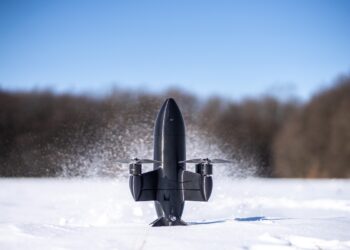
Dronamics started as a cargo drone company, and it is now betting that the same airframe can do much more than move boxes.

You Might Also Like

AI in cybersecurity remains a tool for understanding, not response

How space could become the next battlefield

Auterion conducts live fire swarm drone strike test

In a recent conversation, Svilen Rangelov, co founder and CEO of Dronamics, laid out his plan to build a long range platform that is cheap enough for cargo customers, then adapt it for higher value missions, from disaster relief to defence logistics and airborne sensing.

The core product is built for the “middle mile,” not doorstep delivery. Rangelov says last mile delivery already has people and vans ready to do the job and that the gap is moving small loads quickly between towns and regional hubs. Dronamic’s aircraft have a stated payload of 350 kilograms and a range of roughly 2,500 kilometres. The expectation is that one of their drones can service a wide region and by building centralized warehouses one location could service a wide range of customers.

Rangelov also wants to change the way we think about air cargo. Traditional air cargo has been built around waiting for very large aircraft to fill up, which makes it a last resort for many shippers. His view is that the economics change if you design the aircraft around the volume of a small delivery van, then fly it into the edge of a town where ground logistics already exist.

What changed in the past year is the customer set. Rangelov comes from a family steeped in Bulgaria’s military world, he says he always knew defence “plays by a different set of rules.” But he argues Europe’s push to prioritise European made systems has created an opening for a strategic sized, class three drone built and produced in Europe.

Dronamics is not yet flying commercial routes. Rangelov says the company plans to start cargo operations later this year in Bulgaria, and that it expects its first government contracts in the first half of the year. On the defence side, he sees immediate utility in military logistics, especially where road networks and cross border friction make moving equipment slower than it should be.

The more ambitious idea is to turn the platform into a sensor carrier. Rangelov described work to integrate radar payloads that could detect enemy drones at long range, effectively creating a distributed early warning layer. He framed it as a “mini AWACS” concept, with lower cost, fewer personnel at risk, and wider coverage through a fleet rather than one scarce, high value aircraft. He said Dronamics is working with European radar manufacturers and will share more soon.

For now, the company is working to prove repeatable operations in cargo and demonstrate the non-cargo capabilities that pull the platform toward defence, emergency response, and industrial missions. If successful, Rangelov and his team will have built the first European homegrown, strategic sized drone platform that can move goods, move sensors, and support mobility in a region that has historically been underserved logistically thanks to decades of poor road management.

“The vast majority of the world is actually punished by very long distances and we wanted to solve that curse of the long distance,” he said. “So domestic, regional movements can cover all of Europe from a single warehouse, all of the 48 states in the U.S. from a single warehouse.”

Tags: bulgariadronamicsDrones
Previous Post

AI in cybersecurity remains a tool for understanding, not response

John Biggs

John Biggs

John Biggs is an entrepreneur, consultant, writer, and maker. He spent fifteen years as an editor for Gizmodo, CrunchGear, and TechCrunch and has a deep background in hardware startups, 3D printing, and blockchain. His work has also appeared in Men’s Health, Wired, and the New York Times. He has written nine books including the best book on blogging, Bloggers Boot Camp, and a book about the most expensive timepiece ever made, Marie Antoinette’s Watch. He lives in Brooklyn, New York. He runs the Keep Going podcast, a podcast about failure. His goal is to share how even the most confident and successful people had to face adversity.

Related News

Laptop screen showing a search bar.

AI in cybersecurity remains a tool for understanding, not response

byCarly Page
January 22, 2026

Despite industry hype around autonomous defence, new research shows security teams spent 2025 using AI mainly to explain and contextualise...

view of Earth and satellite

How space could become the next battlefield

byPaddy Stephens
January 21, 2026

Future great power conflict is unlikely to be limited to the land, seas and skies. Great powers also rely on...

Rheinmetall and Auterion Announce New NATO-Wide Military Hardware-Software Partnership

Auterion conducts live fire swarm drone strike test

byJohn Biggs
January 20, 2026

Munich- and Virginia-based Auterion says it has completed what it describes as a first for the small drone space in...

blue and yellow striped country flag

Palantir and Ukraine’s Brave1 have built a new AI “Dataroom”

byIngrid Lunden
January 20, 2026

Palantir, the US data analytics giant, has been a regular presence in Ukraine helping with its defence against Russia since...

us a flag on pole near snow covered mountain

Dominion Dynamics raises $15M to build a new arctic defence prime in Canada

byIngrid Lunden
January 19, 2026

The US has become a somewhat unpredictable neighbour to Canada, with President Trump’s threats of annexation and spiking tariffs looming...

Twentyfour Industries emerges from stealth with $11.8M for mass-produced drones

Twentyfour Industries emerges from stealth with $11.8M for mass-produced drones

byIngrid Lunden
January 19, 2026

Make way for another drone startup in the European defence tech ecosystem. Twentyfour Industries is today emerging from stealth armed...

Power outages and small checks: The perils of being a VC in Kyiv

Power outages and small checks: The perils of being a VC in Kyiv

byJohn Biggs
January 16, 2026

When I called Sasha Yatsenko, the power had just cut out. No sirens, no warning, just a few minutes of...

Equal1 Wants Quantum to Be as Simple as CPUs and GPUs — and It’s Raised $60m to Prove It

Equal1 Wants Quantum to Be as Simple as CPUs and GPUs — and It’s Raised $60m to Prove It

byFiona Alston
January 16, 2026

Equal1, an Irish quantum semiconductor company announced this week it had raised $60 million to fuel the next stage of...

Load More

Most viewed

InVeris announces fats Drone, an integrated, multi-party drone flight simulator

Harmattan AI raises $200M at a $1.4B valuation from Dassault

Hydrosat raises $60M for its thermal satellite imaging tech

Twentyfour Industries emerges from stealth with $11.8M for mass-produced drones

Palantir and Ukraine’s Brave1 have built a new AI “Dataroom”

Defense Unicorns lives up to its name: $136M round lifts valuation past $1B

Resilience Media is an independent publication covering the future of defence, security, and resilience. Our reporting focuses on emerging technologies, strategic threats, and the growing role of startups and investors in the defence of democracy.

  • About
  • News
  • Resilence Conference
  • Guest Posts
  • Subscribe
  • Privacy Policy
  • Terms & Conditions

© 2026 Resilience Media

No Result
View All Result
  • About
  • News
  • Resilence Conference
  • Guest Posts
  • Subscribe
  • Privacy Policy
  • Terms & Conditions

© 2026 Resilience Media

This website uses cookies. By continuing to use this website you are giving consent to cookies being used. Visit our Privacy and Cookie Policy.