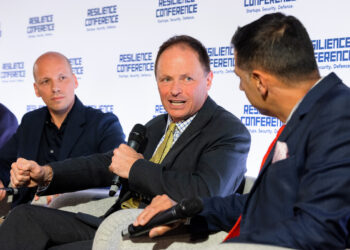
Stark and Tiberius Aerospace, two startups producing kinetic technologies, came together on stage at Resilience Conference to talk about the paradigm shift within defence tech.
The German word for ‘strong’
Its name inspired by the German word for ‘strong,’ Stark says that its first, flagship product — the Virtus strike drone — was built in collaboration with the Ukrainian soldiers using it in the war against Russia.
Stark’s SVP of Strategy and Managing Director Philip Lockwood joined in Stark’s early days after years with NATO in its innovation unit. At NATO, Lockwood was part of the team that incubated NIF and NATO DIANA, in part to help NATO move past its reputation of keeping European defence companies at arm’s length.
Why? Because many of those companies built weapons and sold to countries for a variety of reasons not fully aligned with NATO’s priorities of peacekeeping, counter-terrorism and membership expansion.
But in the 21st century, NATO adversaries have become significantly more aggressive and sophisticated, and so Lockwood was part of the group that saw an opportunity to cultivate a new guard of defence tech startups out of the European countries that make up the alliance. They would do so by pursuing dual-use approaches. Even that concept, however, had to evolve to become workable in today’s geopolitical arena, Lockwood said.
“Thinking of dual-use from the start in NATO … didn’t lend itself to kinetics,” he recalled on stage. In 2022, Lockwood noted, no European defence startup could produce an autonomous strike drone, which was one of the items most-requested by Ukraine at that time. This was due not just to European Union regulations, but also the charters of the startups’ investors (both VCs and their LPs had, and have, codified restrictions against products for warfare). But that now needed to shift.
That shift gave rise to the founding of Stark. The startup was founded originally by the founder of Quantum Systems, a startup building reconnaissance drones, after the German government requested a version of their UAV that could be used for strikes. Quantum Systems couldn’t build it due to its charter, so Stark was founded to fill out that request.
Fast forward 18 months, and Stark became the fastest startup in NATO to get a program of record. The company is now headed by CEO Uwe Horstmann and sitting on a valuation of €500 million after raising money from the likes of Sequoia, NATO’s NIF, In-Q-Tel and Peter Thiel.
The iPhone of Munitions
Tiberius Aerospace and GRAIL, co-founded by Chief Strategy Officer Andy Baynes, approaches its kinetics product differently from Stark. Its thinking comes not as much from how to rethink hardware originally intended for other purposes, but how to build a super-powerful hardware framework on which further interesting innovations can be carried out. That’s not unlike the thinking behind the early days of the iPhone, a product Baynes helped conceive of and build during a previous role at Apple.
“We see ourselves as a bus where other people’s capabilities inside GRAIL can be versioned up and keep our capability current,” he said, referring not to the kind of bus that carries people, but the bus in computing that is at the core of a computer’s architecture and purpose. That’s an interesting concept, but also a curious prospect, considering the product in question is a diesel-fuelled 1.55 missile system that extends the range of a Howitzer from 26 km to 150 km.
“We started by asking ourselves an empirical exam question,” he said. “How do you keep lethality and the sharp edge of lethality over an extended period of time?” From there, he continued, it becomes a corporate risk decision. Do you keep the product in-house, or let other developers contribute to it?
Harkening back to his experience at Nest, where he migrated to keep working with other early iPhone builders, he claimed that the US Department of Defense showed early interest in Nest’s technology. (As for why: Baynes didn’t elaborate, but for context, Nest’s first product, a thermostat controller, was a slick puck that many credit with introducing the idea of “smart home” into the market. Inside its sleek exterior, it broke new ground in design and monitoring concepts.)
However, Baynes went on to say that the Nest executive team was advised against allowing its IP to be associated with the military. That church-and-state mentality has been passed down to “90% of the startup ecosystem,” Baynes said, which makes it challenging to attract more founders and technologies into defence.
Baynes and Tiberius Aerospace see an opportunity much akin to the early days of the App Store ecosystem: it can mobilise more of the tech sector to work in defence by giving founders complete assurance that they will be able to manage their IP in a secure framework (like the iPhone), while at the same time providing them with a target addressable market.
Advice for startups entering the munitions space
“Primes haven’t disappeared and they have sharp elbows,” Lockwood warned the audience. Startups who have kinetic technologies need to regard how crowded the market is and specifically the concentration of products in certain categories.
“To deliver a weapon, separate yourself or build a component everyone needs,” he advised.
Both agreed that the startups that are succeeding are the ones talking to war fighters. Baynes said that this is a critical component of building in this space. “Capital markets are not doing that,” he said, which is leading to “a lot of money going into duplication.”
All is not lost, though. Having the crowd gravitating to specific products (such as you see today in the current plethora of drone makers) means there are other areas that are being overlooked and underfunded. “There is far less capital going into jumping over the one-way effector paradigm,” he said.
Lockwood, who previously also served as a special forces operator, urged startups to look for founders with war-fighting experience, as well as backgrounds in development, acquisition and procurement. “I rarely used my soft background at NATO and now at Stark,” he said.
‘Your capability will be copied’
Both Baynes and Lockwood are confident that Democracies will prevail in the reindustrialisation race, but there will be a cost.
“It took 30 days for the first generation iPhone design to be copied in Shenzhen,” Baynes warned. “Your capability will be copied.” However, he believes that nuts, bolts, and tooling are all solvable hurdles, which open the door to more R&D.
“Democracies foster more rapid innovation — that’s our edge,” Lockwood agreed. “[The West is] waking up to the beginning of our supply chain in raw materials,” which is going to make for opportunities in public/private partnerships.
Still, there are so many more categories and details that need addressing, and overall the region needs more companies and builders to improve its resilience profile. For instance, there is only one factory in Europe and the US producing TNT right now now, Lockwood said.
“That is a terrifying thought.”