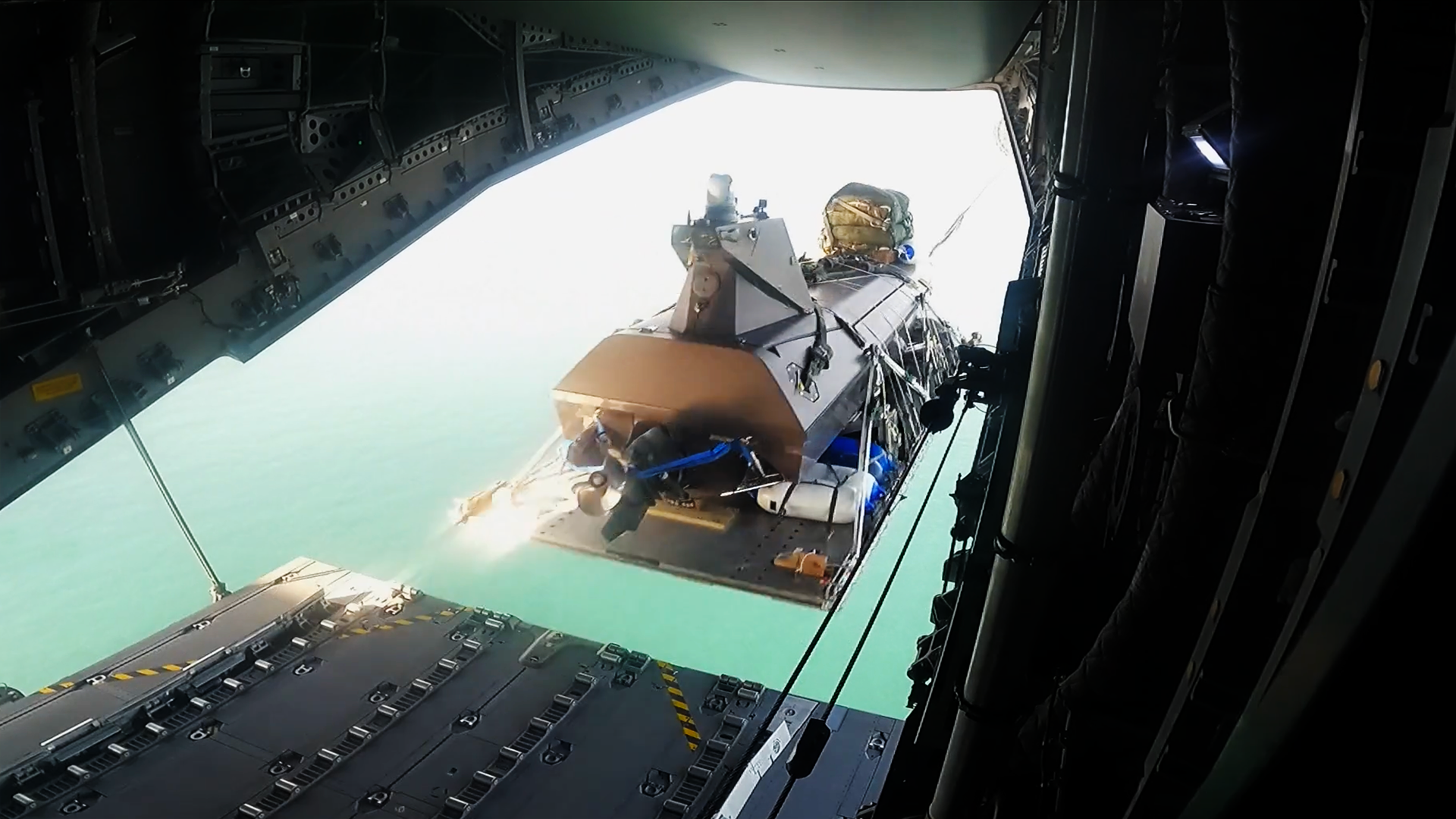
UK-based Kraken Technology group has partner with US-based Capewell to perform the “world’s first extracted-load airdrop of an uncrewed surface vessel (USV) from an A400M military transport aircraft.” The tests were run with the Royal Navy under Project Beehive, a £12.3M procurement program run by UK Defence Innovation to acquire and test up to 20 uncrewed surface vessels (USVs) aka autonomous boats.
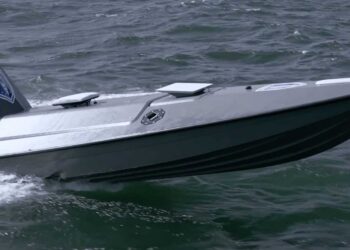
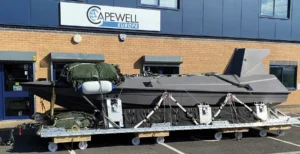
Less precisely, Kraken and Capewell dropped Kraken’s K3 Scout USV, an 8.4 meter long unmanned boat from 400 meters into waves of up to 2.5 meters. The team used a large A400M transport aircraft to drop the boat on one of Capewell’s Universal Maritime Craft Aerial Delivery System (UMCADS), essentially a smart sled designed to control the deployment of equipment at altitude.
Capewell’s Universal Maritime Craft Aerial Delivery System, or UMCADS is a parachute-based system designed that reduces the risk of damage on deployment. The test used the team’s new IN-Release system, an “electro-mechanical release mechanism which enables reliable, synchronised load disconnect across a wide range of aerial and maritime applications.”
“Working in partnership with Capewell and the Royal Navy, we have demonstrated that K3 SCOUT can be rapidly deployed directly from a military transport aircraft into contested or difficult-to-access waters ready for operation,” said Mal Crease, Founder and CEO of Kraken Technology Group. “Kraken, alongside its partners and the Royal Navy, will continue to push boundaries to deliver novel and enhanced operational capabilities with our resilient, modular platforms.”
For Kraken, the test shows that the K3 Scout can work as a platform for the UK’s Hybrid Navy initiative. The ability to airdrop USVs directly into the water changes the deployment model for these sorts of systems, reducing the need for infrastructure or a potentially vulnerable carrier craft designed to place the Scouts into position.
Kraken also made the news recently with a $175M raise that placed the company in European unicorn territory.
Capewell said the trial also showed the adaptability of its delivery system. The company conducted four live airdrops in six working days using the same boat and platform, while showing that UMCADS could be reconfigured for different maritime or land payloads. That pace demonstrated both the robustness of the system and the speed with which it can be prepared for further missions.
““In collaboration with Kraken we were able to validate the integration of a complex payload with our UMCADS platform while demonstrating the ease with which the system can be reconfigured for alternative mission essential equipment be they maritime or land applications,” said Mark Lavender, Director of Business Development and Training at Capewell.
The team did four airdrops in six days using the same craft, displaying the resilience of both the craft and the delivery system.