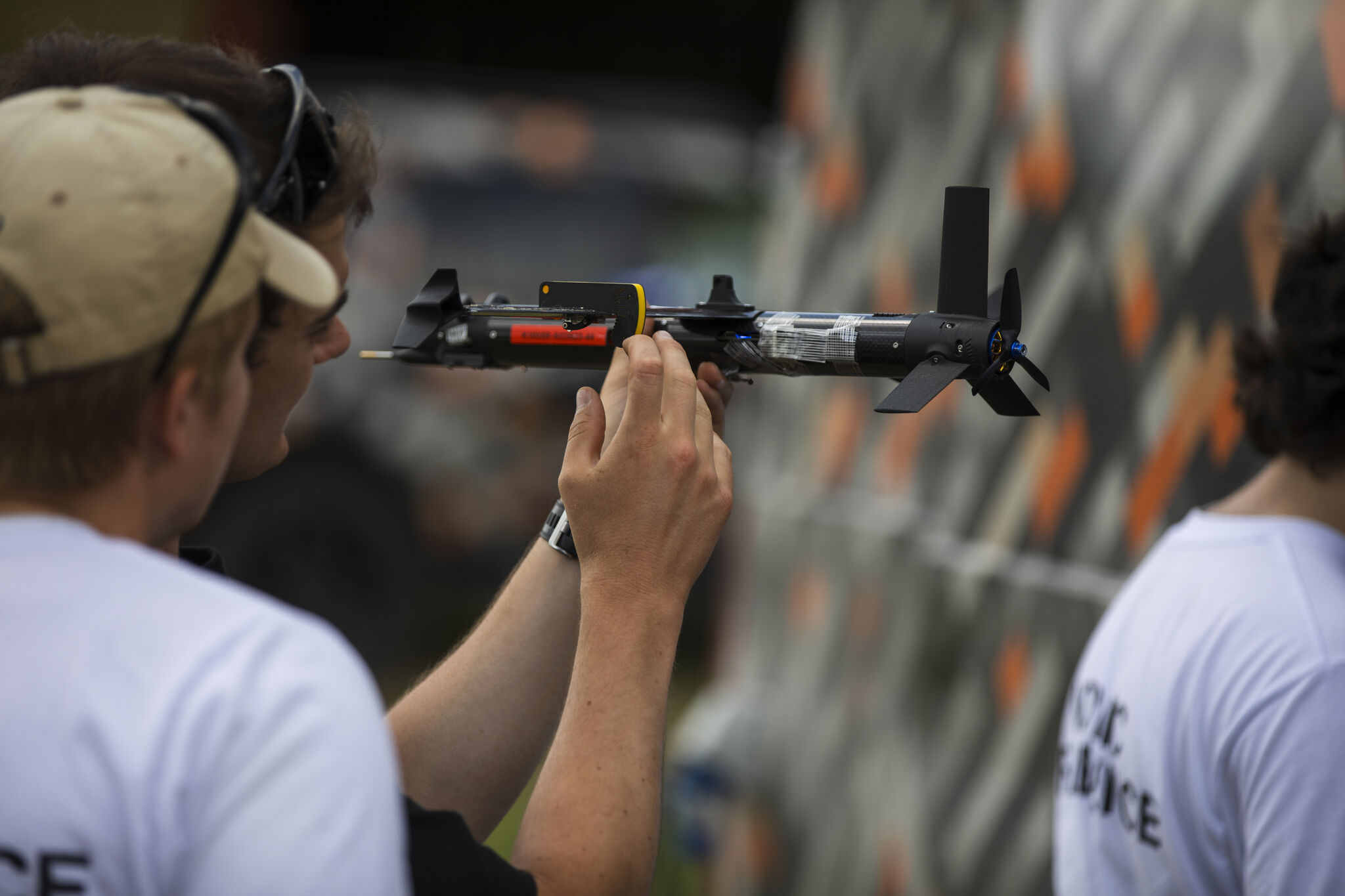
Swedish aerospace startup Nordic Air Defence has publicly demonstrated its K100XR counter-drone interceptor for the first time, showing the system detecting and engaging target drones in a live operation. According to CEO Karl Rosander, the drones are designed for “detecting and engaging target drones in real time,” replacing expensive missiles and other armaments with something that can move quickly and maneuver in difficult aerial environments.
The demonstration comes as European militaries continue to adapt to the drone-driven battlefield seen in Ukraine. Rather than spending hundreds of thousands of dollars on a single missile, the K100XR can act as a counter drone, tracking and taking down potential threats.
The K100XR is designed around “high speed, autonomy, manoeuvrability, and a low cost per kill.” The company says the interceptor can exceed 354 km/h, loiter over an area for twenty minutes, and use onboard AI to detect, classify, and track hostile drones with limited operator input once launched. Nordic Air Defence showed the interceptor working against airborne targets in real time. It uses a propeller-based engine to stay airborne.
The drone itself is only about .3 meters long and is built of carbon fiber. It has a range of three kilometers and can hit altitudes of about 1,000 meters. Because it doesn’t require an operator, users can launch them and let them find and neutralize enemy drones. Further, they are radio-silent and do not require connectivity to any central server.
“We’ve built a team of engineers, operators, and builders who move fast, solve hard problems, and turn complex systems into working capability. With Sweden as our base, we’re continuing to grow internationally – scaling fast and building capability where it matters most: in the field,” said Rosander.
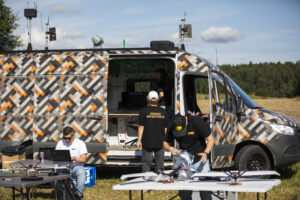
The system is being positioned for use against Shahed-style one-way attack drones and smaller reconnaissance UAVs, the kinds of platforms that have become central to Russia’s campaign against Ukraine. By sending a K100XR after these drones autonomously, drone pilots can focus on controller-more powerful FPV drones while potential threats are neutralized.
Nordic Air Defence has also made the economic argument central to its pitch. Countering a cheap drone with a high-end missile may work tactically, but it creates a poor cost exchange at scale. A low-cost interceptor gives armed forces another layer between machine guns, jammers, and expensive missile systems.
The company has moved quickly since its founding in 2024. It has raised $4.4M in funding, grown its engineering team, and announced collaborations including work with Volvo Defense on a vehicle-mounted protection pod known as VIPRO. It has also signed a letter of intent with Polish defence companies WB Group and Tantalit to explore integration of the K100XR into Poland’s counter-drone network and potential local assembly. They raised $4.4 million in 2024.
Founded in March 2024 and operating with roughly 23 staff after raising about $4.4 million in funding, Nordic Air Defence has moved quickly from prototype, announcing a collaboration with Volvo Defense in September 2025 to integrate the K100XR into a vehicle-mounted protection pod called VIPRO, designed to let military trucks and troop carriers defend themselves against the same drone threats. The whole package, says Rosander, is far cheaper than a Stinger missile and, more importantly, is lighter, faster, and more performant than traditional munitions.