
100 investors to watch 2026 100 investors to watch 2026 100 investors to watch 2026
Saturday 21 November, 2026
[email protected]
Resilience Media
  • News
    • Events
    • Interview
    • Startups
    • Venture
    • Weekly Digest
  • Resilience Conference
    • Resilience Conference London — Oct 2026
    • Resilience Conference Copenhagen — May 2026 (PAST)
    • Resilience Conference Warsaw — Apr 2026 (PAST)
  • Launch
  • About
  • Guest Posts
    • Author a Post
  • Subscribe
No Result
View All Result
Resilience Media
No Result
View All Result

Trinity Robotics raises more than €500,000 to expand production of autonomous combat vehicles

John BiggsbyJohn Biggs
July 7, 2026
in Interview, News, Ukraine
Share on Linkedin

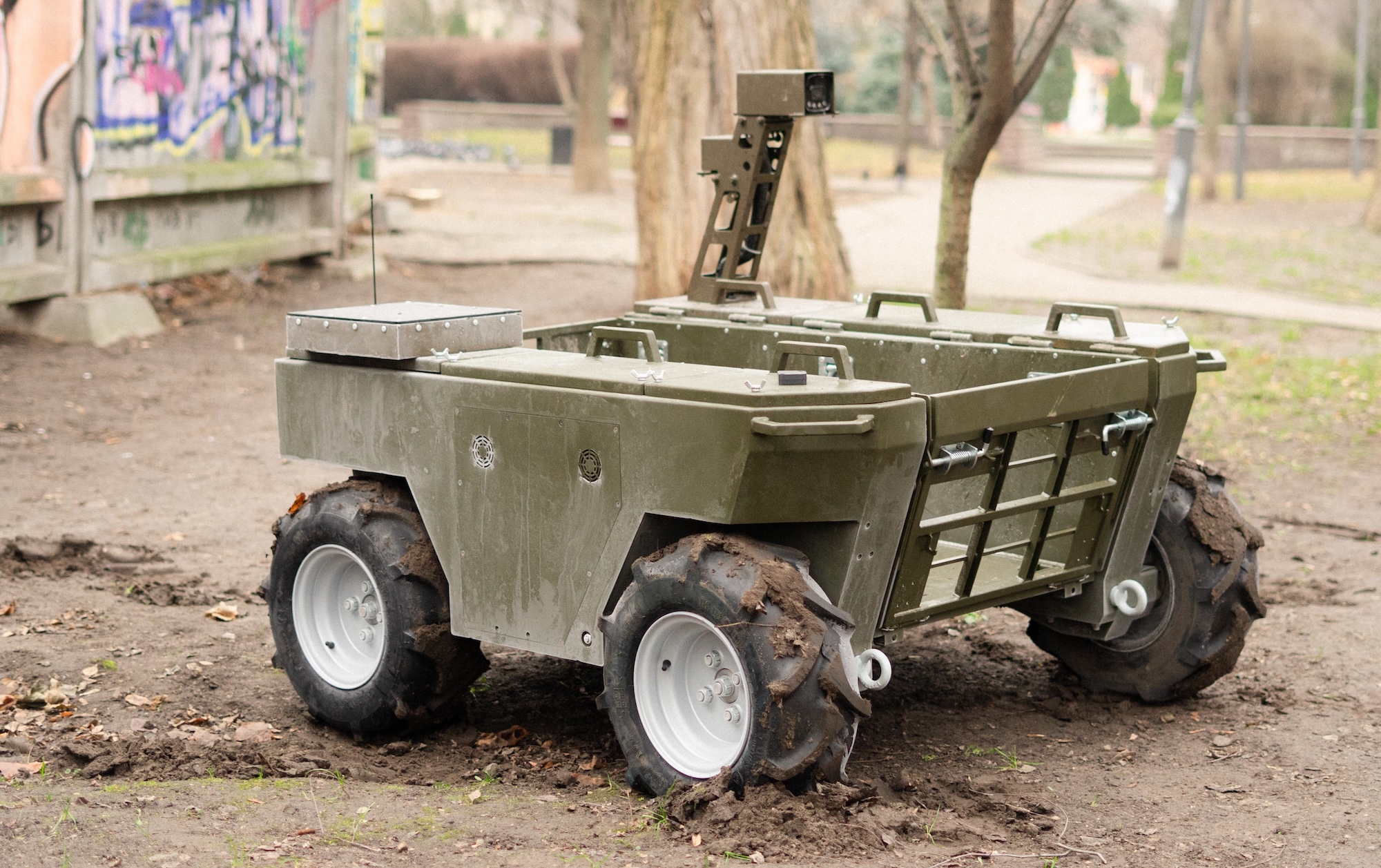
In Ukrainian, Konyk means “horse,” and that’s exactly what Kyiv-based Trinity Robotics has built: an autonomous pack vehicle to support soldiers in the field, whether it comes to delivering resources, dropping off ammunition, or taking a wounded comrade back to base. The company calls their device Konyk One, and it’s just nabbed them over half a million euros in funding from Front Ventures, Hede Capital, and Defence Builder Fund I.

You Might Also Like

USIL Therapeutics passes initial NATO procurement assessment as it develops radiation exposure treatments

Auterion and SkyFall plan German drone factory to boost Ukrainian production

Michigan wants to turn its automotive manufacturing power into a defence industry advantage

The $18,000 Konyk One is seeing active duty, and the founders report success on their mission to bring these systems to the front line. Weighing in at 460 kg and able to carry up to 300 kg, the Konyks can go 14 km/h with a range of 45 kilometers.

“We have received very positive feedback, and our systems are already being used in production on the front line. More than 200 of our UGVs are currently deployed, and over 25, perhaps even 30, units within the Ukrainian Defence Forces are already using them,” said co-founder Oleksii Konik. 

Swedish backers Front Ventures AB and Hede Capital, along with Ukraine’s Defence Builder Fund I, invested in the company to expand production of its autonomous ground defence systems. Axendra advised Trinity Robotics throughout the transaction.

“Ukraine has become the world’s most advanced testing ground for defence innovation. Technologies proven under real combat conditions will shape the future of military capability across Europe. Trinity Robotics represents exactly the type of company we want to support – highly capable, battle-proven, and positioned for significant growth,” said representatives of Front Ventures and Hede Capital in a release.

The funding will help Trinity Robotics scale production of the Konyk One. The founders report that Trinity Robotics has become one of Ukraine’s leading UGV developers, with its systems deployed across several frontline sectors.

Konik believes the investors are most excited by their ability to deliver working products to the battlefield.

“I think they believe in us because they’ve watched our product and our team. They know our team can achieve a lot, not just with this product, but with the other products we’re only beginning to develop. I think they see that we’re just getting started,” he said. “Their commitment demonstrates growing international confidence in Ukraine’s defence technology sector and supports our mission to replace soldiers in dangerous environments with reliable robotic systems.”

Konik also said that his company is ready to expand outside of military applications when the time comes.

“UGVs have great potential.  Many vehicles are, unfortunately, lost in the field, which is to be expected in combat. At the same time, others complete a large number of missions, and the results can be remarkable.

“Beyond the growing military demand, we also see significant dual use potential. UGVs can be deployed in hazardous environments, including after earthquakes and other disasters, where it may be too dangerous for people to operate. Trinity Robotics has a clear vision for developing its technology,” he said.


Tags: trinity roboticsugv
Previous Post

Nordic Air Defence demonstrates a super-fast, super-light drone designed to destroy other drones

Next Post

Expeditions closes its latest fund at €197M, smashing through its original target

John Biggs

John Biggs

John Biggs is an entrepreneur, consultant, writer, and maker. He spent fifteen years as an editor for Gizmodo, CrunchGear, and TechCrunch and has a deep background in hardware startups, 3D printing, and blockchain. His work has also appeared in Men’s Health, Wired, and the New York Times. He has written nine books including the best book on blogging, Bloggers Boot Camp, and a book about the most expensive timepiece ever made, Marie Antoinette’s Watch. He lives in Brooklyn, New York. He runs the Keep Going podcast, a podcast about failure. His goal is to share how even the most confident and successful people had to face adversity.

Related News

USIL Therapeutics passes initial NATO procurement assessment as it develops radiation exposure treatments

USIL Therapeutics passes initial NATO procurement assessment as it develops radiation exposure treatments

byJohn Biggs
November 20, 2026

Luxembourg-based USIL Therapeutics has passed the initial vendor registration assessment of the NATO Support and Procurement Agency (NSPA), giving the...

Auterion, the drone software startup, eyes raising $200M at a $1.2B+ valuation

Auterion and SkyFall plan German drone factory to boost Ukrainian production

byCarly Page
November 20, 2026

Auterion and Ukrainian drone manufacturer SkyFall are planning to establish a joint venture in Germany to increase production of first-person...

Michigan wants to turn its automotive manufacturing power into a defence industry advantage

Michigan wants to turn its automotive manufacturing power into a defence industry advantage

byJohn Biggs
November 20, 2026

  Michigan has spent decades building cars, trucks and industrial equipment. Now the state wants to use that manufacturing capacity...

Atmos space cargo visual

Atmos and MBDA link up to give Europe deep strike capability from space

byPaul Sawers
November 18, 2026

The ability to transport payloads into orbit and return them to precise locations on Earth could give European armed forces...

‘We are using it all’: minister talks about how Ukraine is offsetting Starlink dependency

‘We are using it all’: minister talks about how Ukraine is offsetting Starlink dependency

byIngrid Lunden
November 18, 2026

This week, NATO’s Communications and Information Agency announced during the NATO Edge conference that it was unlocking procurement totalling a...

An ‘optimistic’ Alexander Stubb talks war and peace at Slush

An ‘optimistic’ Alexander Stubb talks war and peace at Slush

byFiona Alston
November 18, 2026

Finland's President Alexander Stubb opened the Slush tech conference in Helsinki by touching on AI, European sovereignty, and a bleak...

Tekever raises $580M at a $6.8B valuation to give flight to more drones

Tekever’s €200 million France plan: new factory, contract with French army

byStanislaw Naklicki
November 17, 2026

In the 1960s and 1970s, Portugal’s workers would migrate to France for manufacturing jobs. Half a century later, the Portuguese...

Satellites become a growing target for grey-zone warfare

ICEYE lights a rocket under its satellite business, offers €2.05B for launcher company Avio

byLuke Smithand1 others
November 17, 2026

Some consolidation is taking place in the space race. Finland-based satellite maker/operator ICEYE has made an offer to buy Avio,...

Load More
Next Post
Proxima Fusion raises €411m to accelerate Europe’s fusion power ambitions

Proxima Fusion raises €411m to accelerate Europe's fusion power ambitions

IQM becomes first European quantum computing company to list on NASDAQ

IQM becomes first European quantum computing company to list on NASDAQ

Top stories

Tiberius says it’s successfully tested Sceptre munitions that behave like more costly missiles
European Defence

Tiberius, the munitions startup, becomes the latest defence tech unicorn, raising $85M at a $1B valuation

November 16, 2026
Atmos space cargo visual
European Defence

Atmos and MBDA link up to give Europe deep strike capability from space

November 18, 2026
OpenAI, facing a cybersecurity lawsuit in the US, is working with NATO… on cybersecurity
Cyber

OpenAI, facing a cybersecurity lawsuit in the US, is working with NATO… on cybersecurity

November 17, 2026
Abstract blue waves of glowing particles
Artificial Intelligence

When AI agents escape: What does it mean for national security?

November 15, 2026

Resilience Media is an independent publication covering the future of defence, security, and resilience. Our reporting focuses on emerging technologies, strategic threats, and the growing role of startups and investors in the defence of democracy.

  • About
  • News
  • Resilence Conference
    • Resilience Conference Copenhagen 2026
    • Resilience Conference Warsaw 2026
  • Guest Posts
  • Subscribe
  • Privacy Policy
  • Terms & Conditions
  • Mission Statement & Code of Practice
  • Press

© 2026 Resilience Media

No Result
View All Result
  • Home
  • About
  • Subscribe
  • Events
  • Guest Posts
  • Interview
  • News
  • Resilience Conference London 2026
  • Resilience Conference Copenhagen 2026
  • Resilience Conference Warsaw 2026

© 2026 Resilience Media

This website uses cookies. By continuing to use this website you are giving consent to cookies being used. Visit our Privacy and Cookie Policy.