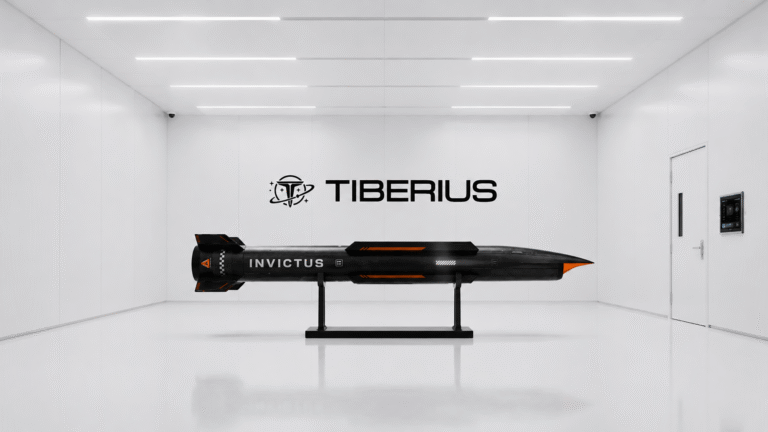
Tiberius Aerospace, a company whose Chief Strategy Officer is former Nest and Apple engineer Andy Baynes, is moving its Invictus long-range missile out of the laboratory and into formal engineering Test & Evaluation, bringing the weapon closer to deployment.
“Invictus is a tube-launched, multi-mission system designed for integration across multiple platforms and domains. Its architecture is intended to support launch from vertical launch systems and autonomous vehicles operating across land and sea, giving warfighters greater flexibility in how long-range precision effects are delivered,” wrote the company in a release.
Tiberius Aerospace launched its first ramjet munition, Sceptre, in May 2025 and recently announced successful ramjet ignition during live firing in the US. This rapid development has helped push the Invictus programme from exploratory laboratory development into a proven engineering program focused on validating propulsion and guidance. The company is testing the Invictus ramjet engine at Purdue’s Zucrow Laboratories.
“Invictus and Sceptre have been designed from first principles to deliver cost-effective lethality from the outset, using our AI-powered platform GRAIL to maximize the combat effect delivered for every dollar spent by simplifying the weapon, engineering it for high-volume production, and building in an open architecture that can evolve without replacing the entire system,” said CEO Chad Steelberg.
Tiberius plans to launch the missile from vertical launch systems as well as autonomous land and sea vehicles. The goal is to give US, UK, and allied forces more options for deploying long-range precision weapons without tying the system to a single launcher or platform.
The platform will “pair a ramjet with an integral booster” to fly at up to Mach 3 for 200 kilometers. The missiles can hit within 5.5 meters of many targets and can carry a 10-15 kilogram payload. The missile also uses Tiberius’ GRAIL control system, a modular architecture that allows for on-the-fly updates in the field.
The US and its NATO allies are facing a missile problem. Modern conflicts can consume precision weapons far faster than existing production lines can replace them. That makes the cost, complexity, and production rate of each weapon almost as important as its range and accuracy. Tiberius, then, is working to create mass-produced missiles for a new form of conflict.
The company says it is using its GRAIL AI platform to connect weapon requirements with US and allied suppliers that can manufacture the required parts. At the same time, Invictus is being designed for high-volume production rather than relying on a small number of highly specialized suppliers. The missile, then, is just as manufacturable as, say, one of Baynes’ products at Apple.