Thursday 26 February, 2026
[email protected]
Resilience Media
  • About
  • News
  • Resilience Conference
    • Resilience Conference Warsaw 2026
    • Resilience Conference Copenhagen 2026
    • Resilience Conference London 2026
  • Guest Posts
    • Author a Post
  • Subscribe
No Result
View All Result
  • About
  • News
  • Resilience Conference
    • Resilience Conference Warsaw 2026
    • Resilience Conference Copenhagen 2026
    • Resilience Conference London 2026
  • Guest Posts
    • Author a Post
  • Subscribe
No Result
View All Result
Resilience Media
No Result
View All Result

Ukraine’s The Fourth Law Raises Funding in Its Quest for Autonomy

AI-directed drones capable of by-passing jamming and other electronic warfare are finding traction with defence investors outside the country

Resilience MediabyResilience Media
July 15, 2025
in News
Share on Linkedin

The Fourth Law, a defence tech startup founded in Ukraine in the wake of Russia’s invasion, has gained traction in its home country over the last couple of years for its drones and related AI technology. Now, the company is announcing its first outside funding from a mix of investors from the US, Canada, Switzerland, Finland, and Spain.

You Might Also Like

Ukrspecsystems, of the Ukraine’s big drone makers, opens a factory in the UK

Germany set to formally announce Stark and Helsing strike-drone contracts this week

Group 14 Technologies is betting on silicon batteries for super fast charging

The startup’s founder and CEO, Yaroslav Azhnyuk, is a serial entrepreneur with peripatetic inclinations and wide-ranging connections. His previous startups have ranged from fintechs through to consumer hardware for monitoring and interacting remotely with your pet — the latter concept landing Azhnyuk at Y Combinator a decade ago, the first team from Ukraine ever to participate in the famous startup accelerator.

But building technology for military applications — no less out of a country several years into a brutal war — is a very different breed of startup. Apart from the geographical origins of its new backers, The Fourth Law currently is not disclosing how much it has raised, nor who is making the investment, nor even much detail of who has been using its tech, and when, although the little public information available online suggests that the products are being used by units in Ukraine’s Land Forces, Marine Corps, and Air Assault Forces.

We have confirmed that it will be using the funding both to continue development and sales of its current range of products, as well as to begin exploring dual-use cases for enterprise applications.

The Fourth Law has several products already under its belt.

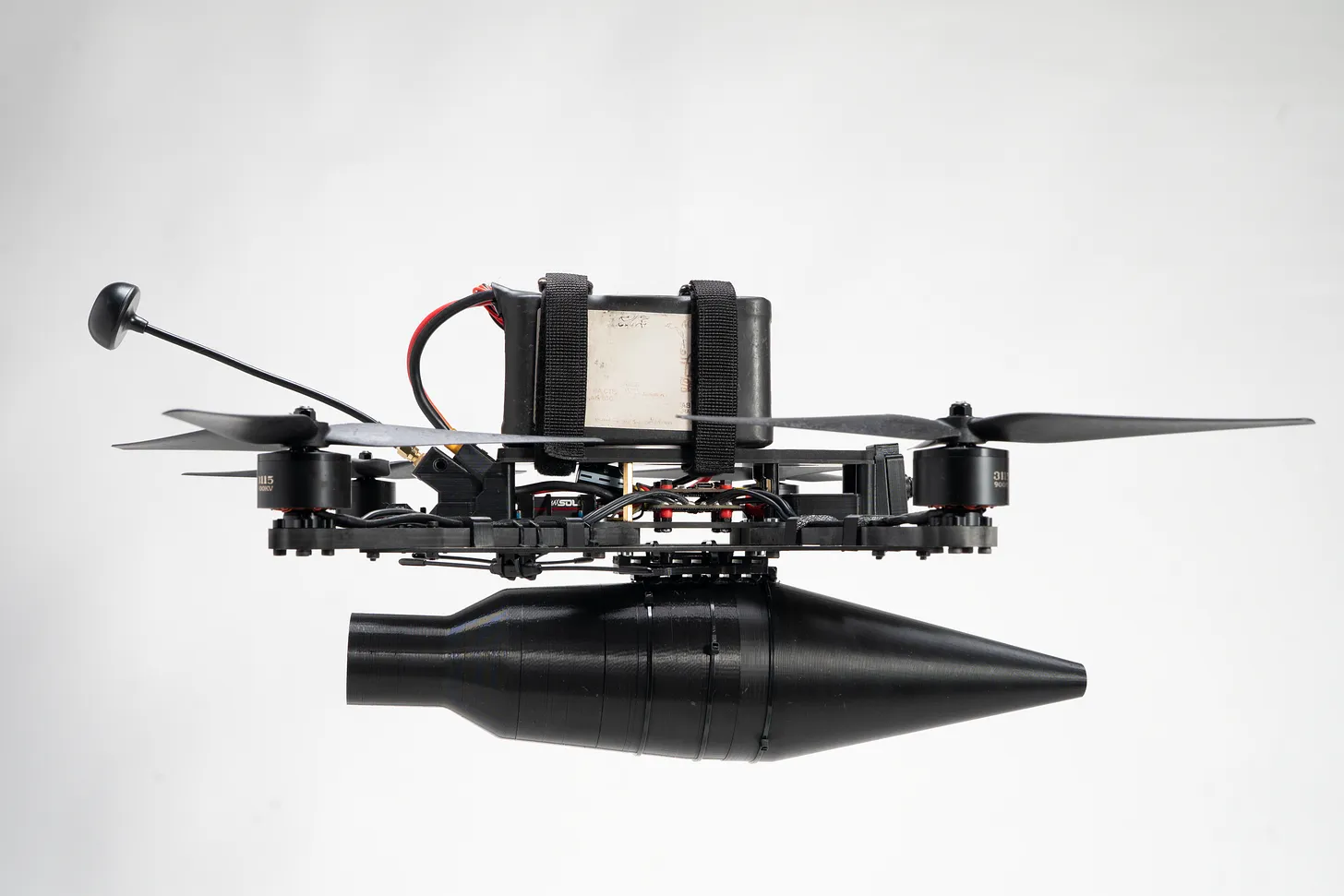
Its two flagship devices — the Lupynis-10-TFL-1 unmanned aircraft system (UAS) drone and the a TFL-1 autonomy module that can be used with third-party aircraft — have gained traction, it said, in the category of first-person vision (FPV) drones, “more than doubling mission success rates while increasing costs by only 10-20%.” (It doesn’t disclose costs, nor what percentage of missions are typically successful.)

The tech is capable of “overcoming EW jamming, acquiring, and striking targets in challenging conditions,” according to Colonel Ruslan Shevchuk of the Ukrainian Armed Forces.

There are dozens of third-party companies already integrating TFL-1 tech into their systems, Azhnyuk added.

Urgent need meets consumer-style usability

In a fascinating interview earlier this year, Azhnyuk described how the startup was born out of the need he saw on the front line, but also his background in consumer technology.

Namely on the defence front, the company addresses one of the most important problems in unmanned warfighting – jamming.

The Russian Army has been investing heavily in electronic warfare capabilities since the Cold War, and that has meant that on the front line in the war in Ukraine, Electronic Warfare is both a major challenge and the focus of serious innovation. This topic is sensitive, and is at the heart of a battle that means life or death for soldiers in the field.

And no one working in the middle of a conflict would ever claim that the problem has been “solved.” Similar to the endless cat-and-mouse race in cybersecurity, ask any radio technician and they will tell you that there is no such thing as un-jammable communications — only that a jammer not powerful enough.

The Fourth Law takes a different approach to Electronic Warfare, an approach encoded into its name. The Fourth Law is a reference to the Three Laws of Robotics by Isaac Asimov. Azhnyuk’s startup seeks the fourth, — yet undiscovered — law by increasing the autonomy of the drones.

The company’s TFL-1 module autonomously performs terminal guidance on kamikaze FPV drones during the last 500 meters of the flight. Usually, it is within this range that electronic warfare equipment, installed at the target, can prevent communications between the drone and its pilot. TFL-1 combats this by using AI for this last part of the flight to remove the need for that communication back to the pilot.

Meanwhile, the Fourth Law’s own drone the Lupynis-10, can travel 30 kilometers with a 1kg payload and has TFL-1 built in.

When it comes to taking cues from Azhnyuk’s consumer experience, that’s a little more straightforward.

In a previous life, prior to the full-scale invasion, Azhnyuk was best known for Petcube, a startup that proved pivotal to the emergence of pet-tech. Petcube raised $24 million, mostly from US venture funds. Azhnyuk’s key takeaways from that experience were clear: make tech that is intuitive and thus easier to use, and that is urgently needed, and the rest will follow.

‘At Petcube I was spending months and years proactively fundraising’, Azhnyuk told Resilience Media earlier this year. ‘Here I spent about 20 days being proactive, and then we just worked with incoming interest.’

Indeed, these days in Ukraine, he added, founders should be spending their time on ‘engineering and product rather than educating uninterested investors about the market and the opportunity.’

Future frontiers

The next technical step for products like these will be to add the ability to drop payloads and then return for another mission.

Future rounds of investment may also help build target acquisition as well as see the products adapted for fixed-wing platform or missiles systems, as well as for land-to-air or air-to-air use cases.

Yet The Fourth Law does not want to limit itself to the Ukrainian market. While the Ukrainian government is slowly opening up the export of Ukrainian defence technologies, The Fourth Law already has offices in the US, the UK, and EU in anticipation of a green light to expand there, Azhnyuk told us

But Azhnyuk is under no illusions about the long road ahead. He has regularly pointed out that the total amount raised by Petcube roughly equals the total amount of foreign direct investment into Ukrainian startups building defence products.

The round raised by The Fourth Law is not a sign of change. ‘The funding across the market is still at ridiculously low levels, which are in stark contrast to the size of the opportunity’ said Azhnyuk in an interview.

The hope is that once export controls are lifted, this generation of experienced tech founders and technologists will have the opportunity to continue to attract serious foreign capital to develop businesses that reach beyond the immediate needs of the war they are fighting right now. The Fourth Law believes that it could become a part of that new guard.
Previous Post

Building Digital Sovereignty: How Valarian Is Quietly Rewiring Secure Infrastructure for NATO and Beyond

Next Post

With its security tech now embedded in 1.5B devices, Exein raises €70 million at a €350M+ valuation

Resilience Media

Resilience Media

Start Ups. Security. Defense.

Related News

Ukrspecsystems, of the Ukraine’s big drone makers, opens a factory in the UK

Ukrspecsystems, of the Ukraine’s big drone makers, opens a factory in the UK

byIngrid Lunden
February 26, 2026

Ukrspecsystems, one of the bigger defence startups in Ukraine, has opened up a factory to  produce drones in the UK....

Europe’s Defence Renaissance Gets a VTOL Boost: STARK Launches AI-Enabled Strike Drone

Germany set to formally announce Stark and Helsing strike-drone contracts this week

byCarly Pageand1 others
February 25, 2026

Germany is expected to formally announce its strike-drone deal with defence startup Stark and Helsing on Thursday, sources tell Resilience...

Group 14 Technologies is betting on silicon batteries for super fast charging

Group 14 Technologies is betting on silicon batteries for super fast charging

byJohn Biggs
February 24, 2026

https://youtu.be/FE_FhVsSm10 For decades, silicon batteries were a pipe dream. The product, a cross between a standard lithium battery and a...

Frankenburg has raised up to $50M at a $400M valuation, say sources

Frankenburg confirms €30M funding to build more EU-made rockets

byJulia Gifford
February 24, 2026

Nearly a month after Resilience Media broke the news that Frankenburg Technologies had raised more funding, today the Baltics-based startup...

Tytan raises €30M for drone defence, sources say at a ~€150M valuation

Tytan raises €30M for drone defence, sources say at a ~€150M valuation

byIngrid Lunden
February 24, 2026

Drones have quickly become a cornerstone of modern warfare, and so has building better tools for those times when drones...

brown and black abstract painting

IQM, the quantum startup from Finland, plans US listing on Nasdaq at $1.8B valuation

byIngrid Lunden
February 23, 2026

IQM, the Finnish startup that has raised more than $570 million over the years to fuel its big ambition of...

Dispatch from Ukraine: Trust but verify

Dispatch from Ukraine: Trust but verify

byFiona Alstonand1 others
February 20, 2026

The message from the Kyiv International Cyber Resilience Forum this week is “everyone get ready and stay ready,” particularly when...

How First Parsec plans to outproduce Moscow with cheap engines

How First Parsec plans to outproduce Moscow with cheap engines

byLuke Smith
February 20, 2026

The drone war in Ukraine runs on volume. Both sides field an ever-more-sophisticated variety of drones. But more sophistication often...

Load More
Next Post
With its security tech now embedded in 1.5B devices, Exein raises €70 million at a €350M+ valuation

With its security tech now embedded in 1.5B devices, Exein raises €70 million at a €350M+ valuation

From Asimov to Azhnyuk

From Asimov to Azhnyuk

Most viewed

InVeris announces fats Drone, an integrated, multi-party drone flight simulator

Twentyfour Industries emerges from stealth with $11.8M for mass-produced drones

Senai exits stealth to help governments harness online video intelligence

Harmattan AI raises $200M at a $1.4B valuation from Dassault

Palantir and Ukraine’s Brave1 have built a new AI “Dataroom”

Frankenburg has raised up to $50M at a $400M valuation, say sources

Resilience Media is an independent publication covering the future of defence, security, and resilience. Our reporting focuses on emerging technologies, strategic threats, and the growing role of startups and investors in the defence of democracy.

  • About
  • News
  • Resilence Conference
    • Resilience Conference Copenhagen 2026
    • Resilience Conference Warsaw 2026
    • Resilience Conference 2026
  • Guest Posts
  • Subscribe
  • Privacy Policy
  • Terms & Conditions

© 2026 Resilience Media

No Result
View All Result
  • About
  • News
  • Resilence Conference
    • Resilience Conference Copenhagen 2026
    • Resilience Conference Warsaw 2026
    • Resilience Conference 2026
  • Guest Posts
  • Subscribe
  • Privacy Policy
  • Terms & Conditions

© 2026 Resilience Media

This website uses cookies. By continuing to use this website you are giving consent to cookies being used. Visit our Privacy and Cookie Policy.