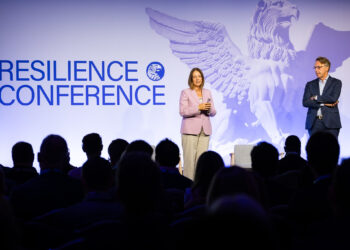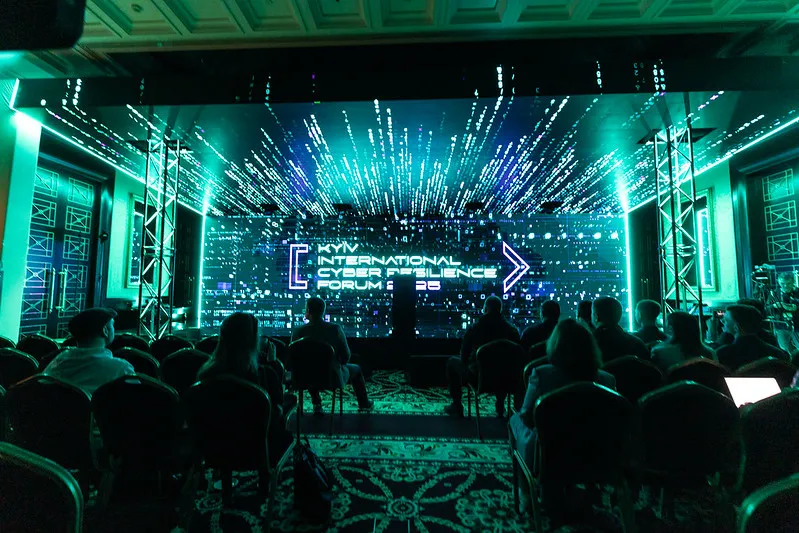
Building Global Resilience Against Evolving Hybrid Threats and Foreign Information Manipulation and Interference was one the most captivating discussions held at the Kyiv International Cyber Resilience Forum. This panel brought together Ukrainian officials who act against Russian influence operations, Ukrainian startups supporting them in this mission, and foreign experts looking to learn from the Ukrainian experience.
The discussion was opened by Josef Schröfl, Deputy Head of the European Centre of Excellence for Countering Hybrid Threats. He explained that in the past there were the “Terrible Four,” – Russia, China, Iran, and North Korea. Each of them had their own specialisations – disinformation, cyber espionage, cyber sabotage, and ransomware.
Recently, these threats have merged as the country’s started to learn from each other. “There were many delegations from Moscow to Tehran, from Tehran to Pyongyang, and in Beijing,” Schröfl explained. He gave an example of this co-operation, when in April 2022, internet cables were cut in France while simultaneously its telecom providers were targeted in a cyber-attack, and the French information space was subject to a disinformation campaign.
The Ukrainian officials were clear that new solutions are needed to confront this rise in hybrid attacks. “The European approach has been to make NGOs and civil society fully responsible for the response to disinformation,” argued Andriy Kovalenko, the Head of the Center for Countering Disinformation, a unit within the Security and Defense Council of Ukraine. He said that this approach puts democratic societies on the defensive and is no longer sufficient. “I believe that military organizations should develop information operations against enemy states to defend their own national interest within the foreign information space,” Kovalenko argued.
This panel was moderated by Yuliia Dukach, Head of Disinformation Investigations at a startup called OpenMinds. For her PhD dissertation she studied the pre-2014 Ukrainian protest activism. Like many Ukrainians today, ended up in her field of due to Russian aggression, rather than by design. As we spoke after the panel, she expressed her surprise about the clarity with which the Ukrainian officials voiced their views, unpopular as they are with many in the West.

At the same time, accessing the information environment of adversaries is precisely what OpenMinds seeks to do. They go beyond, “the first step, social media monitoring and threats intelligence,” it’s founder Sviatoslav Hnizdovskyi told me. Instead, the startup provides an answer to the question of “how would you reach people in hard-to-access areas and zones of conflicts, where you don’t have Facebook or Google.”
This approach has led to traction for OpenMinds. It has cooperated with Western national security institutions, while its research findings have been published by the Financial Times and The Guardian. Hnizdovskyi has been targeted by Russian media, a sign that his work is making an impact.
In addressing why we should achieve deterrence in the information domain, the founder of OpenMinds explained that “in kinetic warfare, defenders statistically have more chances to win [than attackers],” but “in the cognitive warfare domain, the one who deters proactively, has an immense advantage.”
This niche is not too crowded because after the end of Cold War such capabilities were abandoned by the democratic states. “We are now 10-15 years behind countries like Russia and China in this domain, so the mission of OpenMinds is to close this gap,” Hnizdovskyi explained.
Do the decision-makers in Europe feel an urgent need for such a product? Yes, there is a growing interest, the founder of OpenMinds told me. “We are in talks with a few defence tech venture capital firms and might consider a round of investment in 2025.”
Amongst Ukrainian startups that focus on detecting information threats is Osavul, the name of which stems from a rank within the Cossack political system. Osavuls were tasked with important investigations, reflecting what the startup does.
Osavul emerged in the early days of the full-scale invasion as a solution to the information warfare problems the Security Council faced. “The founders of the Ovasul, Dmytro Plieshakov and Dmytro Bilash, used their previous experience in IT startups to provide technology to support the capacities of Ukraine’s strategic communications and disinformation countering agencies,” Stanislav Lurie, Osavul’s Ukraine Office head explained.
Most of the state organisations were focused only on traditional media. Osavul instead developed a tool which also scrapes the platforms where most information sharing happens nowadays, such as Telegram and TikTok. Furthermore, the platform “automates the analysis of large quantities of information that cannot be processed even by the large in-house teams of our customers,” Lurie said.
Government services are not the only customers of Osavul. The startup provides enterprise level solutions to big Ukrainian business, be it turnkey investigations or customisable dashboards.
In 2024 Osavul raised $3m late seed investment. The next round will be opened in a while Osavul’s Ukraine Office head explained.
Mantis Analytics is another startup founded by a group of volunteers assisting the Security Council during the opening days of Russia’s full-scale invasion of Ukraine. The founder, Anton Tarasuyk, spent 6 years at Kyiv Mohyla Academy, one of Ukraine’s oldest universities, studying philosophy. Before the full-scale invasion you would see him commenting on the anthropologist Bruno Latour, but now he co-leads a startup that seeks more than countering disinformation.
Although Mantis Analytics first came into being as defensive instrument in information warfare, “what we care about now is complex risk management,” Tarasuyk told me. This approach requires “search, processing, fusion, and analysis of information which is important for the security of physical equities.”
Therefore, government agencies are not central to the traction of Mantis Analytics, even though allied MOD’s are amongst its customers. Instead, it seeks to provide corporate clients with products on the security of their executives and safety of travel.
The startup has already invested considerable effort to gain corporate traction. “Three times we applied to participate in the Alchemist Accelerator,” known for its B2B centre of gravity, Tarasuyk said. With its third attempt Mantis Analytics was accepted, and that proved valuable in providing insights into the proactive North American sales culture. Now the startup is making inroads into the market of the US.
What makes Mantis Analytics competitive there? “We received a very warm reaction from US companies that do business in Latin America, Eastern Europe, Africa,” the Mantis cofounder explained, saying that their Ukrainian experience was easy to replicate in such markets with lesser information availability.
Mantis raised $450,000 in a pre-seed round. Now the startup is preparing for a seed round, Tarasuyk said.
The Ukrainian startup scene has plenty to offer for those seeking resilience against hybrid threats. It is a primary battleground for disinformation and hybrid warfare, and these startups have evolved on the front line, just as Ukrainian hardware startups have grown in the heat of battle.