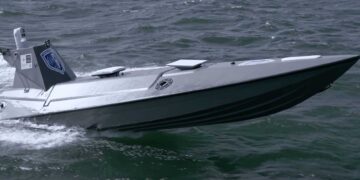
The latest chapter in Ukrainian defence tech startups getting more active outside of the country’s borders was unveiled today. Airlogix, which develops unmanned air systems, has inked a joint venture with drone maker Auterion to manufacture AI-guided aerial systems for Ukraine and allied nations.
The deal was inked officially at the Munich Security Conference taking place this week in Germany.
The deal comes at a time when Ukraine is looking to beef up its war effort against Russia with millions of drones and other unmanned devices. The devices coming out of this partnership initially will be going to Ukraine and Germany.
The pair said that the Ukraine government has requested “thousands” of systems from the new JV, part of a larger partnership between the German ministry of defence and the country. Auterion and Airlogix said that, pending fulfilment, the order is one of the largest to-date for Ukraine drone production. It did not specify how many would be produced or ordered for German forces. The first systems are due to be rolled out in 2026.
The partnership comes in the wake of a number of other pairings between Ukrainian organisations and companies from outside of its borders. Typically, the western partners were already active in Ukraine.
In December, Germany’s Quantum Systems said it would work with Ukraine’s Frontline Systems to mass-produce Ukrainian combat drones in Germany.
Ukraine last week hinted that there would be more partnerships of this kind to come when it announced a “hub” strategy, manufacturing defence tech hardware in several places across Europe — Germany and the UK among them — and using that to spearhead an export business for those systems.
And Palantir last month announced a partnership with with Brave1, the government project to foster and use more defence technology, to build a “Dataroom” to collate and use war data to test and train AI models to develop battlefield applications.
Auterion for its part is officially headquartered in Arlington, VA, as of 2024, although it was born in Zurich, Switzerland and has a strong raft of operations in Munich.
These efforts are partly to help with Ukraine’s immediate war effort, but also to give its companies a ramp to scale their businesses beyond that, an important move to boost Ukraine’s wider economy beyond wartime.
A number of defence tech companies in Ukraine were born out of the war it was facing in the wake of the Russian invasion — indeed that is how Airlogix pivoted to defence tech from autonomous systems originally designed for other use cases — but they have faced a number of issues when it has come to scaling that beyond Ukraine itself. Export restrictions was one of the biggest of these; manufacturing another: that is what a lot of these partnerships are aiming to address. A third is the capital to build their businesses. Airlogix for all its traction in the market has never disclosed how much it has raised and has just three investors named in PitchBook, all from Ukraine: UA1, D3 and Vacuum Deep Tech.
“This joint venture demonstrates how European defense cooperation can rapidly deliver cutting-edge autonomous capabilities to our allies,” said Dr Lorenz Meier, CEO of Auterion, in a statement. “By combining Ukrainian innovation forged in real combat conditions with our advanced engineering excellence, we are creating a new model for allied defense production.”
It’s not only about helping Ukraine companies, however. Many believe that the technologists emerging out of the war effort have been on the cutting edge of autonomy — not to mention holders of key training data and experience from the field itself — so it’s in the interest of western companies to tap that to build their own businesses.
“Ukrainian companies have developed unique expertise through years of combat operations,” said Vitalii Kolesnichenko, CEO of Airlogix, in a statement. “This partnership allows us to scale that experience through European industrial capacity while integrating the most advanced autonomous systems available. Together, we are building the future of allied drone warfare.”
Auterion, which raised €130 million in September 2025 led by Bessemer, has been very active in Ukraine, and in fact also pivoted to defence tech in the wake of Russia’s invasion of Ukraine. It has a tall order to fill and develop its tech in strong competition with the likes of Stark and Helsing, so it’s no surprise to see it working more closely with a key company that complements what it has produced itself.
We plan to attend a press event with the companies later today and will update this post with more information after that.