Saturday 4 April, 2026
[email protected]
Resilience Media
  • About
  • News
  • Resilience Conference
    • Resilience Conference Warsaw 2026
    • Resilience Conference Copenhagen 2026
    • Resilience Conference London 2026
  • Guest Posts
    • Author a Post
  • Subscribe
No Result
View All Result
  • About
  • News
  • Resilience Conference
    • Resilience Conference Warsaw 2026
    • Resilience Conference Copenhagen 2026
    • Resilience Conference London 2026
  • Guest Posts
    • Author a Post
  • Subscribe
No Result
View All Result
Resilience Media
No Result
View All Result

Airbus demonstrates is autonomous Bird of Prey interceptor drone in Germany

John BiggsbyJohn Biggs
March 31, 2026
in News
Share on Linkedin

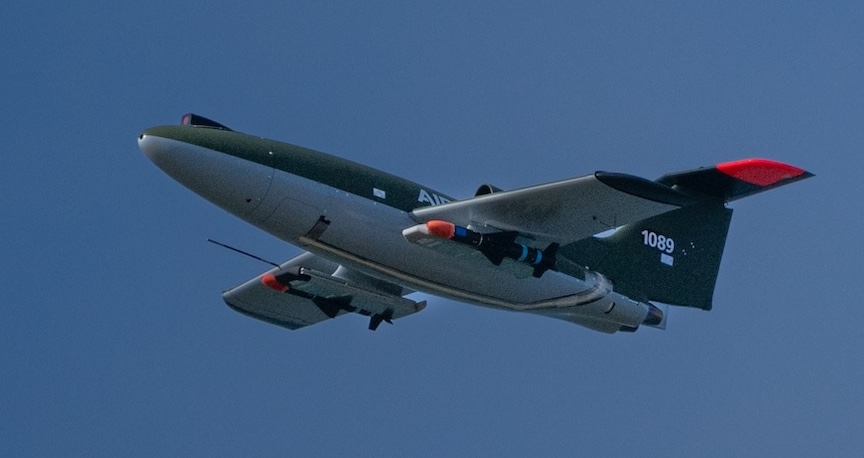
Airbus Defence and Space has completed a first demonstration flight of its Bird of Prey interceptor drone at a military training area in northern Germany. The test focused on detecting and stopping one-way attack drones.

You Might Also Like

The war Rheinmetall thinks it’s fighting is not the one Ukraine is winning

China’s long shot in satellite tech

Varjo begins shipping “extended reality” training systems to Ukraine

In the trial, the drone operated without direct control. It searched for a target, identified a medium-sized kamikaze UAV, and then engaged it using a Mark I air-to-air missile developed with Frankenburg Technologies.

The system is built on a modified Airbus Do-DT25. The prototype has a 2.5 meter wingspan and a maximum takeoff weight of 160 kilograms. It currently carries four missiles, though Airbus says an operational version will carry up to eight.

“This is a defining step for modern air defence,” said Kusti Salm, CEO of Frankenburg Technologies. ”Together with Airbus, it marks the first integration of a new class of low-cost, mass-manufacturable interceptor missiles onto a drone, creating a new cost curve for air defence and enabling defence against mass aerial threats at a fundamentally different scale.”

What’s particularly interesting is that the Bird of Prey carried missiles and did not destroy itself in the interaction, thereby saving potentially millions in drone costs. The Frankenburg Mark I missile is designed for short-range interception. It is about 65 centimeters long, weighs under 2 kilograms, and has a range of up to 1.5 kilometers. It uses a fragmentation warhead intended to disable small aerial targets at close distance. The design aims to keep cost and weight low, which allows the interceptor drone to engage multiple targets in a single mission. Because it fragments, it can easily destroy a target even if it doesn’t score a direct hit.

Airbus says the system is meant to operate within existing NATO air defense networks through its Integrated Battle Management System. That places the interceptor as one layer in a broader air defense structure rather than a standalone solution.

The program moved from start to flight test in nine months. Airbus and Frankenburg plan additional tests through 2026, including flights with live warheads, as they move the system toward operational use.



Previous Post

Post-Quantum trials quantum-resilient drones built for future battlefield threats

Next Post

Varjo begins shipping “extended reality” training systems to Ukraine

John Biggs

John Biggs

John Biggs is an entrepreneur, consultant, writer, and maker. He spent fifteen years as an editor for Gizmodo, CrunchGear, and TechCrunch and has a deep background in hardware startups, 3D printing, and blockchain. His work has also appeared in Men’s Health, Wired, and the New York Times. He has written nine books including the best book on blogging, Bloggers Boot Camp, and a book about the most expensive timepiece ever made, Marie Antoinette’s Watch. He lives in Brooklyn, New York. He runs the Keep Going podcast, a podcast about failure. His goal is to share how even the most confident and successful people had to face adversity.

Related News

The war Rheinmetall thinks it’s fighting is not the one Ukraine is winning

The war Rheinmetall thinks it’s fighting is not the one Ukraine is winning

byJohn Biggs
April 2, 2026

This week, Rheinmetall CEO Armin Papperger made news with a blunt interview in The Atlantic about the changing face of...

birds flying in the sky during night time

China’s long shot in satellite tech

byPaddy Stephens
April 1, 2026

Starlink – estimated as the largest low Earth orbit (LEO) communications constellation by a long shot – has been invaluable...

Varjo begins shipping “extended reality” training systems to Ukraine

Varjo begins shipping “extended reality” training systems to Ukraine

byJohn Biggs
March 31, 2026

Varjo and Fynd Reality are deploying extended reality training systems to support the Ukrainian Armed Forces, allowing the military to...

black and white round illustration

Post-Quantum trials quantum-resilient drones built for future battlefield threats

byCarly Page
March 31, 2026

A UK-based cybersecurity startup claims to have done what many in cryptography circles have long written off as impractical: getting...

BEAM App

A BEAM of light for EU sovereignty as Belgium rolls out Matrix-based messaging app for government

byPaul Sawers
March 28, 2026

Belgium is rolling out its own secure messaging platform, as European states step up efforts to bring sensitive communications under...

Shield AI raises $1.5 billion to acquire Aechelon, a military simulation system

Shield AI raises $1.5 billion to acquire Aechelon, a military simulation system

byJohn Biggs
March 27, 2026

Shield AI is raising $1.5 billion in Series G funding at a $12.7 billion valuation, alongside $500 million in preferred...

Inside Ukraine’s plans to become a global military data hub

Inside Ukraine’s plans to become a global military data hub

byThomas Macaulay
March 26, 2026

Ukraine has a new inspector general in its Ministry of Defence: Yurii Myronenko, appointed on Wednesday evening to evaluate the...

Brave1 and NATO Innovation HQ team up to fast track defence tech

Brave1 and NATO Innovation HQ team up to fast track defence tech

byJohn Biggs
March 26, 2026

Brave1, the Ukrainian government’s defence tech accelerator, is working with NATO Innovation HQ and the NATO Communications and Information Agency...

Load More
Next Post
Varjo begins shipping “extended reality” training systems to Ukraine

Varjo begins shipping "extended reality" training systems to Ukraine

birds flying in the sky during night time

China's long shot in satellite tech

Most viewed

InVeris announces fats Drone, an integrated, multi-party drone flight simulator

Uforce raises $50M at a $1B+ valuation to build defence tech for Ukraine

Auterion, the drone software startup, eyes raising $200M at a $1.2B+ valuation

Twentyfour Industries emerges from stealth with $11.8M for mass-produced drones

Senai exits stealth to help governments harness online video intelligence

Palantir and Ukraine’s Brave1 have built a new AI “Dataroom”

Resilience Media is an independent publication covering the future of defence, security, and resilience. Our reporting focuses on emerging technologies, strategic threats, and the growing role of startups and investors in the defence of democracy.

  • About
  • News
  • Resilence Conference
    • Resilience Conference Copenhagen 2026
    • Resilience Conference Warsaw 2026
    • Resilience Conference 2026
  • Guest Posts
  • Subscribe
  • Privacy Policy
  • Terms & Conditions

© 2026 Resilience Media

No Result
View All Result
  • About
  • News
  • Resilence Conference
    • Resilience Conference Copenhagen 2026
    • Resilience Conference Warsaw 2026
    • Resilience Conference 2026
  • Guest Posts
  • Subscribe
  • Privacy Policy
  • Terms & Conditions

© 2026 Resilience Media

This website uses cookies. By continuing to use this website you are giving consent to cookies being used. Visit our Privacy and Cookie Policy.