Ukraine’s drone war has always come down to volume and accuracy — get enough systems onto the battlefield, and get them to hit what they’re aimed at. A new deal announced on Monday tackles both problems at once.
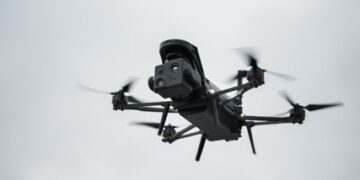
Auterion, the Munich- and Virginia-based drone software company, and Skyfall, an under-the-radar Ukrainian manufacturer, have agreed to fit 50,000 Shrike FPV attack drones — small, camera-guided drones typically flown directly into a target — with Auterion’s Strike Kit and Skynode S autonomy hardware. The contract is worth roughly €90 million, Auterion CEO Lorenz Meier confirmed in a blog post Monday. Deliveries have already begun, with production largely complete and shipping now the main task ahead.
While Auterion has confirmed the funding came from a NATO nation, it hasn’t named which one. However, sources told Resilience Media that Germany is financing the order — a detail Meier himself alluded to by confirming its Munich team is the one delivering it.
The contract works out to roughly $2,050 (€1,800) per drone, including ground control stations and program overhead, Meier said — more expensive than Ukraine’s cheapest manually piloted models, but still far below what Western militaries have typically paid for precision-guided munitions.
With Skynode S installed, Shrike can lock onto and track moving targets on its own, even when jamming knocks out GPS or radio contact. Auterion says a later software push will let the same drones fly and strike as coordinated swarms, without touching the hardware.
“Software defines the modern battlefield,” Meier said in a statement. “We are giving operators terminal guidance today and a path to swarming tomorrow, on the same hardware, through a software update.”
Meier described the order as the “largest partnership” in Auterion’s history, while also pointing to its scale relative to other drone deals within NATO. He compared it directly to the Pentagon’s first Drone Dominance award — a $150 million programme that announced in March an order of 30,000 drones across 11 vendors.
“This single contract exceeds it,” Meier wrote.
Follow the money
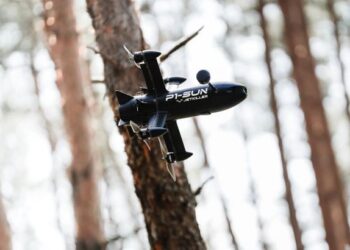
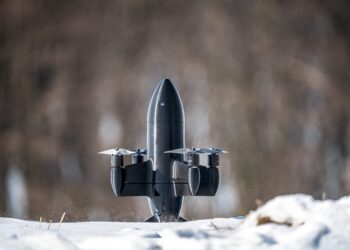
Skyfall builds the Shrike alongside its Vampire heavy bomber and P1-SUN interceptor, and the company recently struck a separate alliance with Airbus aimed at deepening European and Ukrainian air defence cooperation.
Auterion, meanwhile, has spent the past year expanding both its product range and its presence in Ukraine. The company raised €130 million led by Bessemer Venture Partners last September at a valuation above $600 million, and has since run a live-fire swarm test in the US, demonstrated a strike combining FPV and fixed-wing drones from different manufacturers, and formed a joint venture with Ukrainian firm Airlogix to build aerial systems in Germany.
Sources told Resilience Media in February that Auterion is now profitable, and was weighing a fresh raise of roughly $200 million at a valuation topping $1.2 billion, driven mostly by unsolicited investor interest rather than an active push to fundraise. At the time, a company spokesperson said there had been “increased interest from potential and new investors,” while maintaining Auterion was “not fundraising at the moment.”
Asked today about the Skyfall deal’s bearing on any future round, the company said it wasn’t commenting on market rumours or speculation around fundraising at this time.
A reshuffle in Kyiv
Auterion’s announcement landed the same day as Helsing confirmed a $1.8 billion round of funding at a whopping $18 billion valuation, making it the most valuable privately held defence company in Europe. The two aren’t direct competitors — Helsing builds much of its own hardware, while Auterion sells the software layer that runs on everyone else’s — but both are riding the same wave of investor appetite for AI-guided strike capability.
It also landed against a shifting political backdrop in Kyiv. On Sunday, Zelensky announced a government reshuffle, replacing prime minister Yulia Svyrydenko as part of what he called a shift in political strategy — one built around assigning “a specific person with significant experience” to each priority foreign policy relationship, from licensing deals with the US to security cooperation and reconstruction agreements with international partners. He was explicit about the stakes: agreements with allies should translate into “clear gains for our states and the companies of Ukraine and America.”
It’s the same logic behind Monday’s Auterion deal — outside financing, paired with Ukrainian production, delivered through a named industrial partner rather than a government-to-government handout.